On December 1, the government of Alberta will officially end its nearly two-year-old policy of curtailing crude oil production to help shrink the massive price discounts that producers had been enduring. It would hardly be an overstatement to say that North American oil markets have changed dramatically since the production cap was implemented by Canada’s largest oil-producing province in January 2019. A short-but-bruising oil price war and a pandemic that slashed demand for crude resulted in Alberta producers making supply cuts even bigger than their government had mandated. Today, we look back at the provincial government’s policy and what has changed to motivate its suspension.
To survive in Alberta, Canada, you have got to be tough. Not only must Albertans endure brutally cold winters but the energy sector there, which by some estimates makes up more than a quarter of Alberta’s economy, faces its own set of challenges. In particular, oil producers in Alberta have had to brace themselves against the winds of political and market changes. Supplying primarily oil sands-based crude oil from a remote, landlocked region, with essentially one dominant export customer (the U.S.), has meant waiting on Canadian and provincial regulators to sanction enough pipeline capacity to ship growing supplies to market. In addition, wild swings in price discounts for oil supplies has resulted in immense value losses for both producers and the province of Alberta when spare pipeline capacity runs short. Most of the time, Alberta and its oil producers have had to roll with the punches and cope as best they can.

In November 2018, the punches started coming fast and furious in the form of big price discounts for Western Canadian Select (WCS) and other Alberta crude. At that time, West Texas Intermediate (WTI) prices were trading in the $60/bbl range, while WCS, the benchmark heavy oil price marker, was fetching less than $20/bbl, meaning record price discounts in excess of $40/bbl. On December 2, 2018, then Alberta Premier Rachel Notley announced that the province had had enough of the gaping price discounts and would be exercising its authority to limit oil production in an effort to improve the price received for Alberta’s oil.
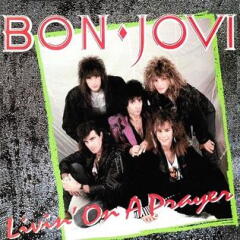
About the song
"Livin' on a Prayer" was written by Jon Bon Jovi, Richie Sambora, and Desmond Child. It appears as the third song on Bon Jovi's third studio album, Slippery When Wet. Released in October 1986 as the second single from the album, the song went to #1 on the Billboard Hot 100 and Mainstream Rock Singles charts. The single has been certified 3x Platinum by the Recording Industry Association of America (RIAA). Personnel on the record were: Jon Bon Jovi (lead vocals), Richie Sambora (guitars, backing vocals), Alec John Such (bass, backing vocals), Tico Torre (drums, percussion), and David Bryan (keyboards, backing vocals).
Slippery When Wet was recorded during the spring of 1986 at Little Mountain Sound Studios in Vancouver, BC, with Bruce Fairbairn producing. Released in August 1986, the album went to #1 on the Billboard Top 200 Albums chart. It has been certified 12x Platinum by the RIAA. Four singles were released from the LP.
Bon Jovi is an American rock band formed in Sayreville, NJ, in 1983. They have released 15 studio albums, three live albums, five compilation albums, five EPs, and 66 singles. The band has sold over 130 million records worldwide, and won two American Music Awards, one Billboard Award, one Brit Award, one Grammy Award, two MTV Video Music Awards, and two World Music Awards. Bassist Alec John Such was dismissed from the band in 1994 and replaced by Hugh McDonald. Guitarist Richie Sambora left the band in 2013 and was replaced by Phil X. Bon Jovi still records and tours, but the release of their 15th studio album, Bon Jovi 2020, was pushed back to October 2020, and the tour for the album has been postponed for now due to COVID.