U.S. crude oil exports from the Gulf Coast remain at a high level, as does interest in transporting crude to Asia and Europe in Very Large Crude Carriers (VLCCs) capable of carrying as much as 2 million barrels (MMbbl) each. The catch is that only one Gulf port — the Louisiana Offshore Oil Port (LOOP) — can send out fully loaded VLCCs, and so far LOOP has loaded only one; other Gulf ports need to fill or top off the gargantuan tankers in open waters using reverse lightering. Plans are afoot to allow greater use of VLCCs, but how long will they take to implement? Today, we discuss the economic benefits of exporting crude on supertankers, the growing use of VLCCs for Gulf Coast exports and the challenges exporters face in utilizing them even more this year and next.
VLCCs are giants. The supertankers have an average length of about 1,100 feet — longer than Houston’s 75-story JPMorgan Chase Tower is tall — with an average beam (or width) of nearly 200 feet and an average fully loaded draft of 72 feet. There are about 800 VLCCs operating in the world today and, as we’ll get to, an increasing number of these behemoths are being filled with U.S. crude along the Gulf Coast and sent to faraway ports in Europe and Asia.

Visualize the infrastructure behind U.S. NGL movement.
The U.S. NGLs Map provides a comprehensive view of the transport, processing, and export networks moving NGLs across the U.S.
We’ve discussed VLCCs several times in the RBN blogosphere, and for good reason: they are, in many cases, the most efficient and least expensive way to transport very large volumes of crude very long distances. As we said in Come Sail Away, the VLCC is the largest of the four types of tankers that account for the vast majority of international crude shipments, the other classes being (in descending size order) Suezmax (capacity ~1MMbbl), AFRAmax (~750 Mbbl) and Panamax (350 Mbbl to 550 Mbbl). [There also are two Ultra Large Crude Carriers (ULCCs) in operation, but their overall impact is minor.] A recent analysis by our friends at Navigistics Consulting found that transporting crude from a fully reverse-lightered VLCC from a trans-shipment area (TSA) off Corpus Christi to various Asian destinations (Singapore and Ulsan, South Korea) would cost 65 to 92 cents/bbl less than sending it on a smaller tanker. That’s up to 25% less — quite a savings when you consider the VLCC’s 2-MMbbl capacity.
The catch with VLCCs is that they are too darn big for almost all U.S. terminals, and that in almost every case, the only way to load a VLCC along the Gulf Coast today is to turn to full reverse lightering. That multiday process involves anchoring a VLCC in a TSA and using AFRAmaxes or other smaller vessels to ferry crude from the terminal to the larger tanker. As we said, LOOP — located in 110-foot-deep water in the Gulf of Mexico, 17 miles south of Port Fourchon, LA — is currently the only terminal in the Gulf that can handle fully loaded VLCCs.
About the song
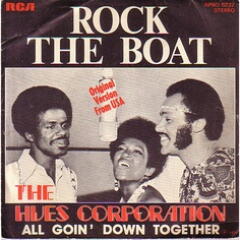
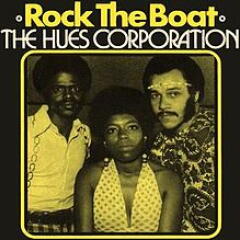
"Rock the Boat," written by Wally Holmes, was a track on the Hues Corporation's 1973 RCA debut album, Freedom for the Stallion. "Rock the Boat" was released with very little airplay or sales activity until hip New York City DJs started giving it heavy rotation on turntables at dance clubs in the city. It soon rocketed to popularity, ending up at #1 on both the Billboard Hot 100 and the Cash Box Top 100. It also reached #5 on Billboard's U.S. Dance Club Songs. It is arguably the first disco song to hit #1 in the U.S., and has sold over two million copies to date.
The Hues Corporation — their name a pun on billionaire Howard Hughes’s aircraft company — was formed in Santa Monica, CA, in 1969. The vocal trio got their start as an opening act in Las Vegas for artists such as Frank Sinatra, Milton Berle, Nancy Sinatra and Glen Campbell. The group first recorded a single called “Goodfootin’” for Los Angeles label Liberty Records in 1970; it failed to make the charts. Their next break came with an appearance in the 1972 horror film, "Blacula." The group had three songs in the movie and on the RCA soundtrack, which led to them signing a record deal with RCA. The personnel on their first album included Hubert Ann Kelly, St. Clair Lee, and Fleming Williams. Williams, who provided the lead vocal on "Rock the Boat," left the group shortly after the album was recorded.