One of the biggest, most important steps in the U.S.’s ongoing energy transition will be the selection and build-out of at least four new clean hydrogen hubs –– development supported to a significant degree by an $8 billion commitment in last year’s bipartisan infrastructure bill, which was signed into law by President Biden in November. Surely there will be a lot of angling among states and regions to land big chunks of that federal money, but it’s a safe bet that one of the new hydrogen hubs will be located along the Texas-Louisiana coast. After all, this stretch of low-lying land not only boasts the U.S.’s highest concentration of existing hydrogen production and consumption, it also offers an extensive network of hydrogen pipelines, easy access to vast amounts of natural gas and renewable power, scores of potential sites for underground hydrogen storage and carbon sequestration, and a slew of marine terminals for exporting hydrogen-packed ammonia to global markets. Best of all, perhaps, the region has the human capital to make a new energy hub happen — heck, look at the infrastructure and markets the folks and companies between Freeport and Lake Charles have already developed for crude oil, natural gas and NGLs. In today’s RBN blog, we begin a detailed look at the federal government’s push to advance clean hydrogen as a fuel of the future and the Houston-led effort to make the western Gulf Coast a buzzing center of hydrogen-related activity.
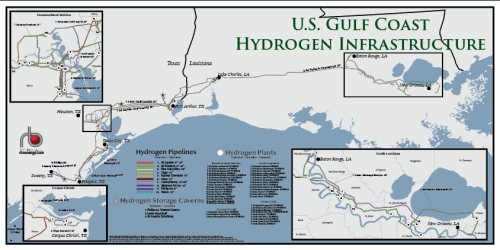
RBN’s U.S. Gulf Coast Hydrogen Infrastructure Map lays out the pipelines and merchant hydrogen plants that make up the gulf coast market, providing an unprecedented snapshot of the region’s hydrogen infrastructure network.
It's clear by now that the transition to a lower-carbon economy in the U.S. and around the world will be an “all of the above” kind of thing, involving everything from wind, solar and nuclear power to battery storage, electric vehicles and fuel cells. And don’t forget hydrocarbons, whose climate impacts can be reduced by blending with renewable fuels or other means — or mitigated (partially or even fully) with carbon offsets and carbon sequestration. Then there’s clean hydrogen, the focus of this blog series (and RBN’s weekly Hydrogen Billboard), whose development the U.S. Department of Energy (DOE) has deemed crucial to meeting the Biden administration’s goals of a 100% clean electric grid by 2035 and net-zero carbon emissions by 2050.
As we said, to propel the clean-hydrogen market forward — much like the federal government did with wind and solar power in the 2000s and 2010s — the Infrastructure Investment & Jobs Act enacted seven months ago provides a total of $8 billion over five years to support the development of at least four regional clean hydrogen hubs that the DOE will select by May 2023. [The new law also sets aside an additional $1 billion to back efforts to reduce the cost of producing clean hydrogen from water via renewables-powered electrolyzers to $2/kilogram (from the current $4-plus/kg) by 2026, and another $500 million to help advance equipment manufacturing technologies and techniques for clean hydrogen processing, delivery, storage, etc.]
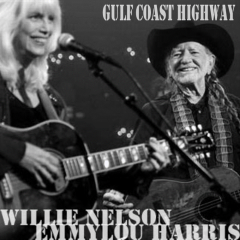
About the song
“Gulf Coast Highway” was written by Nanci Griffith, James Hooker and Danny Flowers. It made its first appearance on Nanci Griffith’s 1988 album, Little Love Affairs. The song is about a couple of lovers who dream of growing old together in their home off Highway 90, a route that rolls through southern Texas, often along the Rio Grande. It is full of Texas imagery, including references to bluebonnets, the state flower. Griffin wrote the song with her then-bandleader of 20 years, James Hooker. Hooker worked as a session keyboardist at Royal Studios in Memphis and Fame Studios in Muscle Shoals, AL, before becoming a founding member of The Amazing Rhythm Aces. Nashville songwriter Danny Flowers came up with the song’s line, “She walked through springtime.” Flowers is best known as the author of the song “Tulsa Time.” Nanci Griffith passed away in Nashville in August 2021 at the age of 68. Emmylou Harris recorded “Gulf Coast Highway” with Willie Nelson and included it on her Duets album, released in July 1990. Duets went to #24 on the Billboard Top Country Albums chart. She also included the song on her comprehensive three-CD career retrospective album, Portraits, which was released in 1996.
Emmylou Harris is an American singer, songwriter, musician, and actress. She has released 26 studio albums, three live albums, 11 compilation albums and 70 singles, and has sold over 5.5 million records in the U.S. She has won four Grammy Awards, three CMAs, and two ACMs. She is a member of the Country Music Hall of Fame and the Grand Ole Opry. She holds an honorary Doctor of Music degree from Berklee College of Music. She still records and is playing a series of summer concerts in the U.S. and overseas.
Willie Nelson is an American singer, songwriter, musician, actor, poet, and activist. He has released 97 studio albums, 13 live albums, two soundtrack albums, 51 compilation albums, and 130 singles. He has won 13 Grammy Awards, seven AMAs, 10 CMAs, five ACMs, and two BMI Awards. He is a member of the Country Music Hall of Fame and the National Horticulture Hall of Fame. He has received Kennedy Center Honors, and the Gershwin Prize from the Library of Congress. He has sold over 40 million records in the U.S. and still records. Nelson recently started his summer tour, which runs through September.