Capacity utilization rates for small inland tank barges (10-30 MBbl) this year are sky high at 90-95 percent. Tank barges are being used to move crude oil shipped by rail from North Dakota and Canada to ports on the Mississippi River for transfer to Gulf Coast refineries. Low water levels caused by drought conditions in the Midwest have hampered Mississippi barges but that has not deterred companies from developing new terminal facilities to handle the traffic. Today we review inland waterway tank barge crude movements.
In Part 1 we looked at the growth in barge use to move crude oil from North Dakota and the Eagle Ford over the past two years. The US tank barge market can be divided into two segments – movements along coastal waterways and movements on inland waterways. We looked at the larger coastwise tank barges (30-185 MBbl) moving North Dakota Bakken crude from Albany New York down the Hudson River to refineries on the East Coast and Eagle Ford crude from the South Texas port of Corpus Christi along the Texas Gulf Coast and all the way to the New Orleans, LA area and points between. We also noted talk of moving Bakken crude oil from Anacortes, WA to refineries along the West Coast. This blog covers smaller tank barges used along inland waterways.
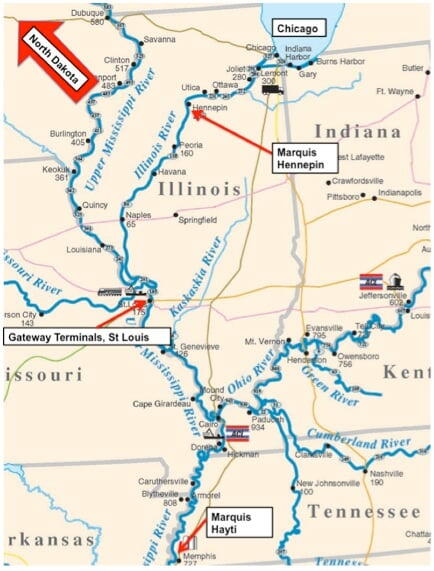
The river system that runs through the center of the US from the Great Lakes down to the Gulf Coast serves as the backbone for inland bulk commodity trade. We found a great map provided by American Commercial Lines - the second largest player in the inland tank barge market. Their map is too big to view in our blog format so we just used a section of it below to illustrate the routes being used for crude movements. The complete map shows the main inland river routes as well as the Class 1 rail systems that interconnect with them. You can download a copy here.
The Upper Mississippi and Illinois Rivers north of St Louis, MO connect Minneapolis and Chicago with the Lower Mississippi route to the Gulf Coast (see map below). At least two companies have developed crude oil rail to barge facilities on this section of the inland river network. Marquis Terminals opened a newly constructed crude oil rail to barge facility at Hennepin on the Illinois River in July 2012 adjacent to their existing ethanol terminal. The facility can store 90 MBbl of crude oil on site and transfer up to 35 Mb/d to barges. Marquis also opened a second rail-to-barge terminal at Hayti, Missouri in October 2012. That terminal can handle one unit train per day of crude (~60 Mb/d) and has 390 MBbl of storage. The primary source of crude for the Marquis operation is North Dakota (via BNSF rail) although crude sent by rail from Canada can also reach their terminals. Crude tank barge shipments are delivered to refineries along the Gulf Coast.