

Geopolitical developments over the last several months have resulted in perhaps the most chaotic and unstable energy market in the last 50 years, rivaled only by the OPEC oil embargoes of the 1970s, the global financial crisis in 2009 and the COVID lockdown years of the early 2020s. The disruptions have driven crude oil prices and production higher in the short term, but there’s a potential long-term shift just ahead. In today’s RBN blog, we look at how the changes on the horizon could lead to sharply lower global crude oil prices and a rollback in U.S. production, two forecasts at the heart of our newly available Future of Fuels report.
It’s been a year of dramatic change, starting with the U.S. removal of Venezuelan President Nicolas Maduro in early January (just before our previous report was published). Things have only accelerated since then, highlighted by the U.S. and Israeli war against Iran that began on the last day of February. While the damage to energy facilities across the Middle East has been significant, the largest impact by far has been the closure of the Strait of Hormuz, mostly stopping the flow of one-fifth of global crude oil and millions of barrels of refined products, while also impacting the LNG market and a number of other commodities. The on-again, off-again talks to find a lasting resolution to the conflict, along with the most recent escalation by the Houthis threatening tanker movements through the Bab el-Mandeb Strait, have only added to the global uncertainty.

The Future of Fuels bi-annual report by RBN's Refined Fuels Analytics provides an in-depth analysis of the U.S. and global refinery industries, focusing on crude oil and fuel market dynamics, supply and demand, alternative fuels, refinery capacities, and price forecasts to help stakeholders navigate the evolving energy landscape.
In addition to the events in the Middle East, the Russia/Ukraine war continues to provide additional stress to markets, especially the rapidly accelerating damage Ukraine has inflicted on Russian refineries, resulting in throughputs hitting decades-long lows and the loss of well over 2 MMb/d (and growing) of refined products. Chinese responses to these events and a variety of other global developments also continue to add uncertainties. Less immediately impactful — but maybe the most significant in the long term — was the exit of the United Arab Emirates (UAE) from OPEC in May, which we expect to have many knock-on effects in the market.
As discussed many times in the RBN blogosphere this year, the changes and unrest noted above have driven prices higher for crude oil and refined products, leading to record-high U.S. crude oil production, surging crude exports and refining margins, and rig counts that are now well above year-ago levels. It’s a rosy picture for producers, and we expect pricing and production will continue to rise in the short term. But major market headwinds appear on the way; the question is how soon they arrive.
Here’s where things stand today and why we could be headed for an era of crude oil oversupply:
Venezuela — The U.S. takeover of the Venezuelan oil industry carries major implications for all segments of the petroleum industry. Operating conditions in Venezuela have improved significantly, leading to an uptick in crude oil production and exports. Because of the evolving conditions there and the uncertain nature of the situation, we are cautiously making only relatively minor changes in our short/mid-term forecasts, but we expect Venezuelan crude production growth to accelerate longer term. On the other hand, we expect only limited improvement in refinery utilization.
Iran — The stability of the Iranian government has decreased significantly in recent months and potential future actions by the U.S. carry major implications for the crude oil and refined product markets. Due to the significant uncertainties, we have not made substantive changes in our forecasts for Iranian crude production, domestic demand or refining capacity, and the availability of transit through the Strait of Hormuz (and perhaps even from Red Sea ports through the Bab el-Mandeb Strait) remains a major risk. That said, a lasting end to the hostilities seems likely at some point, easing the path to a more normal crude market and increased Iranian production and exports.
The UAE and Saudi Arabia — The UAE is far from the first country to depart OPEC, but it’s the first to do so at the top of its game. The UAE has been a relatively less-disciplined OPEC member in recent years, with its consistently rising production often meeting (and sometimes exceeding) its established quotas. With production of 3.4 MMb/d (before the Strait of Hormuz closure), an estimated productive capacity of 4.5 MMb/d, and a goal to raise output to 5 MMb/d by 2030, the UAE figures to be a significant contributor to global supply growth through the end of the decade. We believe this will have a domino effect on Saudi Arabia’s strategy, as it looks likely to boost output, unwilling to be the sole OPEC producer concerned about defending price by restraining production.
Russia — The Russia/Ukraine war has significantly changed global petroleum trade patterns and reduced Russian refinery utilization and oil production. We continue to see declines in the performance of both the upstream and downstream industries in the near to medium term, with potential improvement only after 2029 (assuming the hostilities with Ukraine are resolved by then). Russian crude production is forecast to drop to about 9.9 MMb/d by 2029, with a recovery back to pre-war levels of 10.6+ MMb/d taking until 2050. (Its refining industry will continue to be even more impacted.)
The developments noted above and generally improving prospects for producers in other regions could create a very oversupplied oil market in the next couple of years. Were that to happen, increased global output and lower prices could lead to a decrease in U.S. production, resulting in greater market share for producers elsewhere. So, how much could things change? (Note: The forecasts discussed in today’s blog are specific to the Future of Fuels report. Novi Labs is working on its own production forecast, which will show more moderate changes.)
Let’s start with prices for the key light crude benchmarks, which spiked after the war with Iran began. As shown in Figure 1 below, Domestic Sweet at Cushing (right end of solid blue line) averaged $82.34/bbl in H1 2026, up $17.48/bbl, or 27%, from the 2025 average and the highest since the post-pandemic spike to $95.85/bbl in 2022. Dated Brent (right end of solid green line) averaged $92.66/bbl in H1 2026, up $23.62/bbl, or 34%, from 2025. The uplift this year reflects the impact of the Strait of Hormuz disruption, and upside risk remains tied to the situation there, the potential for renewed OPEC discipline, and faster-than-expected demand growth.
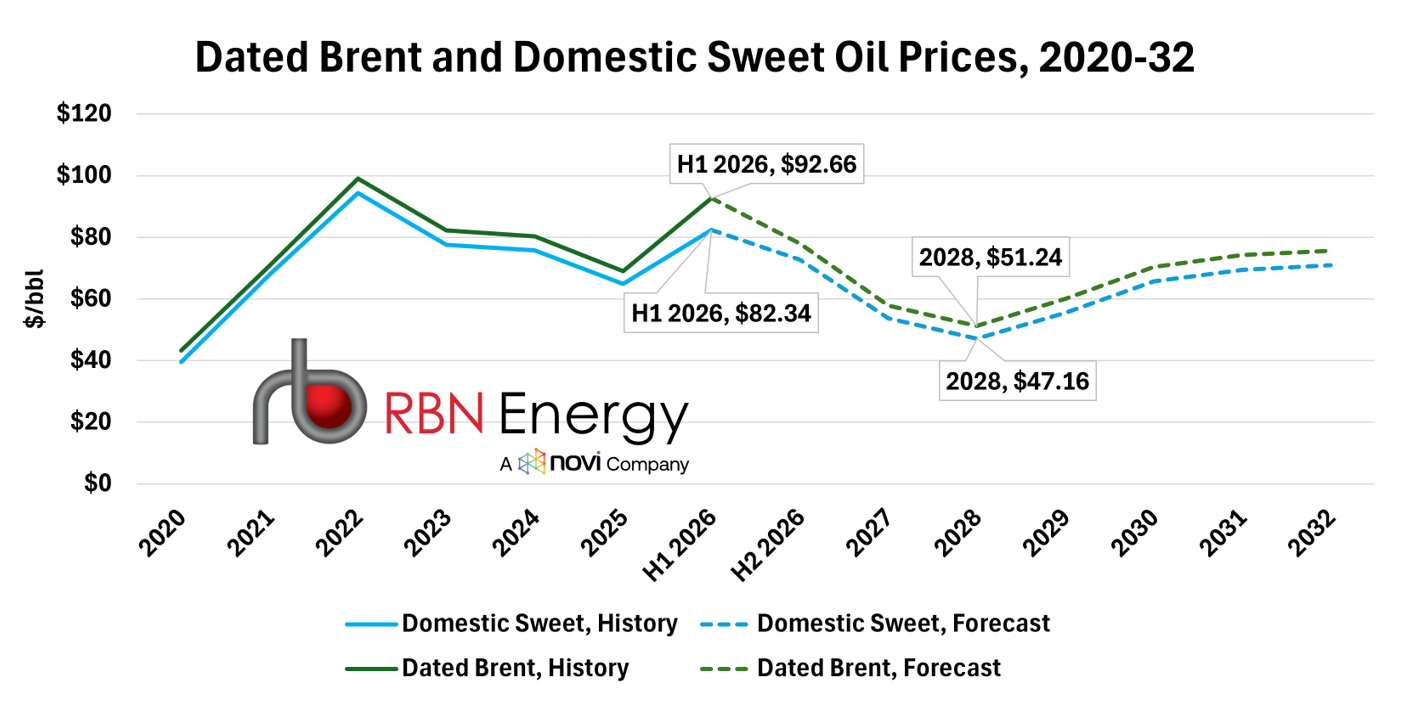
Figure 1. Dated Brent and Domestic Sweet Oil Prices, 2020-32. Source: Future of Fuels
But with growing U.S. production this year (more on that in a bit) and a more favorable global outlook, we expect prices to retreat in the next few years before reversing course. Domestic Sweet (dashed blue line) is expected to fall all the way to $47.16/bbl in 2028 before recovering to $55.58/bbl in 2029 and beginning a long-term rise. It’s the same story for Dated Brent (dashed green line), which slides to $51.24/bbl in 2028 but ticks up to $60.10/bbl in 2029.
The improved outlook for many global producers — including (but not exclusively) the UAE, Saudi Arabia and Venezuela — and a challenging pricing environment could bring big changes for U.S. producers, who have largely maintained their focus on capital discipline and shareholder returns even amid this year’s higher prices. U.S. production (solid blue line in Figure 2 below) reached its pre-pandemic peak at 12.3 MMb/d in 2019, slid to 11.3 MMb/d in 2020 and 2021, then began a steady climb higher, topping out at a stronger-than-expected 13.6 MMb/d in 2025. U.S. production is now forecast (dashed blue line) to peak at 13.9 MMb/d in 2026, but then begin to fall, sliding to 12.1 MMb/d by 2030 before beginning a gradual recovery. Relative to the previous Future of Fuels forecast, production is 1.39 MMb/d lower by 2030. We’ll note that although we feel relatively comfortable with the general direction of the global supply/demand balance and resulting lower prices, the absolute level of that decline could very well be less, depending on the resiliency of U.S. shale production at lower prices.

Figure 2. U.S. Crude Oil Production, 2020-32. Source: Future of Fuels
Which production areas are likely to be the most affected by the changing environment? The Permian remains the resilient core of U.S. supply, rising from 6.6 MMb/d in 2025 to a peak of 7.3 MMb/d in 2041 (although lower in 2030 than in our previous report), while production from the Eagle Ford, Bakken, Midcontinent and Rockies declines over the long term. Gulf of Mexico production peaks near 2.2 MMb/d in 2028. Alaska approaches 600 Mb/d in 2032 as production growth out of the Pikka/Nuna/Willow developments is later offset by declines elsewhere.
We should note that the production outlook is much different for Canada, where output is now forecast to grow steadily from 5.3 MMb/d in 2025 to a plateau just above 6.2 MMb/d in the mid-2040s, peaking in 2044 and holding near 6.2 MMb/d in 2050. Western Canada drives almost all of the growth. Non-upgraded bitumen increases from 2.2 MMb/d in 2025 to 2.9 MMb/d in 2050, while condensate also grows and conventional light/heavy production declines. The new forecast is slightly lower than the previous case around 2035, but higher after 2040.
The last several months have demonstrated how quickly geopolitics can rewrite the energy market narrative. Today's supply disruptions, elevated prices and record production have reinforced the industry's ability to respond to scarcity, but they also may be laying the groundwork for the next cycle of oversupply. As new barrels emerge from Venezuela, the UAE, Saudi Arabia and elsewhere while geopolitical risks gradually ease, the market could shift from worrying about too little crude to managing too much. That transition would have far-reaching implications for producers, refiners, midstream operators and investors, particularly in the U.S., where higher-cost barrels would face the greatest pressure. In the newest edition of our Future of Fuels report, we explore these scenarios in greater detail and examine how a very different crude market could reshape North American energy through midcentury.
Our biannual Future of Fuels report provides analysis on the key factors shaping crude oil and refined product markets, from pricing and supply/demand dynamics to alternative fuels and refining capacity. To learn more, click here.

About the song
“Waiting on the World to Change” was written by John Mayer and appears as the first song on his third studio album, Continuum. Mayer stated that he had written the R&B ballad as an attempt to capture his generation’s frustration with the changing world around them. Released as the first single from the album in July 2006, it went to #1 on the Billboard Adult Alternative and Adult Contemporary charts, and #14 on the Billboard Hot 100 Singles chart. It has been certified 4X Platinum by the Recording Industry Association of America. Personnel on the record were: John Mayer (lead, backing vocals, lead guitar), Pino Palladino (bass, backing vocals), Ricky Peterson (keyboards), Roy Hargrove (horns), and Steve Jordan (drums, percussion, backing vocals).
Continuum was recorded between November 2005 and July 2006 at Village Recorders in Los Angeles, Royal in Memphis, and Avatar and Right Track in New York City. Produced by John Mayer and Steve Jordan, the album was released in September 2006 and went to #2 on the Billboard 200 Albums chart. It has been certified 4X Platinum by the RIAA. Five singles were released from the LP.
John Mayer is an American singer, songwriter, guitarist and record producer. He attended Berklee College of Music in Boston before leaving to play the club scene around Atlanta in the late 1990s. He released an independent EP, Inside Wants Out, in 1999. After an appearance at South by Southwest in Austin in 2000, he was signed by Columbia Records. He has released eight studio albums, seven live albums, five EPs, three compilation albums and 25 singles. He has sold more than 20 million records worldwide. He has won two ASCAP Awards, seven Grammy Awards, two MTV Video Music Awards and a World Music Award. As a hobby, Mayer collects high-end watches and has a collection valued at over $10 million. He continues to record and tour and will be appearing at Radio City Music Hall in New York City with Buddy Guy in October.
"About the Song" -- written by Mickey McMahan , RBN Director of Musicology