


U.S. exploration and production companies (E&Ps) are tapping the brakes on their capital spending in 2019 after two years of strong investment growth and a return to profitability that in 2018 approached the level generated in the $100+/bbl crude oil price environment back in 2014. The pull-back in capex this year appears likely to slow the pace of production growth, and comes despite a 30% rebound in crude oil prices in the first quarter of 2019. What’s going on? Well, many investors remain skeptical about E&Ps, as evidenced by stock prices that remain in the doldrums, and to gain favor with investors, a number of E&Ps are returning cash to them in the form of share buybacks and higher dividends. Today, we consider the current state of investment in the E&P sector, how it’s affected by stock valuations and how it affects production growth.
In a number of blogs over the past three years, we’ve documented the dramatic recovery of the E&P sector from the financial crisis caused by the plunge in oil prices that began in late 2014. Through portfolio high-grading and an intense focus on operational efficiency, the 44 representative E&Ps we track demonstrated that they could grow reserves and increase production on lower capital budgets. The nearly 50% reduction in “finding and development” costs (the cost of “finding” an additional barrel through organic capital spending), excluding acquisitions — from $15.01/boe (barrel of oil equivalent) in 2014 to $8.41/boe in 2018 — helped the E&P sector roar back to profitability last year. Our universe of 44 E&Ps on average netted a healthy pre-tax operating profit of $11.03/boe in 2018, which compares with a barely breakeven profit of $0.07/boe in 2017 and is only 20% below the profit generated by the group in the $100+/bbl environment in 2014. And with first-quarter 2019 oil prices rising 30% — the largest quarterly rise since 2009 — the E&P sector appears to be in a position to report continued profit growth this year.
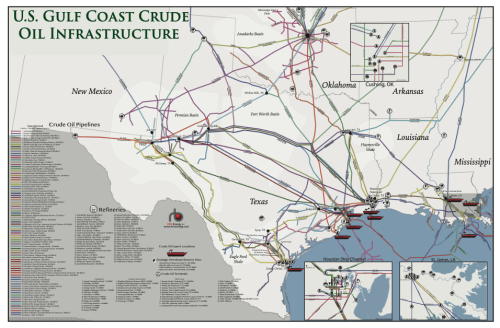
RBN’s US Gulf Coast Crude Oil Infrastructure Map - is up-to-date and provides a clear and comprehensive view into North America’s most dynamic and important crude oil market landscape.
Despite 2018’s strong results and 2019’s seemingly positive outlook, investors remain skeptical. As we said last month in Part 1 and Part 2 of our “Surprise, Surprise” series, E&P share prices by December 2018 had plunged 40% from their September highs when crude prices slid to $45/bbl, and despite the subsequent oil price rebound, share prices have recovered less than half of their late-2018 declines.
Several oil companies released slimmed-down 2019 capital budgets in late 2018, when oil prices were still sagging. Many industry observers assumed the planned declines in investment reflected conservatism about the oil pricing outlook going forward. The oil price decline turned out to be short-lived, however, with prices recovering strongly starting in late December 2018 and through the first quarter of 2019. Still, updated capex plans released with year-end 2018 results in late January and February continued to mirror the overall trend, and almost no companies moved to revise their budgets upward. (Guidance updates released so far with first-quarter results in late April and early May do not indicate any significant changes from year-end forecasts.)
About the song
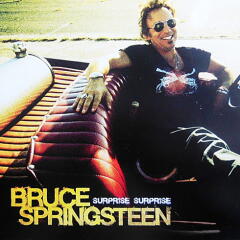
"Surprise, Surprise" was written by Bruce Springsteen and appears as the 11th cut on his 16th studio album, Working on a Dream. The album was produced by Brendan O'Brien, and released in January 2009. Springsteen said about the album, "I hope Working on a Dream caught the energy of the band fresh off the road from some of the most exciting shows we've ever done." The LP debuted at #1 on the Billboard Top 200 Albums chart, and has been certified Gold by the Recording Industry Association of America. It has sold over 3 million copies worldwide to date. Personnel on the record were: Bruce Springsteen (lead vocals, guitar, harmonica, keyboards), Roy Bittan (piano, Hammond organ, accordion), Danny Federici (Hammond organ — this would be Federici's last recordings with the E Street Band before his passing in April 2008), Nils Lofgren (guitar, vocals), Patti Scialfa (vocals), Steven Van Zandt (guitar, vocals), Max Weinberg (drums), and Soozie Tyrell (violin, vocals).
Bruce Springsteen is an American singer-songwriter, musician, and leader of the E Street Band. He has made 18 studio albums, six live albums, and sold more than 135 million records worldwide. Springsteen has won 20 Grammy Awards, two Golden Globes, one Academy Award, and one Tony Award. He is a member of the Rock and Roll Hall of Fame and Songwriters Hall of Fame, and has received a Kennedy Center Honor and Presidential Medal of Freedom; he also has been named the MusiCares Person of the Year. “The Boss” still records and tours to this date.




Comments
What percentage of total US Production do the 44 E&Ps Account for? Gas and crude/liquids?
Roughly one-third of oil production and half of natural gas production. I used last years BP statistical review for reference.