


U.S. natural gas production continues to increase, with more growth expected at least through the middle of this decade to feed new LNG export capacity coming online along the Gulf Coast. Production growth will require new infrastructure, but long-distance transmission lines have become increasingly difficult to build due to entrenched environmental opposition. Meanwhile, gathering pipes have grown in size and length, blurring the lines between gathering and transmission. In today’s RBN blog, we’ll discuss what separates gathering systems from transmission pipelines, why those differences matter, and how those systems are continuing to evolve.

The NATGAS Appalachia weekly report provides the data and insights to monitor the northeast natural gas market’s twists and turns and identify the risks and opportunities along the way, including tracking supply-demand trends, outbound capacity and their impact on takeaway pipeline utilization, and regional prices.
America’s gas production has more than doubled since the start of the Shale Revolution, from about 50 Bcf/d in 2005 to around 104 Bcf/d in 2023. That rise in output began in gas-focused regions like the Barnett, Marcellus and Haynesville, but as more producers shifted to liquids-rich basins, an increasing proportion was produced as associated gas from crude oil-focused wells in places like the Permian, Bakken and Eagle Ford. Those oil-focused wells have become increasingly gassy over time and come with a lot of NGLs. All this has fueled a spate of new gas processing and related assets across the major shale growth basins, with production continuing to set records. As we have blogged about frequently, the U.S. will still need to add a lot of infrastructure — including gathering systems, gas processing capacity and transmission pipelines — to handle all that gas and associated NGLs. We recently covered the gas processing buildout in OMG. We also did a full series last year about the buildout of NGL pipeline infrastructure (see Get Ready) and another series about the pipelines that are increasingly taking gas to the Gulf Coast to help feed new export-driven LNG liquefaction facilities (see Gotta Get Over). Today we focus on gas gathering and transmission networks and we’ll start with a look at the basic functions of each.
Natural gas gathering systems (dashed black oval in Figure 1 below) collect raw, unprocessed supplies from production sites, usually to a central location, often for compression, before most volumes are shunted toward processing and treatment sites. If the gas does not need processing or treating, it gets directed to transmission networks. The gas is usually separated from water and other impurities right at the wellhead. For more treatment, the gathering line carries the gas to the processing plant. We’ve blogged about gathering a lot. A year ago, in Straighten Up and Fly Right, we discussed how rural gas gathering pipelines have increasingly come under federal safety regulations, adding more than 400,000 miles of onshore pipes to the oversight of the Department of Transportation’s Pipeline and Hazardous Materials Safety Administration (PHMSA) starting this year.
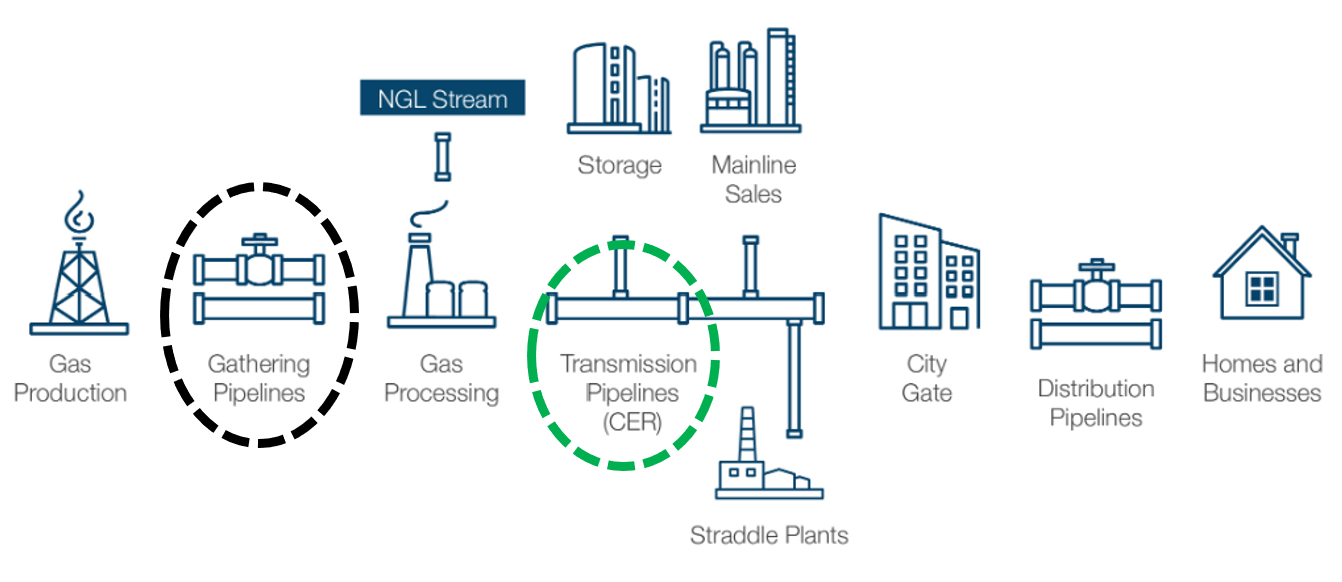
Figure 1. Schematic of Natural Gas Transportation System. Source: Canada Energy Regulator
About the song
“Shall We Gather At The River” was written by American poet and gospel music songwriter Robert Lowry in 1864. The song was first recorded by the Metropolitan Quartet and released on an Edison cylinder (pre-vinyl) in 1917. The song’s lyrics cover the theme of reuniting with loved ones in the afterlife. It has been featured in a few western motion pictures over the years. It appears as the fourth song on side two of Willie Nelson’s 20th studio album, The Troublemaker. Personnel on Nelson’s version were: Willie Nelson (lead vocal, guitar), Dan Spears (bass), Bobbie Nelson (piano), Larry Gatlin (guitar, backing vocals), Paul English (drums), Mickey Raphael (harmonica), Jimmy Day (dobro), and Dee Moeller, Sammi Smith (backing vocals).
The Troublemaker was recorded in February 1973 at Atlantic Recording Studios in New York City with Arif Mardin producing. Its initial release was canceled after Atlantic Records closed its country music division. After the huge success of Willie Nelson’s Red Headed Stranger album on Columbia Records in 1975, Columbia released The Troublemaker in September 1976. It went to #1 on the Billboard Top Country and #60 on the Billboard 200 Albums charts. One single was released from the LP.
Willie Nelson is an American country music singer, songwriter, guitarist, and actor. He moved to Nashville in 1960, and as a songwriter penned the hits “Funny How Time Slips Away,” “Hello Walls” and “Crazy” during this period. Frustrated by the Nashville country music business machine, he relocated to Austin in the early ’70s and became one of the key players in what was to become the outlaw country movement. He has released 100 studio albums, 14 live albums, 51 compilation albums, two soundtrack albums, and 180 singles. He has sold more than 60 million records worldwide. He has appeared in 36 motion pictures, and several television programs. He is a member of the Country Music Hall of Fame, and the National Agriculture Hall of Fame. He won the Gershwin Prize from the Library of Congress and received Kennedy Center Honors in 1998. At the age of 90, Nelson continues to record and tour.







Comments
Greetings,
This article was very applicable after my time at Meritage Midstream in the PRB (recently acquired by Western). Just one clarification I thought I would make is that by statute, the state of Wyoming does allow for condemnation (i.e. eminent domain) for gas gathering pipelines.
Cheers,
Michael
In reply to Small Clarification by Michael Woodward
Hey Michael,
You are right and thanks for pointing this out. We are tweaking the blog.
Cheers