A little over a year ago, we discussed the rapidly expanding third-party shipper market for crude oil in West Texas. At the time, crude at Midland was trading at nearly a $15/bbl discount to Gulf Coast markets. Pipeline space out of the Permian was hard to come by and extremely valuable, and everybody and their brother — literally, in some cases — were forming a limited liability corporation and trying to secure space as a walk-up, “lottery” shipper. A lot of people made a lot of money, but now, just over a year later, much of that lottery opportunity has dried up. Nowadays, these same folks are looking for new opportunities, or going back to old strategies, only to find that being a third-party shipper today is more expensive and more burdensome. In today’s blog, we recap how lottery shippers made buckets of money in late 2018 and early 2019, only to see their target of opportunity dry up due to midstream investment.
Back in July 2018 (seems so far away right now doesn’t it?), we wrote a blog detailing how crude differentials in basins that were short on pipeline takeaway were often subject to big pricing shifts when pipeline space was allocated. The focus at the time was on the Permian, where robust production was meeting a brick wall of space constraints on area pipelines. There was simply too much crude being produced, and not enough capacity to move it to market — things got so bad that there was some talk that producers might have to shut in production or even stop drilling wells, as they were running out of ways to transport their oil. In the latter half of that blog, we touched on a subject that was overlooked by some, but had become a serious source of revenue for others: lottery shippers.
To truly understand Cushing — what it does and how it works — you need to know the hub’s assets and how they fit together. RBN’s Cushing Crude Oil Playbook provides the first one-stop, comprehensive guide to the hub’s assets.
Lottery shippers are the folks who are nominating the 10% of shipper space on a pipeline that is mandated to be set aside by the Federal Energy Regulatory Commission (FERC) for walk-up customers. Most of the time, the majority of the other 90% of space on a pipe has been eaten up by committed shippers with term deals, so it’s unavailable to the common Joe. There are also regular shippers, often called historical shippers, who are treated differently by each pipeline. They exist in a limbo world between a committed shipper and a lottery shipper — essentially, they are lottery shippers that have won enough and shipped frequently and consistently enough (usually something like 10 to 12 months in the last 18 months) that if there is any piece of the 90% of pipeline space that isn’t committed to, they get first dibs at it. Lottery shippers are then left with their set-aside 10% space and anything else that isn’t being used by committed and historical shippers.
About the song
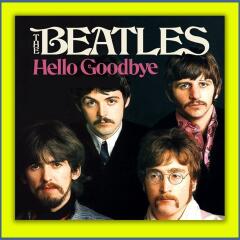
“Hello, Goodbye” was written by Paul McCartney and credited to Lennon/McCartney. It was recorded at EMI (Abbey Road) Studios in London in October-November 1967, with George Martin producing. The song was released as a single in November 1967, backed with John Lennon’s “I Am the Walrus” (also credited to Lennon/McCartney). It was the first non-album single released by the group since the death of their manager, Brian Epstein, and since the release of the phenomenally successful Sgt. Pepper’s Lonely Hearts Club Band album. Promotional films were made for “Hello, Goodbye” featuring The Beatles lip-syncing to the song, wearing their Sgt. Pepper’s uniforms. One of the “Hello, Goodbye” promotional films aired on The Ed Sullivan Show in the U.S. in 1967. The song went to #1 on the U.S. Billboard Hot 100 and has been certified Gold by the Recording Industry Association of America (RIAA). Both “Hello, Goodbye” and “I Am The Walrus” were included on the U.S. Magical Mystery Tour album, released in November 1967. Personnel on the record were: Paul McCartney (lead, backing vocals, bass, piano, bongos, conga), John Lennon (backing vocals, guitar, Hammond organ), George Harrison (backing vocals, lead guitar), Ringo Starr (drums, maracas, tambourine, backing vocals on coda), and Kenneth Essex and Leo Birnbaum (viola).
The Beatles were an English rock band formed in Liverpool in 1960. With the lineup of John Lennon, Paul McCartney, George Harrison and Ringo Starr, the group is the best-selling music act in history, with sales of over 800 million records worldwide. They have released 23 studio albums, five live albums, 53 compilation albums, 21 EPs and 63 singles. The band also released four full-length motion pictures. The group has won one Academy Award, one Billboard Award, four Brit Awards, 26 Grammy Awards, 15 Ivor Novello Awards, one MTV Video Music Award, and three World Music Awards. They are members of the Rock and Roll Hall of Fame, the UK Music Hall of Fame, and the Vocal Group Hall of Fame. They were awarded MBE's by the Queen in 1965. The Beatles have six Diamond albums, 20 multi-Platinum albums, 16 Platinum albums and six Gold Albums, as certified by the RIAA. The Beatles officially broke up in 1970. John Lennon was murdered in 1980. George Harrison passed away in 2001. Paul McCartney and Ringo Starr still record and perform as solo artists.