Perhaps the most hyped-up topic in energy these days is how much electricity new data centers will need to keep up with the increased use of artificial intelligence (AI). And that’s prompting some big questions, such as where all the power will come from and how much natural gas demand will rise. But another crucial question may be whether these data centers will pull that power from the grid or generate it themselves on-site. In today’s RBN blog, we’ll discuss the benefits and challenges of each approach.
First, let’s offer a bit of background and some data-center basics. As we discussed in Storm Front, large-scale data centers (see photo below) can be home to thousands or even tens of thousands of networked computers that process, store and share data. Data centers — many of them owned and operated by tech giants — are among the most energy-intensive building types, consuming up to 50 times the energy per square foot of a typical commercial office building, with electrical demand at larger facilities ranging from 100 megawatts (MW) to 2,000 MW. (For perspective, as we noted in Just Can’t Get Enough, a city the size of Lubbock, TX, — population 267,000 — only requires about 700 MW.) Demand for data centers has grown exponentially with the expansion of AI tools like ChatGPT and Perplexity, which require far more computational power — and energy — than conventional Google searches.
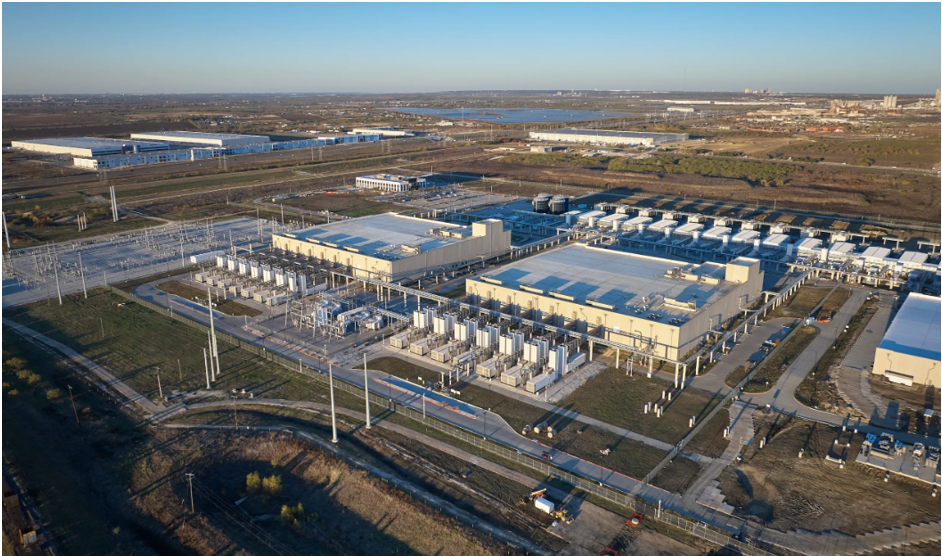
A Google Data Center in Ellis County, TX. Source: Google
As we discussed in We Should Be Friends, renewables like wind and solar often remain an important (if intermittent) part of the power mix for data centers (see Together In Electric Dreams) and nuclear power holds significant long-term potential (along with years-long red tape). But natural gas typically remains Option #1 because, as we noted in Dive In, it is a consistent source of around-the-clock power that can be deployed at scale, usually within a reasonable period of time.

About the song
“Options Open” was written by Kathleen Edwards and appears as the fifth song on her fifth studio album, Total Freedom. The song talks about keeping options open in a romantic relationship. Released as a single in August 2020, it went to #30 on the Billboard Alternative Songs Singles chart. Personnel on the record were: Kathleen Edwards (lead vocals, acoustic, electric guitar), Jim Bryson (acoustic, electric guitar, organ, piano, synthesizer, percussion, backing vocals), Ian Fitchuk (bass), Peter Van Althen (drums, percussion), Todd Lombardo (nylon string guitar), Gord Tough (electric guitar), and Daniel Tashian (backing vocals, guitar).
Total Freedom was recorded during 2019-20 at Edwards’s home studio in Stittsville, ON, and in Kingston, ON, and Nashville. Produced by Jim Bryson, Ian Fitchuk and Kathleen Edwards, the alt-country album was released by Dualtone Nashville in August 2020 and went to #183 on the Billboard 200 Albums chart and #24 on the Billboard Canadian Albums chart. Two singles were released from the LP.
Kathleen Edwards is a Canadian singer-songwriter and musician. Her alt-country sound has been described as Suzanne Vega meets Neil Young. Her first release was a five-song EP, Building 55, put out on her own indie label in 1999. After playing SXSW in 2002, she was signed to Rounder Records. She has released six studio albums, five EPs and 14 singles. She has won a SOCAN Songwriter Prize. Her next album, Billionaires, will be released in August, followed by a US and Canadian tour beginning in September.