


The Transpanama Pipeline (TPP) currently ships up to 600 Mb/d of crude from the Atlantic coast of Panama to the Pacific. The pipeline was originally built to facilitate Alaskan crude shipments to the US Gulf Coast but was reversed in 2009 to move Atlantic basin crudes to South American and Far East markets without going through the Panama canal. Could the TPP be utilized to move US crude production from the Gulf Coast to West Coast refineries? Today we review that possibility.
History
The TPP is an 81 mile crude oil pipeline that runs across Panama from the Port of Chiriqui Grande, Bocas del Toro on the Atlantic (Caribbean) coast to the port of Charco Azul on the Pacific coast (see map below). The TPP was opened in 1982 as an alternative to the Panama Canal, to carry crude oil from the Pacific to the Atlantic Ocean. The primary purpose was to ship Alaska North Slope (ANS) crude transported down the Pacific coast to Panama from Valdez, AK to US Gulf Coast refineries. Between 1982 and 1996 the pipeline transported 2.7 billion Bbl of ANS to Gulf Coast refineries. The pipeline was then closed in 1996 as Alaskan crude volumes declined (see After the Oil Rush). In 2003, the TPP was re-opened to move Ecuadorian crude from the Pacific to Gulf Coast refineries.
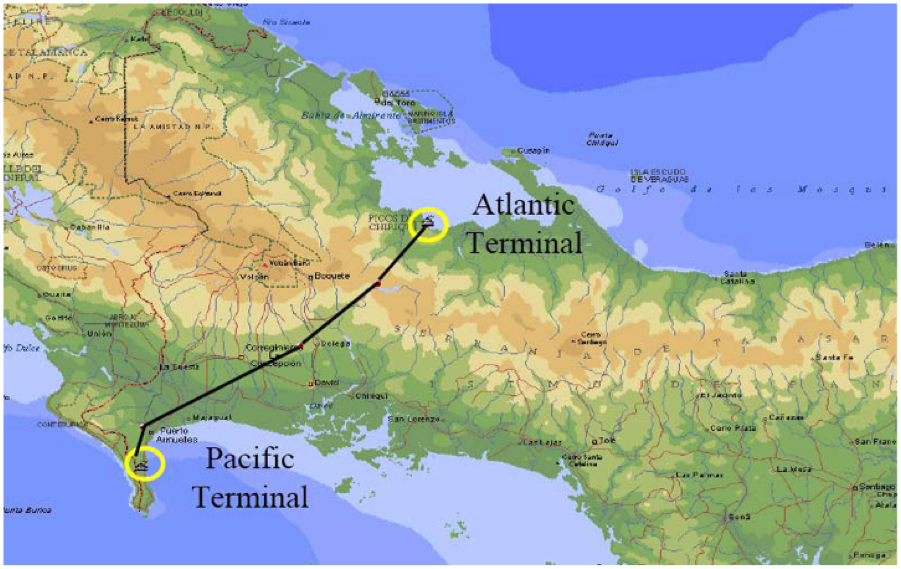
Source: Tesoro Presentation
In 2008, pipeline owner Petroterminal de Panama, S.A. signed an agreement with BP to upgrade the pipeline and reverse it’s direction to flow from the Atlantic to the Pacific. The upgrading included building an additional 5 MMBbl of storage at terminals at either end of the pipeline. After the reversal, Petroterminal signed long-term (7 year) commitments with BP and Tesoro for pipeline capacity and storage utilization. BP initially committed to ship 65 Mb/d in 2008 and lease 5 MMBbl of storage but increased their commitment to 100 Mb/d in a 2012 agreement. Tesoro committed to shipping 107 Mb/d and leasing 4.4 MMBbl of storage under a 2009 agreement.
The Government of Panama (40 percent), Swiss oil trader Gunvor (17 percent) and the pipeline operator, Northville Industries, own Petroterminal. The three companies that currently own capacity on the pipeline are BP, Tesoro and Gunvor. Current capacity is 600 Mb/d. There is little public information available about the flow of oil but in 2012 Argus reported that BP was shipping 300 Mb/d and Petroterminal has reported a 4-fold increase in shipments since 2010.
Significance
The TPP route reduces transport time and shipping costs between Atlantic and Pacific Coast ports by avoiding a trip around Cape Horn at the tip of South America. The pipeline competes directly on this route with the Panama Canal although the latter has some disadvantages. The Canal has restrictions that limit maximum vessel size to “Panamax” capacity of 50 thousand MT or about 380 MBbl of light sweet crude. The Panama Canal has also been subject to periodic delays from traffic congestion. As we previously explained in September 2012 (see Panama Tailored to Fit Larger Vessels), the Panama Canal is currently being expanded so that by 2015 larger vessels including oil tankers carrying 600 MBbl will be able to pass through. However, the TPP provides shippers with a more flexible alternative because port terminals at either end of the pipeline can berth very large crude carrier (VLCC) vessels that carry up to 1 MMBbl. That means a VLCC on the Atlantic side carrying crude from (say) North Africa or Europe can offload crude to the TPP to be reloaded onto another VLCC on the Pacific side. Economies of scale in moving crude by VLCC make this an attractive alternative to using smaller vessels and facing possible delays using the Canal.
Large onshore storage at both ends of the TPP also provide for crude oil blending and the optimizing of crude distribution to West Coast refiners. Different crudes can be blended to meet refinery needs at the PTT terminals and VLCC cargoes delivered at the Atlantic end can be broken down into smaller batches for shipment to West Coast refineries that do not have adequate storage to cope with VLCC size shipments.
The primary significance of the TPP is that it facilitates the increased flow of crude between Atlantic and Pacific markets. The pipeline makes it feasible to ship a variety of Latin American and West African crudes to West Coast refineries. For example it cuts the shipping distance from Nigeria to Los Angeles by about 3,400 miles – reducing the journey time by about 30 days. Other improved journey times include those for Venezuelan crude to Far East markets (14 days faster), Russia to West Coast South America (11 days faster) and North Sea to US West Coast (35 days faster).
Future Value to US Market?
Given that US domestic and Canadian crude production grew by 1.5 MMb/d between 2010 and 2012 and is expected to grow by a further 4 MMb/d by 2018, dramatic changes in North American crude supply and distribution logistics are underway. These changes will not only impact domestic crude flows within the US and Canada but will also cause the redirection of crudes formerly imported to the US to alternative markets. As a result there are a couple of ways that the TPP could play an increased role. It could improve the flow of US domestic crude between East and West Coasts or it could help importers currently supplying US Gulf Coast refineries to transport their crude to alternative markets.
Taking the first of these, there is demand for a better flow of US domestic crude production from the Gulf Coast region to the West Coast. Most US pipelines flow from West to East and there are no pipelines across the Rockies – leaving the West Coast dependent on Alaskan crudes and imports (given that California production is declining). We recently reviewed a pipeline proposal from Kinder Morgan designed to ship crude from West Texas to California (see “Is the Price of Freedom Too High” Part 1 and Part 2). However, that project failed to attract sufficient shipper interest in the face of competition from rail transport and a mismatch between West Coast refinery crude needs and West Texas grades. Cost wise - shipments from the US Gulf to the West Coast only make sense if those crudes are produced close to the Gulf Coast. Crude produced further away – in North Dakota or in Canada could probably be shipped more economically by rail to the West Coast. But the lighter crude production from the Texas Eagle Ford and Permian basins that is close enough to the Gulf to consider shipping through the TPP does not meet the needs of California refineries configured to process heavier sour crudes.
And shipments of US domestic crude through the TPP would have to be shipped to the Atlantic coast of Panama from US ports and from the Pacific end of the pipeline to West Coast ports. That counts as movement between two US ports and such shipments are expensive because they have to be made on US built and operated “Jones Act” vessels that add as much as $3/Bbl to costs (see The Sea and Mr. Jones). The additional expense and the lack of qualified ships to make the journey would likely make any such movements uneconomic.
Using TPP to move US crude production to international markets would get around the Jones Act restriction but would run into the US ban on crude exports that prevents all but limited shipments to Canada (see The Lease Condensate Export Problem). Although moving US crude through the Panama pipeline to the West Coast is allowed (the pipeline was built to move ANS to the Gulf Coast), other destinations would require US Government approval. For these reasons we do not expect the TPP to provide much assistance in the redistribution of US domestic crude production until there is a change to the export ban.
But the Panama pipeline is able to provide a useful alternate route to market for those crude suppliers that are finding their imports to the US pushed out by expanding domestic and Canadian production. Already the volumes of light sweet crude imported into the Gulf Coast have been reduced to a trickle by the availability of new domestic production. This has had an impact on West African and North Sea producers in particular. These producers can use the TPP to gain access to new markets on the West Coast of South America or the Far East. Likewise as heavier crudes supplied to US Gulf refiners from Mexico and Venezuela are pushed out of that market by new flows of competitive grades from Canada in the next 18 months (see Sailing Stormy Waters) they can use the TPP to access alternative Far Eastern markets. The only constraint for Venezuela and Mexico would be that the TPP quality specification requires crude to be at least 15 API degrees of gravity – meaning that some heavier grades these countries produce could not be shipped without blending.
The TPP provides improved crude competition between East and West markets – helping to keep prices in balance. It also provides an important competitive alternative to the Panama Canal for crude shippers. However the restrictions imposed by the US ban on crude exports and the Jones Act make it unlikely that the TPP will help to improve the redistribution of crude between US ports. But as growing US and Canadian production pushes out imports, the pipeline may provide a competitive alternative to the Panama Canal for Atlantic basin producers looking for routes to markets in the Pacific.

About the song
“The Girl from Ipanema” a bossa nova song - has been recorded by many artists. The biggest hit version sung by Astrud Gilberto was released in 1964





Comments
Nice article indeed. Very interesting! get instant twitter followers
Excellent piece as always, Sandy.
Could a parallel pipeline be built to move refined products? If Gulf Coast refiners bolted on additional atmospheric distillation units to flash off more gasoline and diesel from the growing volume of unconventional Light Sweet production, could these refineries move large volumes using converted Ultra Large Crude or Very Large Crude Carriers to the Atlantic intake of the pipeline to be picked up on the Pacific side by similarly reconfigued ULCCs or VLCCs? This could expedite exports to Asia and Pacific Latin America.
There appears to be a growing surplus of ULCCs and VLCCs, and this use combined with the growing infrastructure in the lower 48 states could benefit both exporters and importers of refined products.
Is TPP currently being used to ship crude from Venezuela to China?
Hi
The TPP could be used to ship Venezuelan crude to China but we did not do the necessary shipping analysis to figure that out. I would guess you could tell from PDVSA chartering activity whether they are moving crude to Panama.
Sandy
In reply to TPP by Marcel Depart
The TPP now has SBM (Single Buoy Mooring) and CALM (Catenary Anchor Leg Mooring) very similar to the LOOP which uses SALM (Single Anchor Leg Mooring). This system is located almost 2 miles offshore from what they call the "Atlantic Terminal". The crude is then unloaded into 36" diameter submarine pipes that transcind the almost 2 miles to shore and then reaches the terminals 7 million bbls of storage. The TPP is absolutely capable of loading and unloading VLCC's on both ends.