Crude oil production in the Denver-Julesburg (D-J) Basin has nearly doubled since January 2016 — only the Permian has outpaced the D-J’s growth rate over the same period — and production there now averages about 640 Mb/d. The D-J has just about everything producers want, including an unusually intense concentration of hydrocarbons within four geologic layers, or “benches,” only a few thousand feet below the surface, low per-well drilling costs, and direct pipeline access to the crude hub in Cushing, OK. Production growth in the D-J has spurred a rapid build-out of crude gathering systems and other infrastructure, especially in Colorado’s Weld County, the epicenter of D-J activity, which is located a short drive northeast of Denver. Today, we begin a series on existing and planned pipeline networks to move D-J crude from the lease to regional hubs and takeaway pipes.
For the past few years, the Denver-Julesburg Basin in northeastern Colorado and southeastern Wyoming has been like a backup vocalist to the Permian, the U.S.’s crude-production superstar; the D-J gets no limelight and not-so-much love. Remember, though, that many of those who started out as background singers later emerged as stars in their own right. Cher, for example, sang backup on the studio recording of The Ronettes’ “Be My Baby” in 1963, two years before Sonny & Cher hit the top of the charts with “I Got You Babe.” Whitney Houston provided backing vocals for Chaka Khan and Lou Rawls before she became famous, and Phil Collins played the drums and sang backup for Genesis for five years until lead singer Peter Gabriel left the band and Collins stepped into his shoes, giving Genesis a new lease on life in the process.

Canadian crude output is rising, requiring new export routes. As traditional pathways face constraints, the U.S. Rockies—especially the Guernsey, WY hub—are emerging as key corridors for moving Canadian heavy crude to downstream markets, including the Gulf Coast.
We think it’s time to give the D-J its due. As we said in our Rocky Mountain High? Drill Down Report earlier this year, the D-J Basin is the more prolific of the two main production areas in the Rockies’ Niobrara Shale, the other being the Powder River Basin in northeastern Wyoming. Crude oil is the focus of drilling-and-completion work in the D-J, though the basin’s wells also produce large volumes of associated gas — a rich mix of natural gas and natural gas liquids — that only augment the wells’ crude-related revenue. Most of the oil produced in the D-J comes from three hydrocarbon-packed benches — the Niobrara B, the Niobrara C and the Codell — with smaller volumes coming from the Niobrara A layer. In Weld County, the beating heart of the D-J, these benches lie only 5,000 to 8,000 feet below the surface, which helps keep drilling costs relatively low: less than $5 million a pop, on average, according to the folks we’ve talked to. In contrast, per-well costs in the Bakken average around $7 million, and in the Permian they average close to $8 million.

About the song
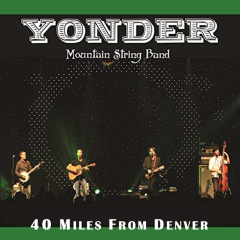
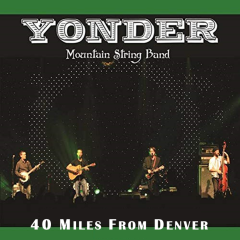
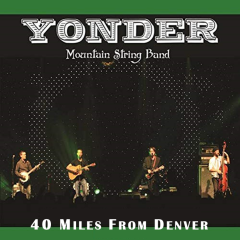
"40 Miles From Denver" was written by Ben Kaufmann, and appears as the eighth cut on Yonder Mountain String Band's debut album, Elevation. The album was released in September 1999 on Frog Pad Records, an independent record label run by the band. Production chores were handled by Sally Van Meter. Personnel on the record were: Dave Johnston (banjo, vocals), Jeff Austin (mandolin, vocals), Ben Kaufmann (bass, vocals) and Adam Aijala (guitar, vocals). The song features producer Sally Van Meter on resophonic guitar. An interesting side note to this song is that Nederland, CO, where Yonder Mountain String Band resides, is about 40 miles from Denver — just like the D-J.
Elevation was recorded at Rancho DeVille, Sawtelle Studio and Swallow Hill in Denver. Additional musicians on the album were: Darol Anger (fiddle), Celeste Krenz (backing vocals), Mike Marshall (mandolin) and Sally Van Meter (electric lap steel, resophonic guitar).
Yonder Mountain String Band is an American progressive bluegrass/jam band formed in Nederland, CO, in 1998. The band was started by Dave Johnston and Jeff Austin, who had previously played together in The Bluegrassholes in Urbana, IL. After relocating to Colorado, the two put together what would become Yonder Mountain String Band. They developed a loyal following by constantly touring on the bluegrass and jam band circuits. Austin left the band in 2014, and passed away earlier this year. The current lineup features original members Johnston, Kaufmann and Aijala, joined by Allie Kral (fiddle, vocals) and Jake Joliff (mandolin, vocals). Yonder Mountain String Band has released five studio albums and five live albums. They continue to record and tour.