Without a doubt, the two biggest changes to U.S. natural gas markets in the last 15 years have been the Shale Revolution and the development of LNG exports. These completely upended the way gas flowed in this country, with the Northeast now home to the largest gas-producing basin and the Gulf Coast — including its fleet of LNG export terminals — now the U.S.’s largest demand center. Production growth in the Marcellus/Utica has stalled, however, largely due to the regulatory and legal challenges associated with building new pipeline takeaway capacity. One possible fix would be a new East Coast LNG terminal, which in addition to having easy access to cheap, almost-local gas would also be close to gas-hungry European markets. But just how likely is such a project? In today’s RBN blog, we discuss the advantages and hurdles of developing LNG export capacity on the East Coast.
Visualize the infrastructure behind U.S. NGL movement.
The U.S. NGLs Map provides a comprehensive view of the transport, processing, and export networks moving NGLs across the U.S.
The Mid-Atlantic region already has one LNG terminal, of course — Cove Point LNG, on the Chesapeake Bay in Maryland (yellow diamond in Figure 1) — and we should look at that facility in depth before we discuss the potential for a second LNG export terminal close to the Marcellus/Utica. Cove Point is a single-train, 5.25-MMtpa (700 MMcf/d) liquefaction-and-export facility owned by Berkshire Hathaway. All of its feedgas comes from the Marcellus/Utica via contracts with two area upstream producers, Coterra Energy in Northeast Pennsylvania and Antero Resources in Southwest Pennsylvania and West Virginia. The producers also manage gas transmission from the production area to Dominion Cove Pipeline (purple line), which feeds into the LNG terminal. [Feedgas flows from the supply area to Dominion Cove Pipeline via Transco Pipeline (orange line) and Columbia Gas Transmission (blue line).]
About the song
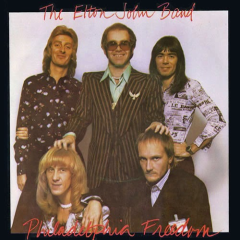
“Philadelphia Freedom,” an exuberate anthem by Sir Elton John, peaked at #1 on Billboard’s Hot 100 chart on April 12, 1975. The song’s timing was impeccable, as it ushered in the 1976 Bicentennial of the signing of the Declaration of Independence. In fact, though, the title of Elton John’s song was a tribute to tennis star and woman’s rights icon Billie Jean King, who coached a team named the Philadelphia Freedoms. The song was dedicated to her as well as the “Soulful Sounds of Philadelphia,” the latter of which was lyrics writer Bernie Taupin’s inspiration. The song made its album debut on 1977’s Elton John’s Greatest Hits Volume II.
Elton John’s Greatest Hits Volume II was Elton John’s 16th official album release and the second compilation. The original 1977 U.S. version featured one song from 1971 and two songs from 1974 that were not on the first greatest hits album. It also featured several hit songs from 1975 and two hit singles from 1976. It was certified 5X Platinum by the Recording Industry Association of America.
Sir Elton John (Reginald Kenneth Dwight) is a British singer, songwriter and pianist. He started playing piano at an early age and released his debut studio album, Empty Sky, when he was 22. He has released 31 studio albums, five live albums, 22 compilation albums, nine soundtrack albums, four EPs, and 140 singles. He has sold over 400 million records worldwide. He has won two Academy Awards, six Grammy Awards, one Tony Award, nine Ivor Novello Awards, and two MTV Video Music Awards. He is a member of the Rock and Roll Hall of Fame and Songwriters Hall of Fame, and is a recipient of Kennedy Center Honors. He received a CBE in 1995 and was knighted by Queen Elizabeth II in 1998. He still records and is on a three-year farewell tour that ends in New Zealand in 2023.