Through the second half of the 2010s, the Permian Basin’s crude oil supply trajectory was clear: up, up and up. From the start of 2015 to the end of last year, crude production in the world’s leading shale play increased by an amazing 3 MMb/d, from 1.7 MMb/d to 4.7 MMb/d. Three new pipelines with a combined capacity of more than 2 MMb/d were built to move a lot of those incremental barrels to Corpus Christi, which — thanks in part to newly developed storage and docks — has become the U.S.’s #1 port for crude exports in recent months. But Permian producers have trimmed their crude output by at least several hundred thousand barrels a day this spring in response to falling demand and low prices. Has the Permian been thrown off course, and if it has, what would that mean for marine terminals in Corpus? Today, we continue our series of Gulf Coast crude export facilities with a look at the three newest terminals along the Corpus Christi Ship Channel.
This is the sixth episode in our review of U.S. crude export infrastructure and utilization. In Part 1, we looked at the Seaway Freeport and Seaway Texas City terminals, both of which are part of Enterprise Products Partners and Enbridge’s broader Seaway Crude Pipeline (SCP) system. We estimate Seaway Freeport’s export capacity at 200 Mb/d and Seaway Texas City’s at 300 Mb/d. In Part 2, we discussed the Houston Fuel Oil Terminal (HFOT), which is now owned by Energy Transfer, and the Seabrook Logistics Marine Terminal, which is jointly owned by Magellan Midstream Partners and LBT Tank Terminals. We peg HFOT’s export capacity at 480 Mb/d, and Seabrook Logistics’ at 300 Mb/d. Then, in Part 3, we examined Enterprise Hydrocarbon Terminal, or EHT, which is one of the largest energy-related marine terminals on the Gulf Coast; it also is a major LPG export facility. EHT’s peak observed crude-loading capacity, on a monthly basis, is 600 Mb/d; however, RBN’s crude export capacity model suggests the terminal’s capacity could be several hundred thousand barrels a day higher. The focus of Part 4 was the three crude export terminals in the Beaumont/Nederland, TX, area. We estimate the sustainable throughput capacity of Energy Transfer’s Nederland Terminal to be 700 Mb/d, and put Phillips 66’s Beaumont Terminal and Enterprise’s Beaumont Marine West Terminal’s capacities at 420 Mb/d and 210 Mb/d, respectively. Last time, in Part 5, we looked at the Louisiana Offshore Oil Port (LOOP), which is the only Gulf Coast terminal that can fully load 2-MMbbl Very Large Crude Carriers (VLCCs); LOOP is also a major crude import terminal. When it is in export mode, LOOP can sustainably load 900 Mb/d into VLCCs, and the terminal frequently loads at a rate of more than 1 MMb/d. (Within a seven-day period in early May, LOOP loaded an astonishing 6.8 MMbbl onto VLCCs.)

The RBN Crude Oil Analytic Suite gives you access to four weekly reports covering crude oil markets, including: Crude Billboard, Crude Permian, Crude TradeView, and Crude Voyager.
Next, we turn our attention to Corpus Christi, which as we said in our introduction has become the U.S.’s leading crude export venue by volume. There is so much to discuss that our review of the Corpus area terminals will take three blogs; we start today with a look at the EPIC, Pin Oak and Eagle Ford terminals.

About the song
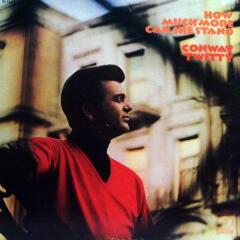
"How Much More Can She Stand" was written by Harry Compton, and was the first single released from Conway Twitty's 1971 album of the same name. The song also appears on the 1973 release, Conway Twitty’s Greatest Hits, Volume I. "How Much More Can She Stand" was recorded at Bradley's Barn in Mt. Juliet, TN, in February 1971, and produced by Owen Bradley. Released as a single in March 1971, the song went to #1 on the Billboard Hot Country Songs Singles chart. It would become Twitty's sixth #1 solo hit single. Personnel on the record were: Conway Twitty (lead vocals), Joe E. Lewis (background vocals), The Jordanaires (background vocals), Harold Bradley (electric six-string bass), Grady Martin (electric guitar), Larry Butler (piano), Jimmy Capps (acoustic guitar), John Hughey (steel guitar), Tommy Markham (drums, percussion), Bob Moore (bass), and Herman Wade (electric guitar).
Conway Twitty (Harold Lloyd Jenkins) was an American country music singer; he also left his mark in the rockabilly, rhythm and blues, and pop genres. Besides his solo work, Twitty had several hits with his duet recordings with Loretta Lynn. As a solo artist, he released 58 studio albums, 20 compilation albums, and 99 singles. With Loretta Lynn, he released 10 studio albums, seven compilation albums, and 13 singles. Twitty has sold more than 50 million records worldwide. He won seven Academy of Country Music Awards, four Country Music Association Awards, and two Grammy Awards, and is a member of the Country Music Hall of Fame and the Rockabilly Hall of Fame. Twitty had just inked a deal to open a new theater in Branson, MO, the day before his death in June 1993. He was 59 years old.