Crude oil exports out of the U.S. are the topic du jour these days. At the heart of the discussion are the who, what, where and when of how the export capacity will be developed. Who is going to build the next crude oil export terminal, what type will it be (offshore or onshore), where are they going to put it (Corpus, Houston, Louisiana — the list goes on), and when will that new capacity be available? Everyone seems to have a different answer, and for good reason. Crude oil export terminals aren’t easy to develop, any way you look at them. Today, we examine the financial and logistical hurdles that export terminals must clear in order to reach a final investment decision, and what those obstacles mean for what kind of terminal gets built, where it gets built, who builds it and how soon.

Canadian crude output is rising, requiring new export routes. As traditional pathways face constraints, the U.S. Rockies—especially the Guernsey, WY hub—are emerging as key corridors for moving Canadian heavy crude to downstream markets, including the Gulf Coast.
In Part 1 of our series, we briefly highlighted the history of U.S. crude oil exports. Since Congress lifted the ban on most oil exports in December 2015, U.S. export volumes have quickly increased from an average of 600 Mb/d in 2016 to an average of just over 2.7 MMb/d so far in 2019. We’ve seen seven weeks in which exports have topped 3 MMb/d so far in 2019, according to Energy Information Administration (EIA) data, and the four-week average for crude oil exports is currently at an all-time high (3.290 MMb/d). Based on RBN’s assessment of available capacity, which we also covered in Part 1, we believe there is currently more room for exports to grow. Our analysis suggests there is now around 5.1 MMb/d of actual, actionable export capacity that could move volumes onto the water and out to international markets. Our breakout of that capacity is shown in Figure 1, with the pink areas of the pie charts representing available capacity at each port.

About the song
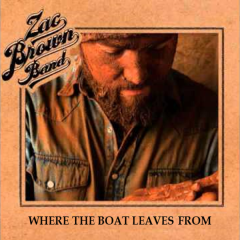
"Where the Boat Leaves From" was written by Zac Brown and Wyatt Durrette. It is the third cut on The Foundation, the first major label studio album from the Zac Brown Band. The album was recorded at Brighter Shade Studio in Atlanta, Compass Point Studios in Nassau (the Bahamas) and The Sound Station in Nashville. Released in November 2008, The Foundation was produced by Zac Brown and Keith Stegall. It reached #2 on the Billboard Top Country Albums and #9 on the Billboard Top 200 Albums charts. It was certified 5x Platinum by the Recording Industry Association of America. Personnel on the record were: Zac Brown (lead and background vocals, acoustic guitar), Jimmy De Martini (fiddle, background vocals), Greenwood Hart (keyboards, accordion), John Driskell Hopkins (bass guitar, background vocals, lead vocal on "It's Not OK"), Brent Mason (electric guitar), Marcus Petruska (drums, background vocals), Gary Prim (keyboards, Hammond B3 organ) and Joel Williams (electric guitar).
Zac Brown Band is an American country band based in Atlanta. They have released six studio albums, two live albums, one greatest hits album and two extended plays. They have won three Grammy Awards, three ACM Awards, two CMT Awards and one CMA Award. Brown got the ball rolling for his career by featuring his band at the restaurant/music venue he opened with his father-in-law in Lake Oconee, GA, in 2004 called "Zac's Place." The release of the Zac Brown Band's first indie album, Home Grown, occurred in the same year. Current members of the Zac Brown Band are: Zac Brown (lead vocals, guitar, banjo, bass), Jimmy De Martini (fiddle, guitar, mandolin, background vocals), John Driskell Hopkins (guitar, baritone guitar, uke, bass, banjo, background vocals), Coy Bowles (guitar, slide guitar, keyboards), Clay Cook (guitar, slide guitar, keyboards, background vocals), Chris Fryer (drums), Matt Mangano (bass), and Daniel de los Reyes (percussion). The band still records and tours to this day.