The Permian Basin is awash in light, sweet crude oil that’s cheap to produce and easy to process. It’s so awash, in fact, that supplies are overwhelming takeaway pipeline capacity. The resulting bottleneck in West Texas has cratered prices in Midland, where West Texas Intermediate (WTI) — the region’s light, sweet benchmark — has blown out price-wise against the same grade in other locations, including Houston, with its crude-export docks. Less well known, but influential beyond its geography, is Midland West Texas Sour, or WTS. WTS is suffering from the same wide differentials as WTI at Midland, and those yawning spreads are dragging down the price of Maya, Pemex’s flagship heavy, sour crude. Today, we discuss some surprising ripple effects of takeaway constraints out of the Permian.
As crude output in the wildly prolific Permian rocketed past 3 MMb/d — and beyond the region’s pipeline takeaway capacity — a day of reckoning came for the price of oil in West Texas. We talked about the precarious pricing for WTI at Midland in We Gotta Get Out of This Place, which noted the relationship between pipeline constraints and the teetering value in West Texas. Midstream companies are racing to build the pipelines needed, as we examined in Help On The Way. In No Time, we showed how increasingly desperate shippers are pondering the feasibility of long-haul trucking or revived crude-by-rail to mitigate the takeaway crisis. The market is like quicksand for price differentials now, as supply keeps growing and additional pipeline capacity — while under development — isn’t coming online soon enough.

Crude Oil TradeView provides up-to-date data and insights into the behavior of differentials for 33 crude assessments across North America. Each week, it also walks you through the reasoning of why differentials widen, narrow, flip (premium vs. discount), or blow out.
And it’s not just WTI at Midland that’s being hit. WTS — the heavier, more sour counterpart to WTI at Midland — is in the same sort of takeaway lockdown as its lighter, sweeter brother, and has been suffering a similar price crash. Given that WTS has a lower API gravity than WTI (32 to 35 vs. 37 to 42) and higher sulfur content (1.5% vs. 0.45%), WTS requires a more intense degree of refining — that is, more complex (and expensive) coking and hydrocracking equipment — to break the crude down into the most valuable mix of refined products. (As regular readers of RBN blogs know, the Gulf Coast has more than its share of these complex refineries thanks to decades of major investments by their owners. See I’d Like To Buy The World A Coke for more on cokers.)
One victim of WTS’s low-price predicament is Mexico’s flagship heavy grade, Maya. As we said in It Ain’t Heavy, It’s My Maya, Maya is a very heavy, very sour grade — 22 API gravity and 3.5% sulfur — that makes up just under half of state-controlled Petróleos Mexicanos’ (Pemex) total production and most of Mexican crude exports. Pemex’s own refineries largely lack the upgrading capacity to effectively process Maya; historically its natural market and primary destination has been coking refineries along the U.S. Gulf Coast. (See Complex Refining 101 for more on refinery upgrading processes.)
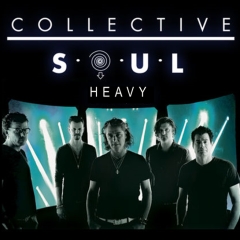
About the song
"Heavy," written by Collective Soul singer and front man Ed Roland, was the first single from the group’s fourth album, Dosage, which was released in January 1999. Dosage was produced by Anthony J. Resta and recorded at Criteria Studios in Miami. “Heavy” was the last of the band's run of seven #1 singles, and stayed on the charts the longest (15 weeks). Lead singer and songwriter Roland said, "I wanted a song without the title in the lyrics, so with the hook being ‘all your weight, it falls on me,’ with the combination of a heavy guitar riff, the title ‘Heavy’ just came up." The personnel on the Dosage LP were: Ed Roland (lead vocals and rhythm guitar), Ross Childress (lead guitar), Shane Evans (drums), Dean Roland (rhythm guitar) and Will Turpin (bass and backing vocals).
Collective Soul was formed in Stockbridge, GA, in 1992. According to Ed Roland, the band took its name from a phrase in Ayn Rand's book, "The Fountainhead." Atlantic Records signed the band in 1993 because of the heavy amount of radio airplay a demo of their song "Shine" was getting on multiple college radio stations in the South. Collective Soul won Billboard Music Awards for Top Rock Song in 1994 for "Shine" and in 1995 for "December." The group has released nine studio albums and one live album to date. The band is currently at work recording their 10th studio album, which will be released as a double LP in February 2019. Collective Soul also is getting ready to embark on "The Rock & Roll Express Tour," which includes 3 Doors Down and Soul Asylum.