With Broadway theaters shuttered and Hollywood studios on lockdown, one of the most compelling long-term American dramas is the ongoing saga of U.S. E&P Occidental Petroleum (Oxy). Act One was a compelling David-vs.-Goliath story as Oxy battled oil major Chevron in early 2019 to acquire Anadarko Petroleum and its prime Permian acreage. Among the most fascinating elements was the supporting cast, which featured business legend Warren Buffett, who contributed a critical $10 billion to push Oxy’s deal over the top, versus billionaire investor and corporate raider Carl Icahn, who led an unsuccessful struggle to stop what he called “the worst deal I’ve ever seen.” Oxy snagged Anadarko with a winning bid of $57 billion, the fourth-highest total for an oil and gas transaction and a 20% premium to Chevron’s offer, and predicted strong future production, dividend, and cash flow growth. But those optimistic projections have been upended in the ongoing Act Two, as plunging oil demand and prices from the COVID-19 pandemic have stymied planned asset sales and ravaged cash flows. Oxy has responded by reining in spending, revamping operations, refocusing divestment plans, and restructuring debt. But is it enough? Today, we analyze the company’s current strategies and financial maneuvering, as well as the near-term outlook, under a range of oil price scenarios.
Although almost all U.S. E&Ps have been rocked by the oil market crisis to some degree, Oxy faces an especially difficult challenge because of the massive debt it assumed in its purchase of Anadarko, which includes $11.1 billion due in 2021-22. Before we get to the implications of that debt and Oxy’s plans for navigating it, let’s quickly review the details of Oxy’s blockbuster acquisition of Anadarko.
On April 12, 2019, Chevron announced it had reached an agreement to acquire Anadarko for $65/share or, more precisely, $16.25/share in cash and $38.75/share in stock, plus the assumption of debt. Oxy, which said it had made several private offers to acquire Anadarko in 2018 and 2019, countered on April 24, 2019, with a bid of $76/share, including $38/share in cash, more than twice the cash Chevron was offering and a total 20% premium above Chevron’s bid. On April 30, Oxy boosted the credibility of its offer by announcing that Warren Buffett had agreed to contribute $10 billion of the $19 billion cash offer in exchange for Oxy preferred shares paying an 8% annual dividend. On May 9, Chevron declined to exercise its option to submit a revised bid, and the Anadarko board accepted Oxy’s offer, despite having to pay a $1 billion, or $2/share, deal-termination fee to Chevron.

Canadian crude output is rising, requiring new export routes. As traditional pathways face constraints, the U.S. Rockies—especially the Guernsey, WY hub—are emerging as key corridors for moving Canadian heavy crude to downstream markets, including the Gulf Coast.
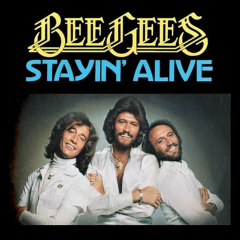
About the song
"Stayin' Alive was written by Barry, Robin, and Maurice Gibb, and appears as the first song on side one of the soundtrack album, Saturday Night Fever, featuring the Bee Gees. Recorded at Château d'Hérouville in Hérouville, France, and Criteria Studios in Miami, the song was produced by the Bee Gees, with Albhy Galuten and Karl Richardson. Released as a single in December 1977, it went to #1 on the Billboard Hot 100 Singles chart. It has been certified 3x Platinum by the Recording Industry Association of America (RIAA). Personnel on the record were: Barry Gibb (lead, harmony vocals, rhythm guitar), Robin Gibb (harmony vocals), Maurice Gibb (harmony vocals, bass), Alan Kendall (lead guitar), Dennis Bryon (drum loops), Blue Weaver (keyboards, synthesizer), and Joe Lala (percussion).
Saturday Night Fever is the soundtrack album from the hit 1977 movie of the same title, starring John Travolta and featuring music from the Bee Gees. It is the second best-selling soundtrack album of all time, with over 45 million copies sold worldwide (as a double-disc album). Recorded between 1975 and 1977 and released in November 1977, the LP went to #1 on the Billboard Top 200 Albums chart, where it stayed for 24 straight weeks. It has been certified 16x Platinum by the RIAA. Six singles were released from the album.
The Bee Gees were a pop music group formed in Australia in 1958. Consisting of brothers Barry, Robin, and Maurice Gibb, the group started out in the rock era of the mid ‘60s, then later migrated to the disco era of the late ‘70s. They released 22 studio albums, two live albums, four soundtrack albums, 15 compilation albums, and 83 singles. They have sold over 120 million records worldwide. They have won seven Grammy Awards, three American Music Awards, and one Brit Award. The Bee Gees are members of the Grammy Hall of Fame (with a Lifetime Achievement Award) and the Rock and Roll Hall of Fame. Maurice Gibb died in 2003 and Robin Gibb in 2012. Barry Gibb continues to record and occasionally tour as a solo artist.