


There is no doubt about it: With its location, infrastructure and long history, Mont Belvieu, Texas, is and will remain the center of the NGL fractionation world. It is worth noting, though, that fast-increasing production in the “wet” Marcellus and Utica has been spurring development of a new NGL hub of sorts in southwestern Pennsylvania, West Virginia and eastern Ohio. But the fractionation sector in the Utica/Marcellus is an orange to Mont Belvieu’s apple—that is, the infrastructure needed to separate NGL into its various purity products is evolving in an entirely different (and, well, more “fractionated”) way near Houston, PA than it did near Houston, TX. Today we explain this and summarize new fractionation-related developments in the Utica/Marcellus.
In this series, we have discussed the continuing boom in NGL production and the efforts by the four leading fractionators in Mont Belvieu to expand their fractionation capacity—and NGL pipeline and storage--capacity to help deal with the flood of NGL’s coming Mont Belvieu’s way. As we said in Part One, Mont Belvieu’s location near several oil and gas production regions, in the heart of petrochemical production, and near the coast (a must for importing and exporting) make it a natural center for NGL fractionation; it also sits atop one of the world’s largest salt dome formations (handy for NGL storage). We also described (in Part One) the Mont Belvieu-area fractionation assets of Enterprise Products Partners (EPD) and Targa Resources Partners, and (in Part Two) those of ONEOK Partners and Lone Star NGL. All four of Mont Belvieu’s Big Four have either added—or are in the process of adding—new fractionation capacity. When the build-out is finished, Mont Belvieu will likely have sufficient fractionation capacity for a good many years into the future.
This time we turn our sights to the Utica and wet Marcellus. As we said in our They Long To Be Close to You series, wet gas production in the Utica/Marcellus is taking off like a rocket, and midstream companies are scrambling to keep up by reversing existing gas pipelines and building new ones. Critical elements in the region’s fast-developing infrastructure, of course, are new gas processing plants and, given the significant and growing volumes of NGLs in the wet gas there (see Figure #1, which assumes 80% ethane rejection), new NGL-separation capacity of three types: de-ethanizers, C3+ facilities, and C2+ fractionators (the only type seen in Mont Belvieu).
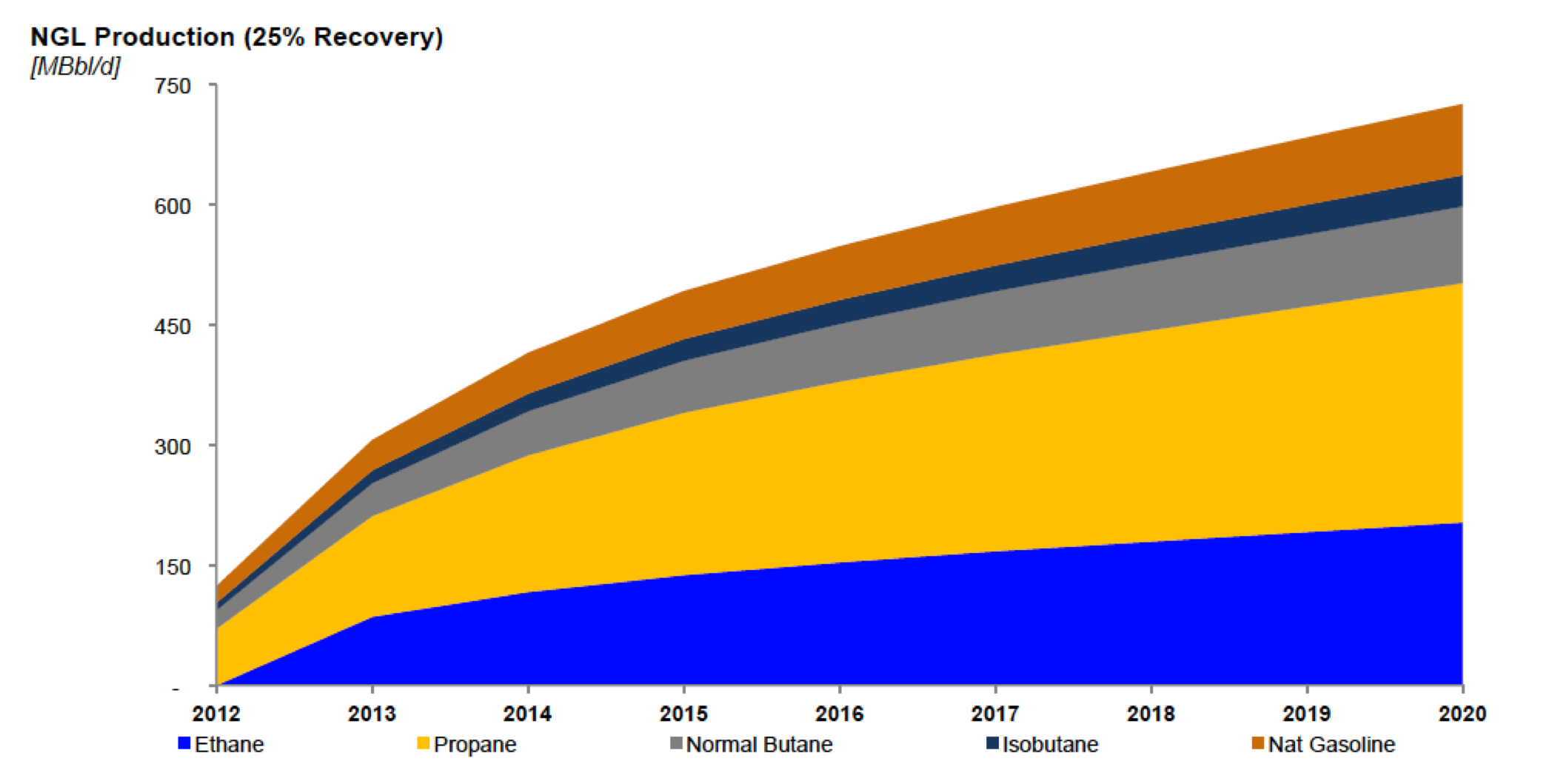
Figure #1
Source: Dominion (assumes 80% ethane rejection) Click to Enlarge
As their name suggests, de-ethanizers separate ethane, or C2, the lightest of the five NGLs, and the volume-dominant NGL in almost all wellhead gas streams. C3+ units, in turn, separate the other four NGLs—propane (C3), normal butane (NC4), isobutane (IC4) and natural gasoline (C5+)—but not ethane. C2+ facilities, finally, remove everything from C2 (ethane) through C5+ and, since they fractionate or separate all NGLs, they are simply called fractionators. If you think the NGL-separation sector in the Utica/Marcellus sounds more complicated than it is in Mont Belvieu, where all of the NGL-separation facilities are C2+ fractionators, you are correct. First of all, pre-shale revolution, the production of natural gas in what is now the Utica/Marcellus was limited to conventional wells. Those wells produced (and still produce) only modest amounts of gas with only modest quantities of NGLs. That meant the facilities to separate NGLs only needed to be modest in size. Furthermore, with no demand for ethane in that part of the country, there was no real need for ethane removal, so the facilities that got built were C3+ units that left whatever ethane (C2) there was in the residue gas stream to be sold as natural gas.

About the song
“My Generation” was written by Pete Townshend and appears as the sixth song on side one of The Who’s debut album of the same name. The song was released as a single in November 1965. It went to #74 on the Billboard Hot 100 Singles chart in the U.S., but soared to #2 on the UK charts, making it the highest-charting single for The Who in Britain, along with “I’m a Boy” in 1966. Personnel on the record were: Roger Daltry (lead vocals), Pete Townshend (guitar, backing vocals), John Entwistle (bass, backing vocals) and Keith Moon (drums).
The album My Generation was recorded at IBC in London from April to November 1965, with Shel Talmy producing. Released in the UK in December 1965, the album was released in the U.S. in April 1966 with a different cover picture and a slightly different track listing under the title The Who Sings My Generation. It failed to chart in the U.S., which is ironic since many critics since its release have rated it as one of the best rock records of all time. It has been re-released in various versions and different formats over the years. Four singles have been released from the LP.
The Who are an English rock band formed in London in 1964 by Roger Daltry, Pete Townshend, John Entwistle and Keith Moon. They developed from an earlier mod R&B group with the same members called The Detours. The Who identified with both the mod and pop art movements in Britain in the 1960s. The group used the on-stage destruction of guitars, amplifiers, and drums as part of their performance art.
Pete Townshend and John Entwistle were among the earliest users of Marshall stack amplifiers, designed by Jim Marshall in his London shop in 1962. The Who have released 12 studio albums, 16 live albums, 27 compilation albums, four soundtrack albums, four EPs and 58 singles. They have sold more than 100 million records worldwide. The band was inducted into the Rock and Roll Hall of Fame in 1990 and the UK Music Hall of Fame in 2005. Daltry and Townshend received Kennedy Center Honors in 2008. Keith Moon died in 1978 and was replaced by Kenney Jones until 1988. (Jones also reunited with the band for a benefit concert in 2014.) John Entwistle died in 2002. Current touring musicians include Zak Starkey (drums), Simon Townshend (guitar, backing vocals), Loren Gold (keyboards, backing vocals), and Jon Button (bass). The Who continue to record and tour. They are currently on a North American tour — “The Who Hits Back!” — with dates booked until November.





Comments
Not to mention PP (propane-propylene) fractionation. Enterprise made some good profits in this. Columns require around 200 theoretical feet to make the split. You can see several twin 100, more or less, feet tall large diameter columns from I-10 at Mont Belvieu for this purpose.
I (mis?) understood from prior RBN blogs that the US has a such a serious potential ethane surplus that ethane that is not demanded for chemicals or exports and which can't be accepted by NG pipelines that ethane is likely to be cheaper than methane for the moderate future.