


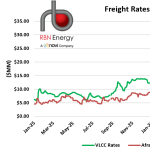
The cost to charter a Very Large Crude Carrier (VLCC) has quickly emerged as a growing headwind for U.S. Gulf Coast crude exports to Asia. Voyage costs for VLCCs to Asia surged 38% last week to $25.61 million per voyage (far right of green line in chart below), the highest since early March, when rates skyrocketed to above $29 million at the onset of the War in Iran.
This recent move marks a sharp escalation in the cost of placing U.S. barrels into Asian markets and stands in stark contrast to USGC-to-Europe Aframax rates (red line in chart below), which fell 14% over the same period. As discussed in our Crude Voyager, this divergence has shifted relative freight economics increasingly in favor of shorter-haul Atlantic Basin movements, while raising the hurdle for U.S. crude to clear into Asia.
The freight spike is particularly noteworthy given the simultaneous buildup in VLCC activity around the Gulf. Nine VLCCs entered the region last week, the highest count in six weeks, while five departed, leaving a sizable pipeline of vessels positioned for upcoming export programs. That creates an interesting tension in the market: vessel activity points toward stronger long-haul exports, but the cost of moving those barrels east has risen substantially. If VLCC rates remain elevated, Gulf Coast crude differentials or the Brent-WTI spread may need to weaken or widen, respectively, to restore Asian export economics.
