


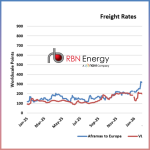
The tanker bill keeps climbing for U.S. crude headed to Asia. As discussed in this week’s Tradeview and Crude Voyager reports, the cost of chartering a Very Large Crude Carrier (VLCC) from the U.S. Gulf Coast (USGC) to Asia skyrocketed 42% last week to more than $52 million per voyage (far right of red line in chart below), breaking a record high of $44 million per voyage which was set just one week earlier. Rates to Europe offered little relief: Aframax costs eased 10% from the previous week’s record but remained near WS450 (far right of blue line), double the Worldscale numbers seen at the start of the month.
Renewed Chinese buying and Europe’s need for replacement barrels are competing for tanker capacity as disrupted flows through the Strait of Hormuz keep vessels occupied longer. At current quoted rates, moving Gulf Coast crude to Asia by VLCC costs more per barrel than shipping it to Europe by Aframax, despite the VLCC’s much larger cargo capacity. This is an unusual reversal of their traditional economies of scale, where the larger vessel classes are often more cost-efficient on a per barrel basis, as Asian buyers bid aggressively for tonnage amid disrupted flows through the Strait of Hormuz.
That changes what a wider Brent–WTI spread is worth to an exporter. Freight absorbs more of the potential gain before a barrel reaches its buyer, while elevated premiums for domestic grades raise the cost of securing the cargo in the first place. Even with strong overseas demand, those costs can narrow or close the export arbitrage, especially on voyages to Asia.
