


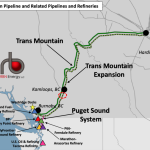
On September 25, the Commission of the Canada Energy Regulator (CER) approved a request for route deviation for the Trans Mountain Pipeline expansion (TMX, green dashed line in map below). The request had been made by the pipeline’s owner, Trans Mountain Corporation (TMC), wholly owned by the Canadian federal government, in order to allow it to complete pipeline construction through a short 1.3 kilometer (~1.1 mile) section of the pipeline’s pre-approved route (red dashed oval). The deviation was requested owing to severe technical challenges with completing construction in the 1.3 km section and will allow for a more conventional mix of tunnelling and trenching to reach completion in this section. Importantly, the approval for deviation and pending completion of all other construction work along the pipeline’s route, should allow TMC to meet a currently planned start-up date for TMX in late Q1 or early Q2 2024. Had the request for deviation not been granted, TMC had indicated that the technical challenges associated with the original route would have created additional cost and further delay to the pipeline’s completion, possibly to as late as the end of 2024.
Featured Articles


You've Got Another Thing Comin' - How Will Steeper Tolls on Trans Mountain Impact Crude Flows?
Western Canada’s Trans Mountain Expansion Project, better-known as TMX, has experienced more than its share of setbacks over the past 10 years: environmental protests, legal challenges, financing issues, an ownership change, and even a serious flooding event in 2021. But it seems the 590-Mb/d expansion of the now-300-Mb/d Trans Mountain Pipeline (TMP) system will finally become a reality by early 2024, enabling large-scale exports of Alberta-sourced crude oil to Asian markets. There’s a catch, though. The project’s long delays and other issues resulted in massive cost overruns that are now being reflected in the preliminary tolls for the soon-to-be-combined Trans Mountain system. The proposed toll increase is so large that it will cost a similar amount to ship heavy crude oil to tidewater on Trans Mountain as it would on the competing Enbridge system to the U.S. Gulf Coast for “re-export,” despite the latter being three times the distance. In today’s blog, we discuss the history of the Trans Mountain expansion, its cost overruns and the calculations that went into the proposed tolls — the kicker being that those tolls could end up being even higher.


You've Got Another Thing Comin', Part 2 - Trans Mountain Expansion Faces More Logistical Challenges
The 590-Mb/d Trans Mountain Expansion (TMX) project, which is inching closer to its planned early 2024 completion, has been one of the most eagerly anticipated energy infrastructure projects in recent Canadian memory. Preliminary tolls for shipping crude on the expanded pipeline system, submitted to the Canada Energy Regulator (CER) in June, are multiples higher than the tolls currently charged on the original 300-Mb/d Trans Mountain Pipeline (TMP), possibly undermining oil producers’ economics for shipping and exporting crude on the combined 890-Mb/d system. However, the higher tolls are not the only concern. Serious logistical challenges remain in the form of restricted tanker sizes, a circuitous route for ships traveling from the open ocean to the Westridge export terminal near Burnaby, BC, and even a very tight passage under two bridges, all of which will add costs and time for each exported barrel. In today’s RBN blog, we provide more details on the complexities surrounding crude oil exports via the Trans Mountain pipeline system.
