The rapid changes in the North American energy market mean it’s more important than ever to talk about how the ongoing relationship between the U.S. and Canada will evolve and strengthen in the coming years, said David Braziel, president and CEO of RBN Energy, on Tuesday.
“We’re two countries, but we’re one market,” Braziel said at the School of Energy Conference in Calgary. “And that market is undergoing major shifts and challenges, driven not only by changing supply/demand dynamics and evolving infrastructure within the market itself, but also by powerful external forces, including regulatory policies and political pressures.”
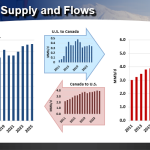
Starting with crude oil, the U.S. and Canada have each seen production increase sharply over the past 15 years. U.S. production has grown from less than 6 MMb/d in 2011 to more than 13 MMb/d this year (see blue bars in the chart below), while Canadian production has risen from about 3 MMb/d to about 5.5 MMb/d today (see red bars on the far right in the chart below).
Despite the rise in production, cross-border flows between the two haven’t changed all that much in recent years, although volumes are up significantly from 2011. Most of the crude the U.S. sends to Canada comes via waterborne tanker from the U.S. Gulf Coast up to terminals in Montreal or New Brunswick. On the other hand, most of the growth in Canada has been heavy-sour crude that has been well-suited for complex refineries in the U.S. Midwest and Gulf Coast. For that reason, crude flows from Canada to the U.S. have doubled, from 2.1 MMb/d to 4.2 MMb/d.