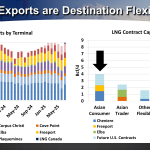
LNG Canada and other export projects in development in Canada target Asia, while projects in the U.S. feature destination flexibility, Lindsay Schneider, Principal Analyst and Consultant at RBN, said during a presentation on the closing day of RBN’s School of Energy Canada, being held in Calgary.
Natural gas intake at the LNG Canada liquefaction site in Kitimat, BC, has been ramping up in the past couple of months as it shifts into the mode of more regular production of LNG for export, according to RBN’s Canadian NatGas Billboard. Gas intake increased to an average of 218 MMcf/d in June in preparation for the first LNG export cargo on June 30. However, LNG Canada has not exported any cargoes since August 10. Several industry sources have reported that Train 1 is experiencing some technical issues, which have led to a slower-than-expected ramp-up as well as flaring at the terminal.
The volumes from LNG Canada and the other sites under development in Western Canada – Cedar Lake and Woodfibre – will head almost exclusively to Asia. That’s because shipping LNG to Asia is much quicker, and less expensive, than shipping from the U.S. Gulf Coast. It takes about 11 days to deliver LNG from Western Canada to Asia, at a cost of less than $1/MMBtu. Travel times and costs from the Gulf Coast are much longer and vary by route. Tankers that pass through the Panama Canal can take 24 days to reach Asia at about $2/MMBtu. It’s about 35 days and $2.80/MMBtu via the Suez Canal and 40 days and $3/MMBtu when going around Africa’s Cape of Good Hope.