



Energy Transfer generated $5.03 billion in adjusted EBITDA in Q3 2026, up 31% year on year but roughly flat with Q2 2026. Sunoco accounted for $560 million, or 47%, of the consolidated EBITDA increase due mostly to the Parkland acquisition, which closed in October 2025. Note, this acquisition also included the 55-Mb/d Burnaby refinery, which benefited from exceptionally strong refining margins in the quarter.
Processed Permian gas volumes increased around 400 MMcf/d, or 8%, year on year, due to better utilization at existing processing plants and the startup of the 275-MMcf/d Mustang Draw I plant in June 2026. The 275-MMcf/d Mustang Draw II plant began operations in October (so it did not contribute to Q3 volumes), and the $2.625 billion Vaquero acquisition, expected to close in Q4 2026, will add another 675 MMcf/d to Energy Transfer’s Permian gas processing capacity along with ~300 miles of intrabasin pipelines later this year. Energy Transfer also announced approval of the new 200-MMcf/d Bear II processing plant in the Permian Basin with an estimated startup in Q3 2027.
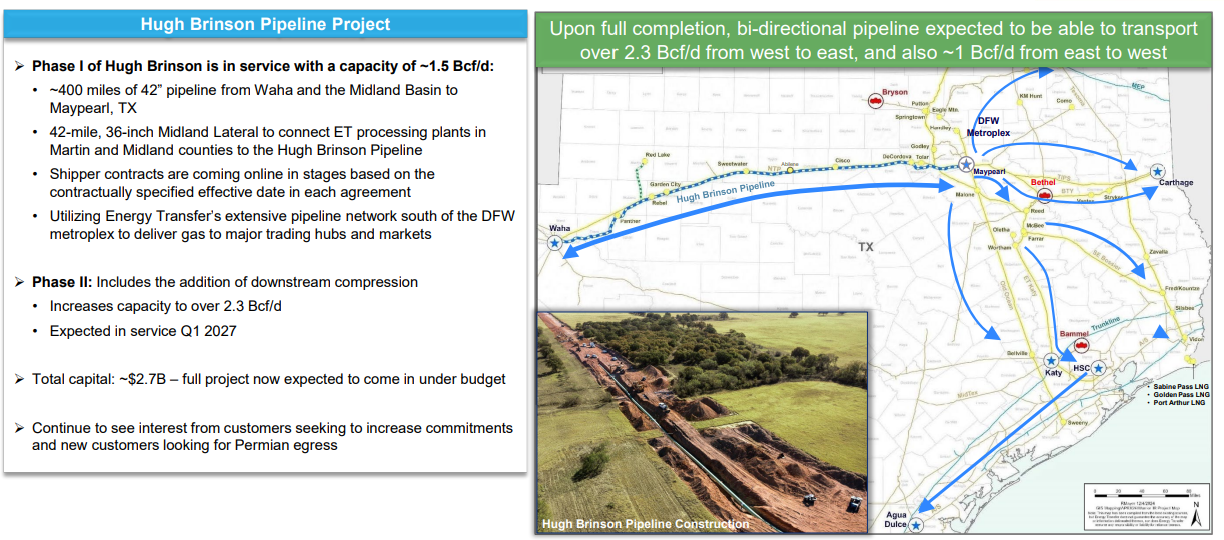
On the gas transmission side, Hugh Brinson (see slide below) reached its full Phase I capacity of 1.5 Bcf/d on September 1. Phase II is expected to add another 800+ MMcf/d in Q1 2027. Energy Transfer also announced a final investment decision on the $1.6 billion, 1.2-Bcf/d South Mississippi pipeline, which is expected to start up in 2030 and will connect the Perryville supply area with Florida Gas Transmission. The company continues to expect the 2.3-Bcf/d Desert Southwest expansion on Transwestern to enter service in Q4 2029.
In Mont Belvieu, the 165-Mb/d Frac IX will enter service in Q4 2026, and management announced the construction of the 200-Mb/d Frac X, which is expected to enter service in the first half of 2029. The company also upsized its expectation for its ethane export expansion at Nederland from 240 Mb/d to 300 Mb/d, with startup to be phased from 2028 through mid-2029. The project will also include 55 Mb/d of additional LPG export capacity.
EBITDA from the crude oil segment increased $125 million year on year, but more than 100% of this gain was composed of a $193 million increase in marketing margins. Refined products throughput fell 10% year on year, but management attributed this to third-party refinery issues during the quarter, so this should not be interpreted as broader demand indicator.
