Improved operational performance helped BP capitalize on favorable markets for refined fuels in Q3 2026, lifting underlying replacement cost profit, its version of net income, 48% from the previous quarter to a record $8.5 billion, the company said in its earnings presentation October 30.
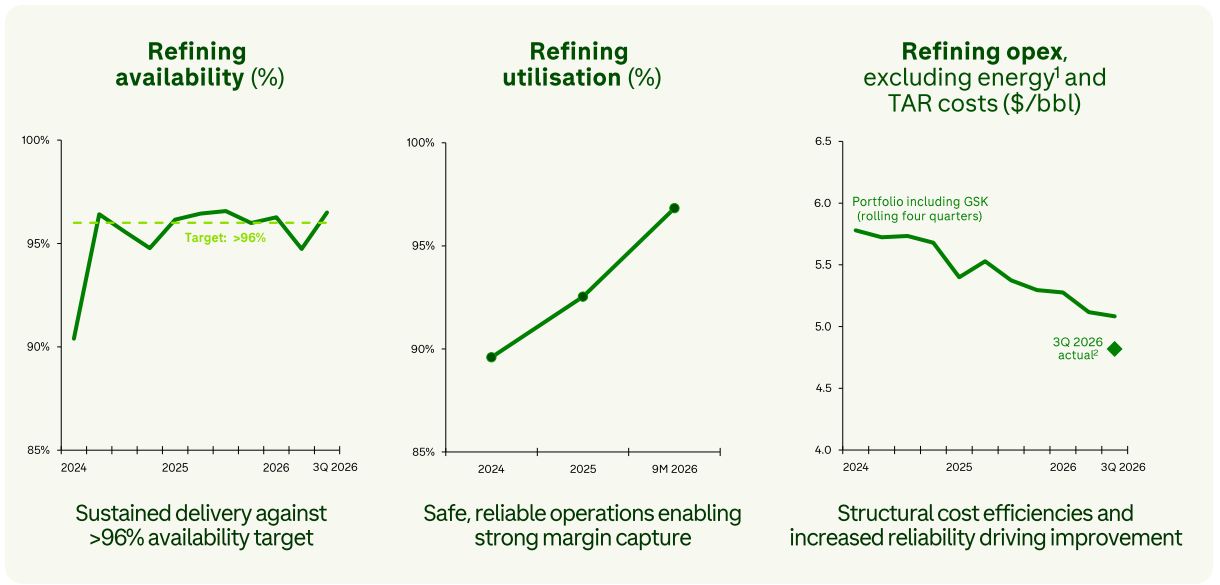
Refining was a major earnings driver. Refining availability (left side of chart below) improved to 96.5%, exceeding BP’s 96% target, while refinery utilization (middle section of chart) averaged 98% over the first nine months of the year. Operating efficiencies, higher reliability and reduced maintenance activity lowered refining costs per barrel (right side of chart). Throughput declined to about 1.4 MMb/d following the sale of the Gelsenkirchen refinery in Germany. Better reliability, optimized product output and stronger market margins supported almost $2 billion in additional refining margin capture.
Source: BP
Upstream production averaged 2.22 MMboe/d, essentially unchanged from Q2 2026. Plant reliability increased to 95.3% from 92.4%, primarily as operations recovered from outages in the North Sea and Indonesia.
CEO Meg O’Neill said BP has taken steps to simplify its portfolio over the last six to nine months, exiting assets that were not the right strategic or financial fit. During Q3, BP launched the sale processes for its U.K. North Sea oil and gas business and its Archaea Energy renewable natural gas subsidiary, agreed to sell its mobility and convenience business in Austria, and completed the sale of the Gelsenkirchen refinery. She said completion of its Castrol sale is expected imminently.
“We continue to see real depth of opportunity in our portfolio, but we need to earn the right to grow. The decisions on what we invest in — and what we do not — are fundamental to improving the portfolio over time,” O’Neill said.
BP also said it would accelerate its Deepwater Horizon settlement payments to Louisiana and plans to prioritize excess cash flow toward settling remaining liabilities.