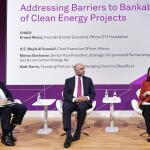
Concerns around the bankability of clean-energy projects, driven by perceived risks and regulatory uncertainty, emerged as a major theme during the annual CERAWeek conference in Houston.
Former Energy Secretary Ernest Moniz, who moderated a panel discussion on the topic on Tuesday (photo below), said there was no shortage of capital available to finance clean-energy projects. But he said there was a lot of uncertainty in the market and that communication was key, starting with making sure that stakeholders know what is needed for a project to advance.
“Different communities that really need to work together just don’t really understand enough about how all the various pieces … for a successful scaling of clean-energy investments come about,” Moniz said.
Marisa Buchanan, BP’s Senior Vice President of Strategic Corporates and Partnerships, said during the same panel discussion that projects faced a number of “critical-path barriers” to increased bankability, including unproven and evolving technology, a lack of available offtakers, overall costs and policy uncertainty.
“What are the things that ultimately can make the difference between driving a project forward, enabling capital to flow, or an investor saying, ‘This looks great on paper but I’m not willing to take that risk or the return isn’t worth it to me.’”
In a separate panel on the topic Monday, Billy Pizer, President and CEO of Resources for the Future, said policy uncertainty had the potential to be especially problematic.
“The more the policies flip-flop back and forth, the more the policies themselves become an obstacle,” he said.
Air Products cited regulatory uncertainty when it canceled three projects, including a green hydrogen facility planned for New York, in February.