


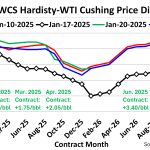
The forward price discount for Canadian heavy crude oil has been whipsawed in recent days as the threat of a 25% tariff on all exports from Canada by the newly minted Trump administration has waxed and waned. The price discount for Western Canadian Select (WCS) that is traded at the Hardisty, AB hub versus the price of the NYMEX-CME WTI contract at Cushing, OK is the most typically cited measure of the relative value of Canadian heavy crude oil that is exported by pipeline into the U.S. Midwest (and the Gulf Coast). As recently as January 10 (red line in chart below), the forward price discount for WCS was ($12)/bbl to ($16)/bbl for contract delivery months covering February to October 2025, a price range considered narrow by historical standards for this time of year.
Featured Articles
Market Uncertainty Forces Canadian Heavy Crude Oil to Tighter Price Discounts


Synchronicity - Canadian Heavy Oil Prices Increasingly Align With Other North American Trading Hubs
In the past, Canadian heavy oil was all too often the sick man of the North American oil market. Plagued by a limited number of refinery outlets and numerous episodes of insufficient pipeline export capacity from Western Canada, it was often subject to far larger price discounts versus the light crude oil price benchmark of West Texas Intermediate (WTI) than was justified by quality and pipeline transportation costs alone. In the past few years, however, improved pipeline export capacity to and through the U.S. has expanded the number of refineries Canadian heavy oil can reach, and the expansion of crude oil export terminals along the Gulf Coast has resulted in greatly improved exposure for Canadian barrels to buyers in international markets. The end result has been a closer alignment of Canadian heavy oil pricing in its home base of Alberta with those in the Midwest and Gulf Coast.


Everybody Hurts - Trump's Tariffs Would Hurt Canadian Oil Producers More Than U.S. Refiners
Tariffs have served as a cornerstone of President Trump’s economic vision. In the campaign, he said he could impose tariffs as high as 25% on all imported goods from Canada — including crude oil — and he could deliver on that promise at any time. This has raised concerns, especially for Canadian producers and U.S. refiners, who depend on the efficient and economical movement of barrels between the trading partners. In today’s RBN blog, we look at how much Canadian crude oil flows to the U.S., how those imports could be affected by tariffs, and how Canadian producers and U.S. refiners would share the financial impact.
