


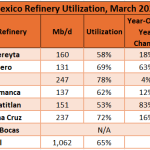
Mexico’s state-run refining company achieved its highest throughput in nearly eight years in March, driven by outgoing President Andres Manuel Lopez Obrador’s (also known by his initials AMLO) efforts to reduce the country’s reliance on costly fuel imports. According to Bloomberg, the company’s six refineries (not including Dos Bocas) operated at 65% of their 1.6 MMb/d capacity in March (see chart below), marking the fourth consecutive month of throughput rates exceeding 50%.
Featured Articles


- Blog
When Worlds Collide - U.S. Gulf Coast Refiners Face Challenges to Accessing Heavier Crude Oil
The prospect of decreased crude oil supplies from Mexico, the top international supplier to the U.S. Gulf Coast (USGC), is creating uncertainty among heavy crude-focused refineries. Mexico’s state-owned energy company, Petróleos Mexicanos (Pemex), instructed its trading unit to cancel up to 436 Mb/d of crude exports for April to supposedly focus on processing domestic oil at its new 340-Mb/d Dos Bocas refinery and/or its existing plants. While the refinery’s startup is likely not nearly as imminent as Pemex says, the cancellation of Mexican crude imports could be problematic for U.S. refiners with plants built to run heavy crude, a necessary ingredient to optimize operations and yields. Adding to the complexity of the situation is the upcoming startup of the Trans Mountain Pipeline expansion (TMX) and the recent reinstatement of U.S. sanctions on Venezuelan crude. In today’s RBN blog, we’ll examine the potential fallout resulting from Pemex’s decision at a time when heavy crudes elsewhere are also becoming less available.


- Blog
Runnin' Down a Dream, Part 3 - Mexico's Plan to Revive their Crude Oil Refining Sector
While U.S. refineries are again running hot and heavy after the end of this year’s seasonal fall maintenance period, Mexico’s refineries have continued to struggle to operate at more than 30% of their capacity, a decline that is exacerbated by that country’s tumbling oil production. In recent years, Mexico’s dismal refinery utilization rate has been a boon for U.S. refiners on the Gulf Coast who can ship, pipe or truck gasoline to America’s southern neighbor in short order. Now, Mexico’s new president, Andrés Manuel López Obrador (AMLO), is pushing to solve Mexico’s refinery problems by building a new one. Today, we discuss Mexico’s growing dependence on U.S. gasoline, and whether building a new refinery south of the border will change things.


- Blog
Look What You Made Me Do - Cut in Mexican Crude Exports Has U.S. Refiners Looking for Alternatives
Mexico’s efforts to start up the newest addition to its refining system — the Olmeca refinery — are causing headaches for global buyers of its crudes. Few are convinced that the plant near the country’s key Dos Bocas oil port is ready for service. Yet its operator, Petróleos Mexicanos (Pemex), surprised many with cuts to its crude exports in April, which were reportedly made to ensure the complex will have enough feedstock and could continue through 2024. In today’s RBN blog, we will discuss what led to the export cuts, the implications for importers, and potential replacement options.
