On September 29, 2026, the five joint venture (JV) partners in LNG Canada announced that they had reached a decision to proceed with the expansion of the LNG Canada site that will result in a doubling of its LNG liquefaction capacity from 14 million tonnes per annum (MMtpa, ~1.8 Bcf/d) to 28 MMtpa (~3.6 Bcf/d). No timeline to completion of the expansion or costs were announced, but industry speculation is that the expansion will be completed in the second half of 2031 or the first half of 2032. Press reports have suggested the expansion's total cost as approaching C$33 billion (US$23 billion). Based on equity ownership, the JV partners in LNG Canada are: Shell (40%), Petronas (25%, with 5% of the 25% implicitly held by Saudi-backed MidOcean), PetroChina (15%), Mitsubishi (15%) and KOGAS (5%).
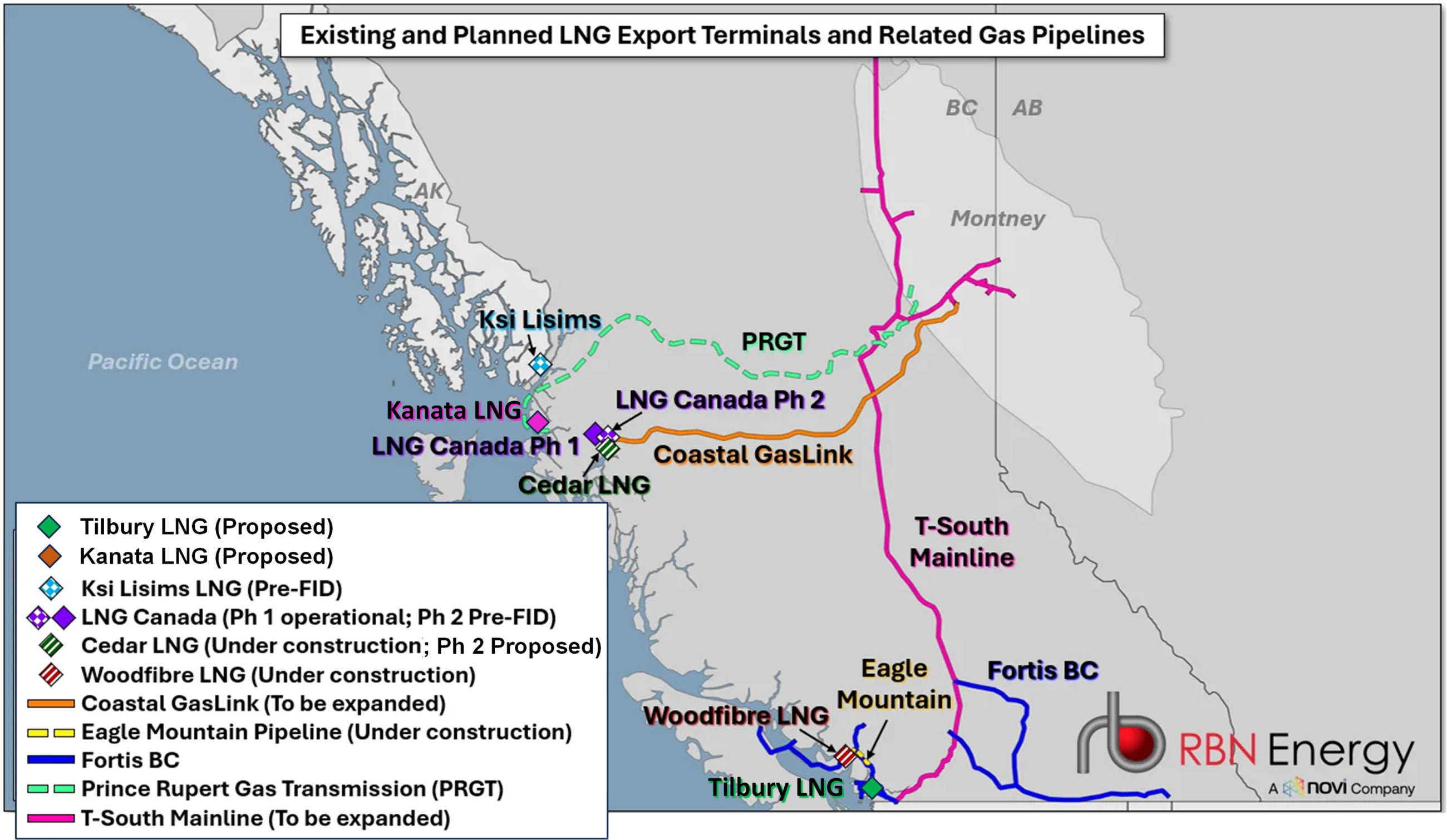
LNG Canada is located near the town of Kitimat, BC on Canada’s West Coast (purple diamond in map above) and is currently the only operating LNG liquefaction export site in Canada, although several others are under construction or are well advanced in the planning process. LNG Canada’s expansion work will include: the construction of two additional LNG trains on the site’s existing footprint which was already sized for potential future expansion; the construction of an additional LNG storage tank, condensate tank, loading berth and additional systems. The JV partners also confirmed that the positive sanctioning will trigger the implementation of an equity agreement originally announced on July 14 with five neighboring First Nations that will result in the investment of up to C$1 billion (US$705 million) in a special purpose equity firm, MNT Investments LP, that will purchase the second LNG storage tank and lease it back to the JV partners for the life of the project. This transaction was described as one of the largest Indigenous ownership positions in major Canadian infrastructure.
Related to the expansion work, the Coastal GasLink (CGL) Pipeline, which feeds gas to the Kitimat site from producing areas in northeast BC (orange line in map above), will double its throughput capacity from the current 2.5 Bcf/d to 5.0 Bcf/d with the addition of five new compressor stations. CGL will, in the future, also be sending additional gas supplies to the under-construction Cedar LNG project (green striped diamond) which is currently scheduled for completion in 2028 and located a short distance from LNG Canada.
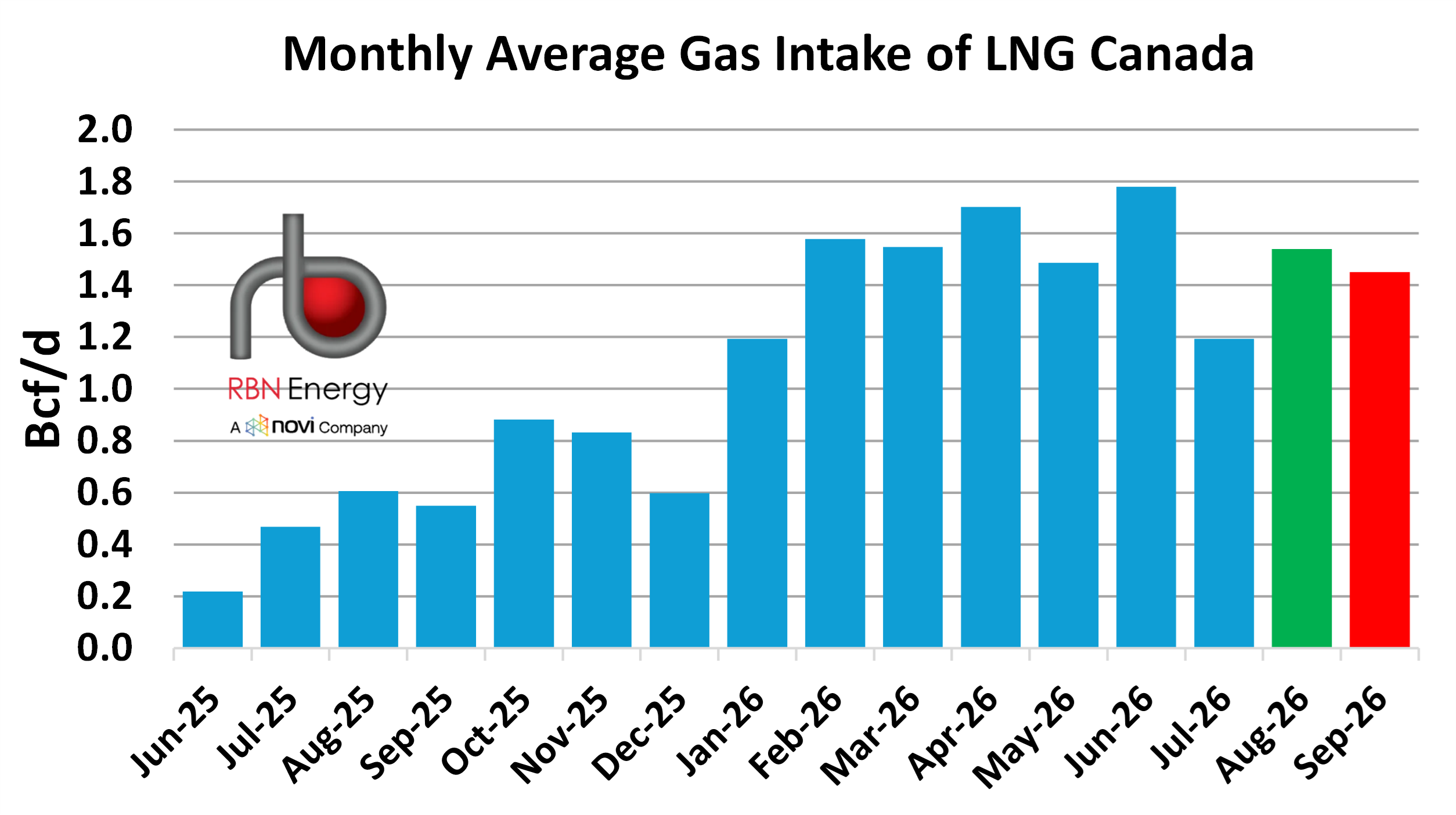
In terms of more recent activity at LNG Canada, the site’s gas intake for August was reported as 1.54 Bcf/d (green bar in chart above). Given that export activity from the site in September has been close to matching the rate of August after allowing for what appeared to be a brief shutdown earlier this month, gas intake in September is currently estimated to be 1.45 Bcf/d (red bar). LNG Canada began commercial operations in June 2025 and to date has shipped nearly 140 cargoes of LNG to Asian destinations.