


As we explained in our blog, Now Here You Go Again, the rate that pipelines charge shippers is, more often than not these days, based on a rate index published every five years by the FERC (shown by the orange line and bottom row in table in Figure 1 below). The rate has two parts: a measure of inflation (navy bar segments) and an adjustment factor (green bar segments).
Inflation is measured by the Producer Price Index for Finished Goods (PPI-FG), while the “adjustment factor” or ”adder” (which can be positive or negative) is calculated by FERC every five years.
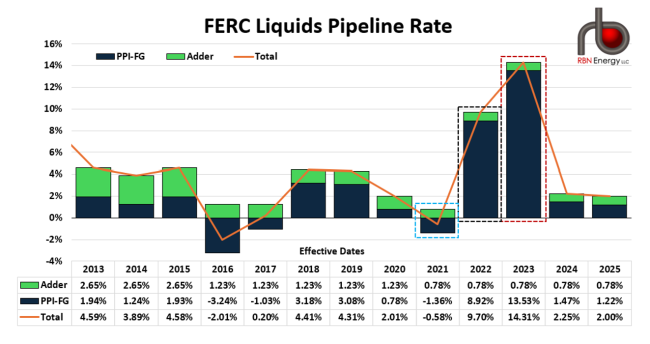
As we blogged recently in Drifting, the index has become a point of major contention between pipelines and shippers. The December 2020 order established an adjustment factor of +0.78% (green bar segments shown from 2021 to 2025) for the five-year period beginning July 1, 2021, lower than the +1.23% seen for the previous five-year period. In 2022, however, FERC issued a midcycle order that reversed the outcome of its 2020 order and lowered the “adjustment factor” portion of the index level — from +0.78% to -0.21%. While that was good news for shippers, who would see reduced transportation costs, it wasn’t welcome news for the pipelines.
In 2024, a D.C. Circuit vacated the 2022 order and allowed pipelines to again charge the +0.78% adder from the original 2020 order. The big question was what to do about the 2½ years when the maximum indexed rates were slashed — should pipelines be able to recoup their foregone earnings?
Well, we got an answer from FERC on Thursday, November 20: The D.C. Circuit’s vacatur of the 2022 Rehearing Order has full retroactive effect and the +0.78% adder will apply to the full 5-year period from 2021 – 2026.
That means that pipelines can go back and charge shippers for the difference between what they paid and the higher rate that includes the +0.78% adder.
Further, the methodological debate [including whether or not the middle 50% or 80% of pipeline rates should be considered] that underlied the back and forth over rates were locked down for the next index - FERC will consider the middle 80% of pipelines in determining the composite central tendency. 80% was the standard used in calculating the +0.78% adder, previously.


