
The liquids pipeline rate index, which the Federal Energy Regulatory Commission (FERC) uses to adjust the rates charged to shippers on the crude oil, refined products and NGL pipelines it regulates, is the most important rulemaking proceeding for interstate oil pipelines, yet few outside the industry understand its true importance or the mechanics of how it’s determined. In today’s RBN blog, we take a deeper dive into the rate index, the disruptions caused by recent attempts to adjust it mid-cycle, and how delays in the five-year review process could cause problems down the road.
In the first blog in this mini-series, Drifting, we discussed the history of the rate index, including recent litigation. For decades, the rates for transporting liquid fuels — oil, petroleum products and NGLs — on interstate pipelines were regulated by the Interstate Commerce Commission. That changed in 1977, when regulatory oversight for liquid fuels pipelines was transferred to FERC. Then, with the Energy Policy Act of 1992, FERC was directed to develop a simpler, more streamlined approach to rate regulation. FERC complied with the law by issuing Order No. 561, which established the indexed approach, changing maximum allowable (“capped”) rates annually through a uniform index, rather than by conducting extensive rate cases. These days, the vast majority of all liquids-pipeline rates are capped based on the rate index, meaning that in markets where competition doesn’t push the rates lower than the cap, the indexed rate is what’s charged.
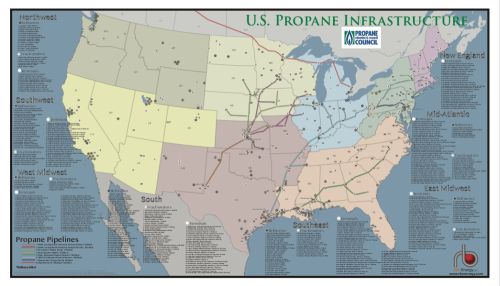
The RBN Energy U.S. Propane Infrastructure map provides a comprehensive view of the propane supply network in the lower 48 states.
Let’s start today’s blog with a look at how different types of pipelines are regulated. As we described in our Different Strokes for Different Folks series, common carriage — the obligation to provide service to all shippers upon reasonable request — marks the key difference between interstate oil and other petroleum liquids pipelines, which are regulated under the Interstate Commerce Act (ICA), and their interstate natural gas pipeline counterparts subject to the Natural Gas Act (NGA). FERC interprets the NGA as necessitating the provision of “contract carriage,” firm service under signed contracts, at FERC-determined rates, with no obligation to provide service to parties not holding firm contracts unless excess capacity is available. Conversely, for regulated oil pipelines, firm service is the exception, not the rule. As a result, generally applicable tariff rates, as opposed to contract rates, drive oil pipeline revenues. FERC plays a pivotal role as the chief rate regulator.
Calculating the Rate Index
FERC adjusts the rate index each year with inflation, but once every five years determines how those annual adjustments will work. The ubiquity of the rate index (about 80% of the oil pipeline industry relies on it, as opposed to cost-of-service or market-based rates) makes FERC’s five-year cycle of rulemaking proceedings to reset the rate index the oil pipeline industry’s most important regulatory process. This year, for the first time, the process for setting the rate index is also one of the most uncertain. The current five-year cycle for the rate index ends on June 30, 2026, and new index rates are set to take effect on July 1, 2026. FERC typically initiates a rulemaking for the new rate index about a year in advance, meaning that the process should have commenced in June 2025. The process has yet to start. (More on that below.)
In its simplest form, the rate index essentially tracks inflation. Which measure of inflation? FERC settled on the Producer Price Index for Finished Goods (PPI-FG) as a proxy for inflation and industry cost changes (blue bar segments and middle row in chart in Figure 1 below). Rates in effect as of 1992 generally were deemed to be just and reasonable and grandfathered in, with future rate changes to be made using the rate index, although there are exceptions. A pipeline and its shippers can reach a settlement to set new rates, the pipeline can file a traditional rate case to try to justify new rates based on its cost of service, or the pipeline can try to prove it has no market power and should be able to charge market-based rates. These approaches often require a lengthy hearing process and plenty of legal wrangling, losing the efficiency of the rate index.

About the song
“You Oughta Know” was written by Alanis Morissette and Glen Ballard. It appears as the second song on Morissette’s third studio album, Jagged Little Pill. Released as a single in July 1995, it went to #6 on the Billboard Hot 100 Singles chart. The song won Grammy Awards for “Best Rock Song” and “Best Female Rock Vocal Performance” in 1996. It has been covered by artists such as Beyonce, Weird Al Yankovic, 1000 Mona Lisas and Britney Spears. The video for the song received widespread rotation on MTV at the time. A note of trivia on the video is the drummer featured in the band playing in the Mojave Desert scenes is Taylor Hawkins. Hawkins would later go on to fame as the drummer of the Foo Fighters and pass away while on tour with the group in March 2022 at 50. Personnel on the record were: Alanis Morissette (vocals), Glen Ballard (programming), Dave Navarro (Jane's Addiction, guitar), Flea (Red Hot Chili Peppers, bass), Benmont Tench (Tom Petty and the Heartbreakers, organ) and Matt Laug (AC/DC, drums).
Jagged Little Pill was recorded between March 1994 and April 1995 at Westlake Recording Studios and Signet Sound in Los Angeles. Glen Ballard produced the record and also co-wrote all the songs on the album with Morissette. Released in June 1995, the album went to #1 on the Billboard Top 200 Albums chart. It has been certified 16X Platinum by the Recording Industry Association of America. Six singles were released from the LP. Jagged Little Pill was made into a Broadway musical in 2019; the show earned 15 Tony Award nominations.
Alanis Morissette is a Canadian-American singer, songwriter, record producer and actress. She has released 10 studio albums, three live albums, six compilation albums, two EPs and 46 singles. She has sold more than 60 million records worldwide. She has appeared in 17 motion pictures, 20 television shows and four theatrical productions, and is currently featured in commercials for US Cellular. Morissette has won one ASCAP Award, two American Music Awards, one Brit Award, two Billboard Music Awards, seven Grammy Awards and three MTV Video Music Awards. She released her latest single, a duet with Carly Simon entitled “Coming Around Again,” in August. She is appearing at the Colosseum at Caesar’s Palace in Las Vegas until November.
"About the Song" -- written by Mickey McMahan , RBN Director of Musicology