


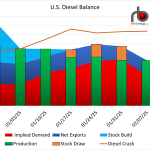
Gasoline demand surged 250 Mb/d to 8.58 MMb/d last week, the highest level this year, leading to a 3 MMbbl inventory draw, while diesel implied demand plummeted, prompting the first inventory build in weeks. Despite weaker crude prices, crack spreads surged as gasoline prices jumped $5.07/bbl while diesel fell $3.17/bbl, driving refining margins higher. The gasoline crack soared 32% to $14.95/gal, and the 3-2-1 crack spread climbed 15.6% to $18.34/gal, signaling improved refining economics, particularly for gasoline-focused operations.
Featured Articles


- Blog
Cracking Up - What's Driving U.S. Refiners' Sky-High Crack Spreads?
Over the past few weeks, many U.S. refiners reported even-stronger-than-expected first-quarter results, and it’s likely their good fortune will continue. Why? Despite the skyrocketing price of crude oil — refiners’ primary feedstock — the prices of the gasoline and diesel they produce have risen even more. And it’s that now-yawning gap between crude oil and refined-products prices that’s been driving refining margins — and refiners’ profits — to near-historic levels. Refining margins, like the character and capabilities of thoroughbreds like “Rich Strike” in Saturday’s amazing Kentucky Derby, are unique to each refinery because of their different sizes, equipment and crude slates (among other things), but there’s a tried-and-true way to estimate the refining sector’s general profitability, as we discuss in today’s blog on U.S. refiners’ sky-high crack spreads.


- Blog
Behind The Margins – Will Lower Gasoline Prices Threaten the Gulf Coast Refining Party?
Recent third quarter earnings reports from US refiners have reflected lower refining margins squeezed by higher feedstock prices for inland crudes like West Texas Intermediate (WTI) rising to the same level as coastal crudes like Light Louisiana Sweet (LLS) while product prices stood still. In the past two weeks domestic crude prices have fallen below $100/Bbl in the face of a Gulf Coast supply glut. But despite lower crude costs, refinery margins have continued to weaken. The primary culprit has been sharply falling gasoline prices. Today we review what Gulf Coast refiners could do to improve margins.


- Blog
Run Run Run - U.S. Refiners Processed Record Crude Oil Volumes in 2018
Record runs allowed U.S. refiners to continue a multiyear streak of strong margins in 2018 despite higher crude prices during the first three quarters and a weaker fourth quarter after product prices tanked along with crude in October. While rising crude prices threatened refinery margins, a high Brent premium over domestic benchmark West Texas Intermediate (WTI) kept feedstock prices for U.S. refiners lower than their international rivals. The availability of discounted Canadian crude also helped produce stellar returns for Midwest, Rockies and Gulf Coast refiners that are configured to process heavy crude. Product prices only weakened in the fourth quarter when gasoline inventories began to rise. Today, we highlight major trends in the U.S. refining sector during 2018 and look forward to 2019.
