


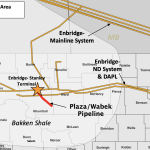
A Native American tribe in North Dakota has entered an agreement to buy an idle pipeline from Enbridge to help deliver oil from wells on its reservation to the broader market for $5 million. The Mandan, Hidatsa and Arikara Nation (MHA Nation) announced the deal Friday (6/9) and the tribe said it expects the pipeline, which will connect its oil facilities on its Fort Berthold Reservation to Enbridge's Stanley, ND terminal and large pipeline network, will be up and running within a year.
Featured Articles


- Blog
If You’ve Got the Money We’ve Got the Crude – The North Dakota Refinery Rush Revisited
There hasn’t been a major new refinery built in the lower 48 since 1976. Now, no less than 5 projects to build new oil refineries are on the drawing boards in North Dakota. These projects are really “micro” refineries since they all have 20 Mb/d capacity compared to the 128 Mb/d national average of operating US refineries (source: Energy Information Administration - EIA). The projects all aim to take advantage of a shortage of refined products in North Dakota – especially diesel – as well as abundant supplies of crude from the Bakken shale. Today we review their progress.

- Blog
If You’ve Got the Money We’ve Got the Crude – New Refineries in North Dakota
There is plenty of crude oil in North Dakota but the State does not refine enough of it to meet rising demand for diesel caused by booming energy industry activity. The latest North Dakota Pipeline Authority data shows oil production in February 2013 up 40 percent since February 2012 to 778 Mb/d. Demand for diesel increased 35 percent between February 2010 and February 2013. North Dakota’s only refinery produces less than half the diesel the State consumes. To help remedy that disparity the first new refinery to be built in the Lower 48 since 1977 is under construction today and two more new refineries are planned. Today we look at the refinery economics.


- Blog
Let Your Crude Flow - Planned Feeder Pipelines to Dakota Access
The Army Corps of Engineers is said to be considering alternative routes for the most controversial segment of the Dakota Access Pipeline, which could help break the impasse that has stalled construction on that part of DAPL. If the 450-Mb/d crude oil delivery project gets back on track soon––something that no one knows for sure––an important two-part question remains: Where will the crude to fill the 450-Mb/d pipeline come from, and where will it be fed into DAPL? Today we look at the supply sources that will help fill one of the most important oil pipelines now under development.
