


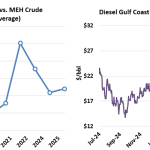
The price spread of U.S. Gulf Coast diesel over crude oil (MEH WTI Houston) has surged over the past four weeks from $20/bbl to $32/bbl. As shown in the right graph below, this is the highest diesel spread over crude in over a year. However, the diesel vs. crude spread was much higher in 2022 and 2023 (left graph below) when the market was responding to Russia’s invasion of Ukraine and the global recovery from Covid.
Featured Articles


- Blog
Why, Encore Edition - What's Throwing the Distillates Market Out of Whack?
The U.S. market for distillates has been crazy the past few months — especially in PADD 1 — and given all that’s going on, it’s likely to stay that way for months to come. Inventories of ultra-low-sulfur diesel, heating oil and other distillates are at their lowest levels for this time of year since before the EIA started tracking them 40 years ago and diesel prices are in the stratosphere, all despite diesel crack spreads being in record-high territory — a strong incentive for refineries to churn out more distillate. In the encore edition of today’s RBN blog, we discuss the many factors affecting distillate supply, demand, inventories and prices and take a look ahead at where the market may be headed next.


- Blog
Why - What's Throwing the Distillates Market Out of Whack?
The U.S. market for distillates has been crazy the past few months — especially in PADD 1 — and given all that’s going on, it’s likely to stay that way for months to come. Inventories of ultra-low-sulfur diesel, heating oil and other distillates are at their lowest levels for this time of year since before the EIA started tracking them 40 years ago and diesel prices are in the stratosphere, all despite diesel crack spreads being in record-high territory — a strong incentive for refineries to churn out more distillate. In today’s RBN blog, we discuss the many factors affecting distillate supply, demand, inventories and prices and take a look ahead at where the market may be headed next.


- Blog
All I Need to Get By?, Part 2 - A Flood of SPR Releases May Test U.S. Crude Export Capacity
Brace yourself for it. Over the next few weeks, there’s a good chance that a tsunami of crude oil will be released from the U.S. Strategic Petroleum Reserve (SPR), and it’s likely that much (if not most) of that oil will be piped to Gulf Coast export docks and loaded onto supertankers. If that happens, the export capacity of crude-handling terminals from Corpus Christi to coastal Louisiana will be stress-tested on their ability to send out much larger volumes than they’re used to dealing with. And that’s only the beginning. Over the next year or two, while U.S. E&Ps ratchet up production in response to higher prices as Europeans and others scramble to replace Russian crude oil, Gulf Coast export terminals may well be called upon to load and ship out even more oil (in addition to refined products) on a regular basis. In today’s RBN blog, we discuss the impending SPR releases and the ability of Gulf Coast ports and individual terminals to handle increasing volumes.
