


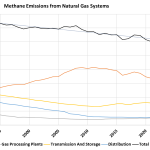
With the final methane rule from the EPA released recently, we thought it worthwhile to take a quick look at the current state of emissions from the industry to contextualize the gains promised by the EPA. EPA publishes estimates of CH4 emissions from what they call the "Natural Gas System" in the Inventory of U.S. Greenhouse Gas Emissions and Sinks, an annual report. They categorize the system into Exploration, Production, Gas Processing Plants, Transmission And Storage, Distribution, and Other. We've totaled those, and present selected segments that we feel are worth discussion. (Note that the individual segments don't add up to the total, due to eliding several segments for clarity.)
Featured Articles


- Blog
Time Has Come Today - How Will EPA's Methane Rule Impact the Certified/Differentiated Gas Market?
The Biden administration’s recent announcement at the COP28 climate change conference in Dubai that it has issued a final rule on reducing methane emissions from the oil and gas industry raises an important question: If the feds will be requiring every producer to phase out flaring, install new equipment, and meet new, aggressive standards for emissions monitoring and leak detection and repair, will there still be a need for entities like MiQ and Project Canary to score or assess the lower-emissions natural gas produced by a significant subset of enviro-conscious E&Ps? In today’s RBN blog, we discuss the potential impacts of the new EPA rule on gas certification/differentiation and the development of a market for low-methane gas.


- Blog
Don't Let Go - Reducing Intentional Releases of Natural Gas Spurred by ESG Objectives, Regulations
Methane, the primary component of natural gas, is the second-most-abundant greenhouse gas tied to human activity after carbon dioxide, and pound-for-pound has 25 times the heat-trapping potential of CO2. We also know that a considerable portion of methane emissions come from the oil and gas industry, not just from leaks but from intentional releases such as “blowdowns,” when operators vent natural gas into the atmosphere to relieve pressure in the pipe and allow maintenance, testing, and other work to take place. Sure, it would be better for the environment and most everybody involved if there was a way to capture natural gas instead of releasing it. (Spoiler alert: there is.) But what are the incentives for producers, pipeline owners, or local distribution companies invest in a solution? Today, we consider what midstreamers, transmission operators, and LDCs can do to minimize blowdowns.


- Blog
Hit Me With Your Best Shot - Will Emissions Limits Force Canadian E&Ps to Reduce Production?
Despite global energy insecurities, many countries continue to push forward with efforts to incentivize an energy transition and fulfill emission-reduction targets. Canada has been no exception, with its federal government earlier this year introducing detailed climate goals for each of its major economic sectors, with particular emphasis placed on oil and gas, the country’s largest emitter. With the aim of a 42% emissions reduction for this sector by 2030 versus 2019 levels, Canada has set a target that may well be beyond reach, raising the possibility that production cutbacks later this decade will be the only alternative. In today’s RBN blog, we examine this potentially disruptive prospect.
