


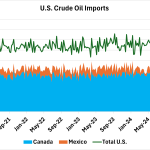
Total U.S. crude imports increased by 470 Mb/d to 6.915 MMb/d, with Canadian supplies rising by 350 Mb/d and once again surpassing 4 MMb/d. This rise could be attributed to companies trying to import as much Canadian crude oil as possible ahead of the tariffs discussed last week. The main story for imports over the past week has been the significant developments regarding crude oil import tariffs between Canada and the United States. On February 1, 2025, President Donald Trump announced a 10% tariff on Canadian crude oil imports, aiming to protect domestic energy producers. However, on February 3, the administration agreed to pause these tariffs for 30 days after Canada pledged to enhance border enforcement to curb drug trafficking into the U.S. In response to the potential tariffs, Canada's Trans Mountain pipeline company anticipates increased interest in its system, which transports oil from Alberta to the Pacific coast, as exporters seek alternative markets, particularly in Asia. Analysts warn that if implemented, these tariffs could lead to higher fuel prices in U.S. regions heavily reliant on Canadian oil, such as the Midwest.
Featured Articles


Everybody Hurts - Trump's Tariffs Would Hurt Canadian Oil Producers More Than U.S. Refiners
Tariffs have served as a cornerstone of President Trump’s economic vision. In the campaign, he said he could impose tariffs as high as 25% on all imported goods from Canada — including crude oil — and he could deliver on that promise at any time. This has raised concerns, especially for Canadian producers and U.S. refiners, who depend on the efficient and economical movement of barrels between the trading partners. In today’s RBN blog, we look at how much Canadian crude oil flows to the U.S., how those imports could be affected by tariffs, and how Canadian producers and U.S. refiners would share the financial impact.


Why Can't We Be Friends? - The Odds For/Against U.S. Tariffs on Imported Canadian, Mexican Crude
President-elect Trump’s plan to impose a 25% tariff on all imported goods from Canada and Mexico — including crude oil — has raised concern among U.S. refiners, many of which depend heavily on those imports and would face serious challenges in replacing them. The question is, given that dependence and the incoming administration’s pledge to reduce energy costs, will refiners — and oil producers in Canada and Mexico — succeed in their efforts to exempt crude oil from the tariff plan? In today’s RBN blog, we discuss the degree to which U.S. refineries incorporate Canada- and Mexico-sourced oil in their crude slates, the potentially devastating impacts of a tariff on Canadian crude in particular, and the odds for and against U.S. tariffs on oil imports from its neighbors.


The Treasure of the Sierra Madre - Mexico's Energy Strategy May Rest on Fate of Natural Gas Pipelines
A significant shift is underway within Mexico’s energy landscape, reflected by the development of large-scale oil and gas infrastructure projects in the country, particularly the Southeast Gateway and Sierra Madre gas pipelines that would move U.S.-sourced natural gas across Mexico. These projects — the first an undersea pipe in the Gulf of Mexico and the second a pipe across the country’s northern tier — would enhance Mexico’s gas transport capacity while supporting power generation and industrial development. Mexico, which is already heavily reliant on imports of U.S. gas, is forecast to see gas demand rise in the coming years as domestic production drops. In today’s RBN blog, we look at those two pipelines, their challenges, and how the potential for U.S. tariffs on Mexican imports might complicate the future of both projects.
