


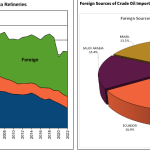
The Canadian government's TransMountain Expansion was touted by former developer, Kinder Morgan, in 2014 as a gateway to new foreign markets for Western Canada's constrained crude barrels, particularly targeting Asia. Back then the U.S. was the #1 customer for those barrels and that continues to be the case today. According to industry analysts and traders, as reported by Rueters, the new destination could very much be the same as the old destination, the U.S. and most likely California. California has a rude refining capacity of just over 1.7 MMb/d spread accross 17 refineries. According to the California Energy Commission, California's refineries were running close to 85% ulilization or 1.4 MMb/d in 2022. California imported 854 Mb/d of foreign supply (green area in left chart) in 2022, equating to 59% of total supply. Canada accounted for 4.1 % (pink dotted pie in right chart below) or a measly 34 Mb/d. With incremental neighborly barrels soon to hit the water, an uptick in that number would not be suprising come 2024.
Featured Articles


Not Giving In - Is the G-7's Price Cap on Russian Crude Oil Exports Having Its Intended Effect?
When the Group of Seven (G-7) countries placed a $60/bbl cap on the price of Russian crude oil in December 2022 — one of many responses to Russia’s February 2022 invasion of Ukraine — there were two primary goals. The first was to keep Russian barrels flowing to the market to help keep global prices in check, and the second was to slash the profitability of Russian oil exports and thereby reduce its ability to wage war against Ukraine. In today’s RBN blog, we look at how effective the sanctions have been and how Russia has tried to work around the price cap.


On The Hunt - Trans Mountain Expansion Will Pose a Test for U.S. Refiners in Need of Barrels
The impending startup of Canada’s government-owned Trans Mountain Expansion Project, better known as TMX, will add exit capacity for Western Canadian crude oil production and is expected to redirect at least some of Alberta’s output toward California and Asia and away from its traditional North American markets, including complex refiners in Eastern Canada and the U.S. Midwest and Gulf Coast. Among them, Gulf Coast refiners, who have become the “price-setting” consumers of heavy Western Canadian crude, are expected to be the hardest hit. In today’s RBN blog, we examine the Gulf of Mexico production and imported grades that might become stand-ins for the “lost” Canadian barrels.


Top of the World - Is 2023 the Peak for Re-Exports of Canadian Heavy Crude Oil from the Gulf Coast?
Thanks to expanding heavy crude oil production in Western Canada’s oil sands in recent years and increased pipeline access from the region to the U.S. Gulf Coast, re-exports of Canadian heavy crude from Gulf Coast terminals set a record in 2023. With additional production gains on tap in the oil sands, it might seem natural to think that another re-export record is in the works for 2024. However, assuming the much-delayed Trans Mountain Expansion Project (TMX) does indeed start up this year — offering a vastly expanded West Coast outlet for oil sands production — last year’s re-export high might end up being a peak, at least for the number of years it takes for growth in Western Canadian heavy crude production to exceed the capacity of the TMX expansion. In today’s RBN blog, we take a closer look at TMX’s likely impact on Gulf Coast re-exports.
