


Anything but normal might be the best way to characterize today’s market for normal butane. Butane production at gas processing plants and fractionators is at or near an all-time high. Butane consumption by steam crackers is maxed out, and so were butane exports until new dock capacity came online this fall. Butane inventories? They’ve risen to record levels too, and this summer, butane prices fell to their lowest mark in more than a decade. Now, with winter-gasoline blending season in high gear and new room for export growth, butane prices at Mont Belvieu are up more than 35% from where they stood a month and a half ago. What does all this mean for the butane market this winter? Today, we discuss recent trends in normal butane production, consumption, exports and stocks.
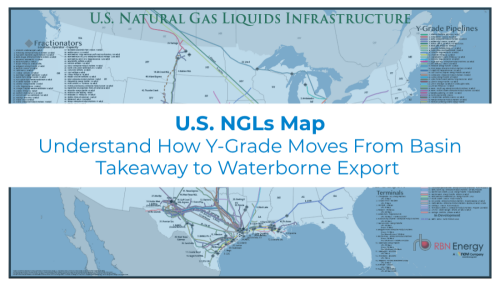
Visualize the infrastructure behind U.S. NGL movement.
The U.S. NGLs Map provides a comprehensive view of the transport, processing, and export networks moving NGLs across the U.S.
As we said in God Only Knows, normal butane (C4), with its four carbon atoms per molecule, is a middle-of-the-pack natural gas liquid (NGL) that’s heavier than ethane (C2) and propane (C3), lighter than natural gasoline (C5+), and is a close cousin to isobutane (IC4), an isomer of normal butane that is a bit more esoteric. Most normal butane is supplied by gas processing plants and fractionators, which separate NGLs from the raw gas stream (processing plants) and split the mixed NGLs into “purity products” (ethane, propane, normal butane, isobutane and natural gasoline). The balance of normal butane supplies in the U.S. comes from refineries. There are three primary domestic markets for normal butane: (1) as a motor gasoline blendstock, primarily during the colder months of the year, when federal environmental regulations allow gasoline to have a higher Reid vapor pressure, or RVP; (2) as a feedstock for steam crackers to produce ethylene and other petrochemical products; and (3) as a fuel — normal butane, like propane, is a liquefied petroleum gas (LPG). And don’t forget exports. With normal butane production significantly increasing during the Shale Era, a big slice of what’s being produced is now loaded onto VLGCs and shipped to Asia, Europe and other overseas markets. (VLGCs are Very Large Gas Carriers.)
We’ll start our review of the current state of the normal butane market with a look at production. As with propane and other purity products, butane production growth is being driven by crude oil and “wet” gas production. Gas plant production of butane has doubled over the past eight years, from 270 Mb/d in 2011 to an average of 540 Mb/d in the first eight months of 2019 (see Figure 1).
About the song
"Days of Wild" was written by Prince and appears as the first cut on the third disc of Prince's 20th album, Crystal Ball. Prince had been performing "Days of Wild" live since 1994. The song was highly popular with Prince's audiences, who often sang along. The version released on Crystal Ball is a live rendition, with studio overdubs. A lyrically revised and cleaned-up version was released as a digital single in June 2002. The song was also given out as a free promotional single to fans attending Prince's Celebration concert held at Paisley Park in Chanhassen, MN, in June 2002.
Crystal Ball was produced by Prince, and released in January 1998. The three-disc box set also included a CD with 12 new acoustic songs entitled The Truth. Personnel on the record were: Prince (vocals, multi instruments, producer), Michael Bland (guitar, backing vocals), Tommy Barbarella (guitar, backing vocals), Bonnie Boyer (backing vocals), Morris Day (drums), D.K. Dyson (percussion, organ, backing vocals), Carmen Electra (backing vocals), Kathy Jensen (clarinet), Kirk Johnson (organ, percussion), Eric Leeds (saxophone), Mayte Garcia (backing vocals), Susannah Melvoin (backing vocals), Mr. Hayes (guitar, backing vocals), Mike Scott (guitar), Rhonda Smith (bass, percussion, backing vocals) and Sonny T (guitar, backing vocals). Crystal Ball went to #62 on the Billboard Top 200 Albums chart.
Prince (Prince Rogers Nelson) was an American singer, songwriter, multi-instrumentalist, dancer, actor, producer and filmmaker from Minneapolis. He released 39 studio albums, four live albums, nine compilation albums and 106 singles, and starred in five motion pictures. Prince has sold more than 130 million records worldwide. He won one Academy Award, seven American Music Awards, two ASCAP Awards, seven Brit Awards, one Golden Globe Award, 10 Grammy Awards and four MTV Video Music Awards. He was inducted into the Rock and Roll Hall of Fame in 2004 and the Rhythm and Blues Hall of Fame in 2016, and was awarded an honorary Doctor of Humane Letters by the University of Minnesota in 2016. Prince passed away in April 2016.





Comments
The term "non-TET" shows up mysteriously at the end of the article. A quick paranthetical would be helpful.
In reply to The term "non-TET" shows up by g p
Non-TET is pricing for product traded at Enterprise Product Partners storage at Mont Belvieu