


Bakken producer wellhead netbacks now favor shipping crude to the East Coast by rail. That is because Brent crude prices are trading more than $13/Bbl above WTI and nearly $11/Bbl higher than Light Louisiana Sweet crude at the Gulf Coast (October 30, 2013). Loading data from North Dakota indicates that volumes being shipped by rail have returned to levels not seen since April although less crude is going to the Gulf Coast. Today we conclude our two part analysis of Bakken producer transport options.
This is Part 2 of a series on the evolving netbacks that Bakken producers in North Dakota can expect when they ship their crude to different destination markets. In Part 1 of this series (which you should probably read first if you have not already) we compared Bakken netbacks in July 2013 – when the Brent premium to WTI was $4/Bbl – to values earlier this month in October as Brent widened out to a $10/Bbl premium ($13.09/Bbl yesterday – October 30, 2013). The netback calculation we are using estimates where a Bakken producer can get the best return on crude at the wellhead based on transport costs and prices for benchmark crudes at four destinations – using either rail or pipeline transportation (see Brent WTI and the Impact on Bakken Netbacks for a more complete explanation). The four destinations are the East Coast (Brent benchmark price), the West Coast (Alaska North Slope – ANS benchmark price), the Gulf Coast (Light Louisiana Sweet – LLS benchmark) and Cushing, OK (West Texas Intermediate – WTI benchmark).
Higher Brent prices versus WTI this past month and the narrowing of the price spread between WTI and LLS (see Goodbye Stranger) moved East Coast rail netbacks for Bakken crude from last place in the netback value table in July to first place in October. The West Coast by rail netback - is lower than the East Coast because ANS prices are now tracking at a discount to Brent (as we explained last week - see What’s Going On?). The highest netback in July was for pipeline shipments to the Gulf Coast because LLS prices at that time were $2/Bbl higher than Brent. By October, LLS prices had fallen to $10/Bbl below Brent pushing Gulf by pipeline netbacks into third place. The netback data indicates that Bakken shippers now have an incentive to move crude to the East and West Coasts by rail versus pipeline to Cushing or the Gulf Coast.
Today we triangulate the netback evidence using data on rail and pipeline movements out of the Bakken assembled by our friends at Genscape. Genscape Oil Market Services provide a variety of infrastructure related data including the weekly PetroRail newsletter. We previously used Genscape data in our analysis of rail movements out of the Bakken to show that shippers were moving barrels off the rails and back to the pipelines as the Brent/WTI spread narrowed earlier this year (see To the Pipelines, Robin!). This time we are looking for evidence that shippers are moving back to rail as the netbacks favor East and West Coast destinations.
Shippers in the Bakken have two alternative routes to market - aside from trucking crude north across the border to Canada. They can load crude onto trains and ship it to multiple coastal destinations or they can ship East by pipeline via the Enbridge system to Clearbrook, MN or South and West to Guernsey, WY. Both pipeline systems end up delivering crude into the Midwest - including Cushing, OK from where limited supplies can be shipped via the Seaway pipeline to the Gulf Coast. Although many shipments are made under long-term agreements with take-or-pay commitments there is now greater flexibility to switch barrels from rail to pipe or back as netbacks change. That is because producers have acquired capacity on both rail and pipe as Bakken crude production has increased and more rail terminal capacity has opened up in North Dakota.
Source: Genscape
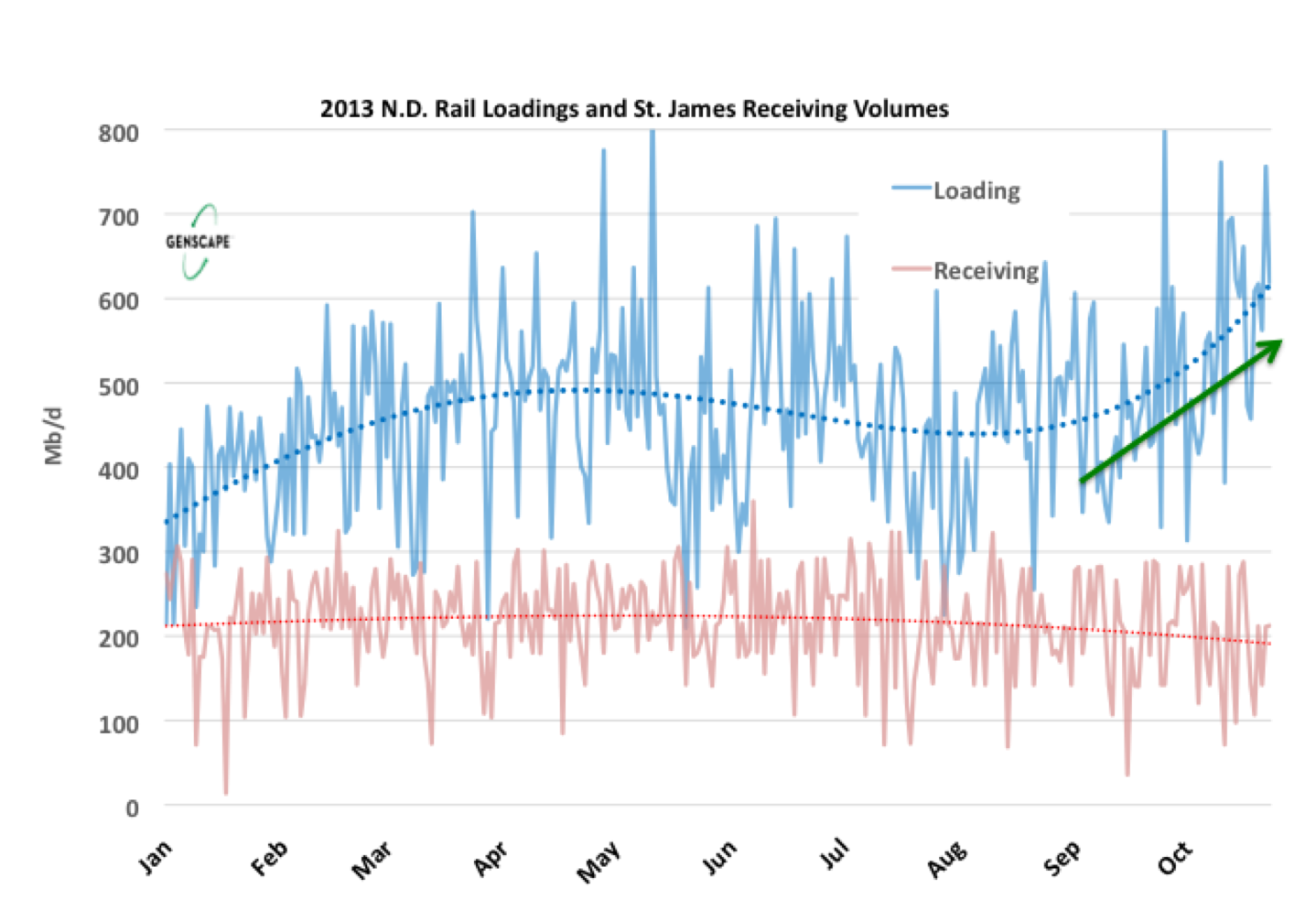
The blue line on the chart above shows Genscape Bakken rail loading data at the twelve facilities the company tracks in North Dakota. These terminals account for 816 Mb/d or 90 percent of the currently operating 900 Mb/d of rail loading capacity in the region. The data is noisy due to variability in daily loading patterns and occasional outages in the Genscape monitoring equipment. However the general trend can be seen from the blue dotted curve fit. Rail loading volumes increased through May of 2013 while the Brent/WTI spread was still wide enough to justify the economics of moving crude by rail to coastal locations. At the end of May through June rail volumes fell as shippers moved barrels back to the pipelines. After recovering again briefly at the end of June, rail volumes fell from July through August as the Brent/WTI differential narrowed to less than $3/Bbl meaning pipeline netbacks to Cushing or the Gulf Coast were higher – encouraging pipeline shipments. In the past two months however as the WTI/Brent spread widened again, the volume of crude shipped by rail has increased back to the record levels seen in April and May of this year (green arrow on the chart).







Comments
Your benchmark for the west coast is ANS. That may be true for the PNW, but the marginal crude for California are imports based on Brent. As rail crude into California grows, the Brent benchmark may dictate rail economics rather than ANS.
Check your St. James unloading number. Someone just quoted me that it was still over 180 MBD for the month of October. His source was Genscape too.
In reply to St. James Unloading by Eli Miller
Thanks for that - you are correct - we had crossed wires with Genscape on the data. I have updated the chart (Figure #1) and revised the text to reflect the correct data. The numbers at St James are down by about 15 percent in October (195 Mb/d average) vs the levels in April and May (228 Mb/d).
Sandy