Vladimir Putin’s fateful decision to invade Ukraine and the ongoing brutality have made Russia a pariah state to many leading hydrocarbon-consuming nations, which in turn has caused cuts in Russian crude oil production and exports. That raises a few important questions, chief among them the degree to which other producers — including the U.S. and the non-Russian members of OPEC+ –– can ramp up their production and displace Russian oil. U.S. output has been increasing recently, albeit only gradually, and production could rise much more quickly under the right circumstances. But if it does, would there be enough crude export capacity available along the Gulf Coast to handle, say, another 500 Mb/d or 1 MMb/d? In today’s RBN blog, we examine the ability of key U.S. export facilities to stage, load and ship out increasing volumes of oil.
Last week, the International Energy Agency (IEA) forecast that, on average, 1.5 MMb/d of Russian oil production will be shut in during April and double that amount — a staggering 3 MMb/d — may be offline in May. There are three primary drivers behind the decline, according to IEA: (1) more run cuts by Russian refiners as the economy there slows, (2) Russian storage capacity filling up and (3) more foreign buyers shunning Russian barrels. To many — including the U.S., Canada, the UK and Australia — the stuff is tainted, not in a physical sense but because Russian oil sales help to finance a disgusting, immoral war. The 27 member nations of the European Union (EU) feel the same way, and it was reported Thursday by The New York Times that EU officials are drafting an embargo under which they would quickly wean themselves off Russian oil too –– a challenging task, given what has become continental Europe’s heavy dependence on crude from the east.

To truly understand Cushing — what it does and how it works — you need to know the hub’s assets and how they fit together. RBN’s Cushing Crude Oil Playbook provides the first one-stop, comprehensive guide to the hub’s assets.
It is too soon to know how this will all play out, but it would seem logical to expect that, for the global crude oil market to be restored to balance, the declines in Russian production and exports will need to be offset to a considerable degree by rising production in — and exports from — the handful of oil-producing countries able to ramp up their output and sales to foreign buyers. In recent weeks we have blogged extensively about related aspects of this same Russia-centric story. For example, in Help Is on Its Way and Baby, I Got It, we discussed the U.S.’s ability to help Europe replace piped-in Russian natural gas with U.S.-sourced LNG. In We’re Not Gonna Take It, we wrote about how U.S. refiners could replace Russian imports in their slates. Also, in I Can’t Go for That (No Can Do) we looked at why many U.S. producers have been slow to increase their crude oil output, and in I Want to Break Free we examined how the Biden administration’s planned release of up to 180 MMbbl from the Strategic Petroleum Reserve (SPR) may serve as (in President Biden’s words) “a wartime bridge to increase oil supply until production ramps up later this year,” a topic we also discussed in Road to Nowhere.
About the song
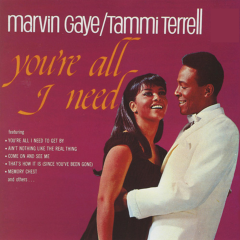
“You’re All I Need to Get By” was written by Nick Ashford and Valerie Simpson. It appears as the third song on side one of Marvin Gaye and Tammi Terrell’s second studio duet album of the same name. Recorded in March 1968 and released as a single in July the same year, the song went to #1 on the Billboard Hot R&B chart and #7 on the Billboard Hot 100 Singles chart. The song was covered in 1995 coupled with “I’ll Be There for You” by Method Man and Mary J. Blige. Their version won a Grammy Award for Best Rap Vocal Performance by a Duo or Group in 1995. Personnel on the Marvin Gaye/Tammi Terrell record were: Marvin Gaye, Tammi Terrell (lead vocals), Nick Ashford, Valerie Simpson (backing vocals), and The Funk Brothers (instrumentation).
The album, You're All I Need to Get By, was recorded at Hitsville USA in Detroit in 1966-67. Produced by Harvey Fuqua, Ashford & Simpson, Johnny Bristoll and Robert Gordy, the album was released in August 1968, and went to #60 on the Billboard 200 Albums chart. After recording the album, Tammi Terrell collapsed on stage during a show with Marvin Gaye in Virginia in late 1967. She was later diagnosed with a brain tumor and was never again able to perform live. Three charting singles were released from the LP.
Marvin Gaye was an American singer and songwriter. He released 25 studio albums, four live albums, one soundtrack album, 24 compilation albums and 83 singles. He has a Grammy Lifetime Achievement Award and is a member of the Rock and Roll Hall of Fame, the Songwriters Hall of Fame, and the Rhythm and Blues Music Hall of Fame. He died in Los Angeles in April 1984 at the age of 44 after being fatally shot by his father.
Tammi Terrell was an American singer and songwriter. She released one solo studio album, four duet studio albums and 20 singles. She was diagnosed with a brain tumor in late 1967. After undergoing several surgeries, Terrell lost her battle with cancer in March 1970 at the age of 24.