


Many who write about hydraulic fracturing suggest, or state explicitly, that it is a new technology in the oil and gas industry. This can hardly be further from the truth. Indeed, it is probably the case that hydraulic fracturing is older than most of the people writing about it. Today we begin a series on hydraulic fracturing and why it has had such a significant impact on gas and oil production over the past few years.
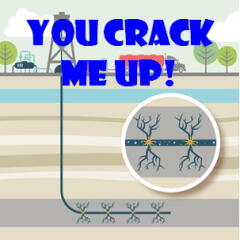
Hydraulic fracturing [1] is a subset of the general category of processes used to artificially stimulate the production of oil and natural gas from geologic formations with low permeability; that is, to enhance production flows from reservoir or source rock in which there is quite low interconnectivity between the hydrocarbon-holding pores in the rock. Artificial stimulation has been a part of the oil and gas industry pretty much as long as there has been an industry. Back in the early days, fracture stimulation techniques were relatively crude and potentially dangerous, since they employed simply dropping a stick of dynamite or a shot of nitro down the well bore to fracture the rock formation at the bottom of the well. This tended, if done correctly, to fracture the rock to improve the permeability (open pathways between the rock pores) and to produce what amounted to a low pressure zone in the formation to which the hydrocarbons would naturally flow.
Beyond the obvious dangers associated with handling and employing these types of explosives, there were clear limitations on the degree of precision that could be applied. Alternatives to the early crude techniques led to the use of fluids injected at pressures that exceeded those of the down-hole rock formations into which they were injected. As instrumentation improved, greater precision was gained in how much pressure was required, for how long, and what forms the fluids should take for different geology and rock chemistry. Halliburton suggests that hydraulic fracturing was first used in 1947 and that it became a commercial process in 1949 [2]; that is, hydraulic fracturing has been being employed in the oil and gas industry for over 65 years. If we accept Drake’s well in Titusville, PA in 1859 as the origin of the modern oil and gas industry, this means that hydraulic fracturing has been an important part of the industry for over 40% of its existence. If we define the modern oil and gas industry from Spindletop, TX in 1901, hydraulic fracturing has been part of the industry for nearly 60% of its existence.
The hydraulic fracturing technique has been employed around the world for nearly all of this time. For example, as far away and as remote as Western Australia, hydraulic fracturing has been employed to stimulate oil and gas production since the 1950s; see Western Australia Government, Department of Mines and Petroleum, www.dmp.wa.gov.au/15147.aspx. It is reputed that over two million oil and gas wells have been hydraulically fractured around the world. The vast majority of these have been vertical wells. What is relatively new is the use of hydraulic fracturing in combination with horizontally (or more generally, directionally) drilled wells.
Hydraulic fracturing has evolved over a long period of time. As noted, the initial commercial applications date to the late 1940s. However, significant research and development work was done, or supported, by the US Government. As far back as the 1970s, following the first oil price spike resulting from the OPEC oil embargo, the government sought to determine if it were possible to enhance the extraction of oil and natural gas from so-called unconventional geology. In addition to research funding, which helped improve both hydraulic fracturing and horizontal drilling techniques and technology, Section 29 of the Energy Policy Act, 1980, provided tax credits for unconventional natural gas development.
The results of the federally funded technology developments (some of it funded through the Gas Research Institute (GRI) – now Gas Technology Institute and the Morgantown Energy Research Center) slowly reached those in industry who were actively trying to produce oil and natural gas from just these sorts of challenging geologies. One such private sector independent operator was George Mitchell and Mitchell Energy, who most people interested in this topic will have heard of. The struggles that Mitchell went through to commercialize the vast natural gas resources in the Barnett formation of Texas are legendary, but even Mitchell was a beneficiary of the federal government involvement, both indirectly by taking advantage of published research results funded by the government and by direct financial support from the GRI in fracturing some early Barnett wells.
One of the main contributions that came from Mitchell Energy’s work was what is referred to as “slick water” hydraulic fracturing. The early research resulted in most in the industry believing that the proper “recipe” for the fracking fluids was one that produced a gel-like fluid for injection. Basically, the reasoning was that most shales that had been experimented on tended to have relatively high clay content, and it was deduced that high-water content fluids would cause the clays to swell, which would have been counterproductive to the aim of opening pathways among the pores. As it turned out, the Barnett shale was lower in clay content and more brittle, so the gels actually tended to “clog” potential pathways, rather than open them. It was experimentation by Mitchell Energy engineers, learning from others, that led to the use of fracking fluids that are mostly water and tend to not include gels. The now typical fracking fluid (although they may differ from one shale to another) is well over 99% water, with chemicals added primarily to reduce friction to speed the flow during the fracturing process. Included in the final flows is a large quantity of sand (or other proppants), which remain behind to hold open the fractures created by the introduction of the water under extremely high pressure.
According to Gregory Zuckerman, author of The Frackers, Mitchell Energy’s success in the Barnett came exclusively from the application of hydraulic fracturing without assistance from horizontal drilling; Mitchell changed the fracking fluid recipe and things like the pressure applied in the process, but they continued to apply this process to vertically-drilled wells. The coupling of the two technologies came later from the work of the likes of Chesapeake Energy targeting natural gas and Continental Resources targeting crude oil. And, it is worth noting that horizontal drilling is also not a new technology, with early applications of directional drilling dating back to the 1920s.
The apparent newness of hydraulic fracturing is simply the result of it coming to the public’s attention only in recent years. While it was an important and integral part of the everyday operation of the oil and gas industry around the world for 65 years, it was the capacity for this technology to release commercial volumes of natural gas and oil captured in shale (sometimes referred to as mudstone) and tight formations that attracted the attention of the media, politicians, and the general public. Hydraulic fracturing employed in more traditional (sometimes labeled conventional) geologic formations assisted in enhancing production flows and moderating otherwise natural production decline, but this was not really news worthy; nor did this significantly change the productive position of the U.S. relative to the rest of the world. However, when hydraulic fracturing was coupled with horizontal drilling, and, through years of experimentation, proved to be able to produce commercial volumes of natural gas and crude oil from shales/mudstones and other tight formations, this did significantly change our productive capacity relative to the rest of the world, as well as our future prospects. That was and is news worthy. So, while hydraulic fracturing has evolved over a long period of time, the combination of this technology with others – horizontal drilling, multi-stage completion, 3-D seismic – has revolutionized the natural gas and oil industries.
IMPORTANT ALERT – LAST DAY FOR OPENING ACT!
There is only one more day to join RBN Backstage Pass as a Charter Member of Opening Act – The inaugural band of hearty energy marketeers, analysts and others generally interested in what makes energy markets work. In keeping with such a special standing, you will receive the commemorative MUG shown below identifying you as one of this elite group. And will get your second month of subscription access for FREE. That’s a $75 value!
[1] There is no universally accepted abbreviation for hydraulic fracturing. The frequently observed abbreviations are fracking, fraccing, or fracing.
[2] Vertical wells in Stephens County, Oklahoma and Archer County, Texas. See, Montgomery, C.T. and Smith, M.B., “Hydraulic Fracturing: A history of an enduring technology,” Journal of Petroleum Technology, December 2010.
About the song
“You Crack Me Up” was written by Mario Cipollina and Huey Lewis and appears as the fourth song on side two of Huey Lewis and the News' third studio album, Sports. Huey Lewis formed the News at Uncle Charlie's bar in Corte Madera in Marin County, CA. "You Crack Me Up" is about an amalgamation of the characters the band encountered while playing in their early days at the bar. Personnel on the record were: Huey Lewis (lead vocals, harmonica). Mario Cipollina (bass), Johnny Colla (saxophone, guitar, backing vocals), Chris Hayes (lead guitar, backing vocals), Sean Hopper (keyboards, backing vocals), and Bill Gibson (drums, percussion, backing vocals).
Sports was recorded between December 1982 and June 1983 at Fantasy in Berkeley, Record Plant in Sausalito, and The Automatt in San Francisco and produced by Huey Lewis and the News. The album's cover shot was taken at the 2 AM Club (also known as “The Deuce”) in Mill Valley, CA. Released in September 1983, it went to #1 on the Billboard 200 Albums chart and has been certified 7x Platinum by the Recording Industry Association of America. With the album's references to two different bars in the Marin County area, the group's credibility as one of the world's greatest bar bands is duly registered. Five singles were released from the LP.
Huey Lewis and the News is an American rock band formed in San Francisco in late 1979. Lewis and keyboardist Sean Hopper had previously played together in the band Clover, who had released five studio albums and backed (minus Lewis and Alex Call) Elvis Costello on his My Aim is True debut album. The two joined up with members of the San Francisco group Soundhole and formed Huey Lewis and the News. They released 10 studio albums, one live album, three compilation albums, and 39 singles. They have sold over 30 million records worldwide. They have won a Brit Award and a Grammy Award. Thirteen members have passed through the band since its formation. The band is currently inactive due to Lewis being diagnosed with Meniere's disease, an inner ear disorder, in 2018.







Comments
Video explanation of the drilling and hydraulic fracturing process:
http://www.youtube.com/watch?v=vO82b2auSdo