- Blog

Play Guitar - Texas Natural Gas Pipeline Capacity, Flows and Basis - The Fretboard Model

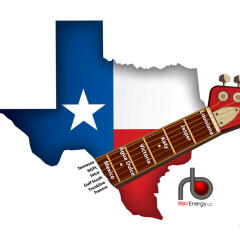
The natural gas pipeline grid in Texas is undergoing a historic transformation as interstate pipelines designed to move gas north and east from the Gulf Coast region are being reversed, enabling Marcellus/Utica gas to flow to LNG export markets in Louisiana and Texas, and via Texas for pipeline export to Mexico.   With a history of oil and gas production going back more than 100 years, no region in the world has a more convoluted network of pipelines than Texas.  The state can be viewed as a dense “spaghetti bowl” of interconnected interstate and intrastate systems that defies traditional gas market analysis, in part because intrastate pipelines do not post receipts and deliveries on their systems as required by federally regulated interstate pipelines.  However, it is possible to assess the dynamics of regional flows and capacities by examining the morass of flow data available from interstate pipelines in the region that connect to the intrastates. To help make sense of this data, RBN has developed a simplified model that facilitates an understanding of Texas natural gas flows and capacities that we call (unsurprisingly since it’s RBN) the Fretboard Model because the region’s interstate pipelines and capacity constraints look (with just a bit of artistic license) very much like a guitar fretboard.  In today’s blog, we introduce this model.

- Blog

All the Way - Natural Gas Mainline Reversals in the Lone Star State

Author Housley Carr

Providing the capacity to transport Marcellus/Utica natural gas to and through the state of Texas to LNG export terminals and to Mexico will require pipeline reversals, new pipe and other enhancements along a combination of interstate and intrastate lines. In many ways, the long-distance part of the job––the reversal of large-diameter pipelines between the Northeast and the Lower Mississippi Valley––is the more straightforward; the greater challenge will be reworking the complicated pipeline networks between the Texas/Louisiana state line and the U.S./Mexico border. Today we review Texas pipeline projects being planned to allow increasing southbound flows of Northeast gas.

- Blog

Oh Lord Won’t You Build Me a Midstream Behemoth? – The Energy Transfer/Williams Acquisition – Natural Gas Markets

The acquisition of Williams Companies by Energy Transfer will create a midstream behemoth. The deal is expected to close during the first half of 2016 subject to regulatory approval. Once complete the main holding company Energy Transfer Corp (ETC) will be a C-Corp entity sitting atop Master Limited Partnerships (MLPs – see Masters of the Midstream for a more complete explanation of these structures) containing the assets of Energy Transfer Partners (ETP), Williams Energy Partners (WPZ), Sunoco LP (SUN) and Sunoco Logistics (SXL). The combined natural gas pipeline network will carry as much as 45% of U.S. Lower 48 dry gas production. Today we take a look at the natural gas infrastructure assets in the deal.