The last three years have seen historic changes in the U.S. octane market. The wholesale value of octane, the primary yardstick of gasoline quality and price, spiked threefold in 2022, followed by another year of high values in 2023. The numbers for 2024 and (so far) 2025 have been more stable, but still historically high. In today’s RBN blog, we look at why retail octane values have risen so high and why refiners have been capturing only a small share of the corresponding increase.
Let’s start with some background on gasoline and octane. Experienced fuel consumers who pay close attention to gasoline prices know that the retail pump price differential between premium gasoline (typically 93 octane) and regular gasoline (typically 87 octane) has increased from a long-term historical value below 20 cents/gal to about 90 cents/gal today. We can think of this premium-regular price differential (also known as the “grade differential”) as the retail value of octane; that is, the current differential of 90 cents/gal is the value the end consumer is willing to pay for the extra six (93 – 87 = 6) octane numbers that come with premium versus regular gasoline. The steady increase in the retail octane value is explained, in broad terms, as steadily increasing octane demand and decreasing octane supply. (For more detail on octane and the octane supply/demand picture, see our Breaking The Chains series.)

Refiners don’t capture the full 90-cent retail value on the octane they produce. In fact, the portion of the octane value they capture is surprisingly small. We’ll put some numbers to that below. But first, to quantify and break down who captures what on octane value, we will picture the gasoline market as a three-stage supply chain:
- In the first stage, pure refiners make refinery gasoline that is later blended with ethanol to make the 10% ethanol blend (commonly called E10) sold at virtually all retail pumps. The refiner’s octane margin depends on the prices received for their refined gasoline products (before ethanol blending), which are commonly called blendstocks for oxygenate blending (BOBs).
- Next, BOBs are sold by refiners into a gasoline supply chain. Spot supply points transact bulk volumes of BOBs near refinery hubs. Rack supply points transact smaller volumes of BOB, often off a pipeline. (The ethanol added to create E10 is mostly done at the rack level.)
- Finally, retail supply points deliver blended E10 into our cars, SUVs and trucks at filling stations.
In this high-level picture of the octane market, we consider two grades of BOB — regular BOB and premium BOB. The octane difference between the two corresponds to the octane ratings of the regular and premium retail E10 products. With this picture of a three-level supply chain (spot, rack and retail levels) and two different grades (regular and premium) of BOB and E10, we can start breaking down the market value of octane by computing the price differentials between the premium and regular product at each point in the chain. That difference is our measure of the market value, or price of octane, at that point.
To see how this works in practice, let’s start with a look at the U.S. Gulf Coast spot trading hub. Figure 1 below shows the historical U.S. average retail octane value (blue line) and the U.S. Gulf Coast spot octane value (orange line).
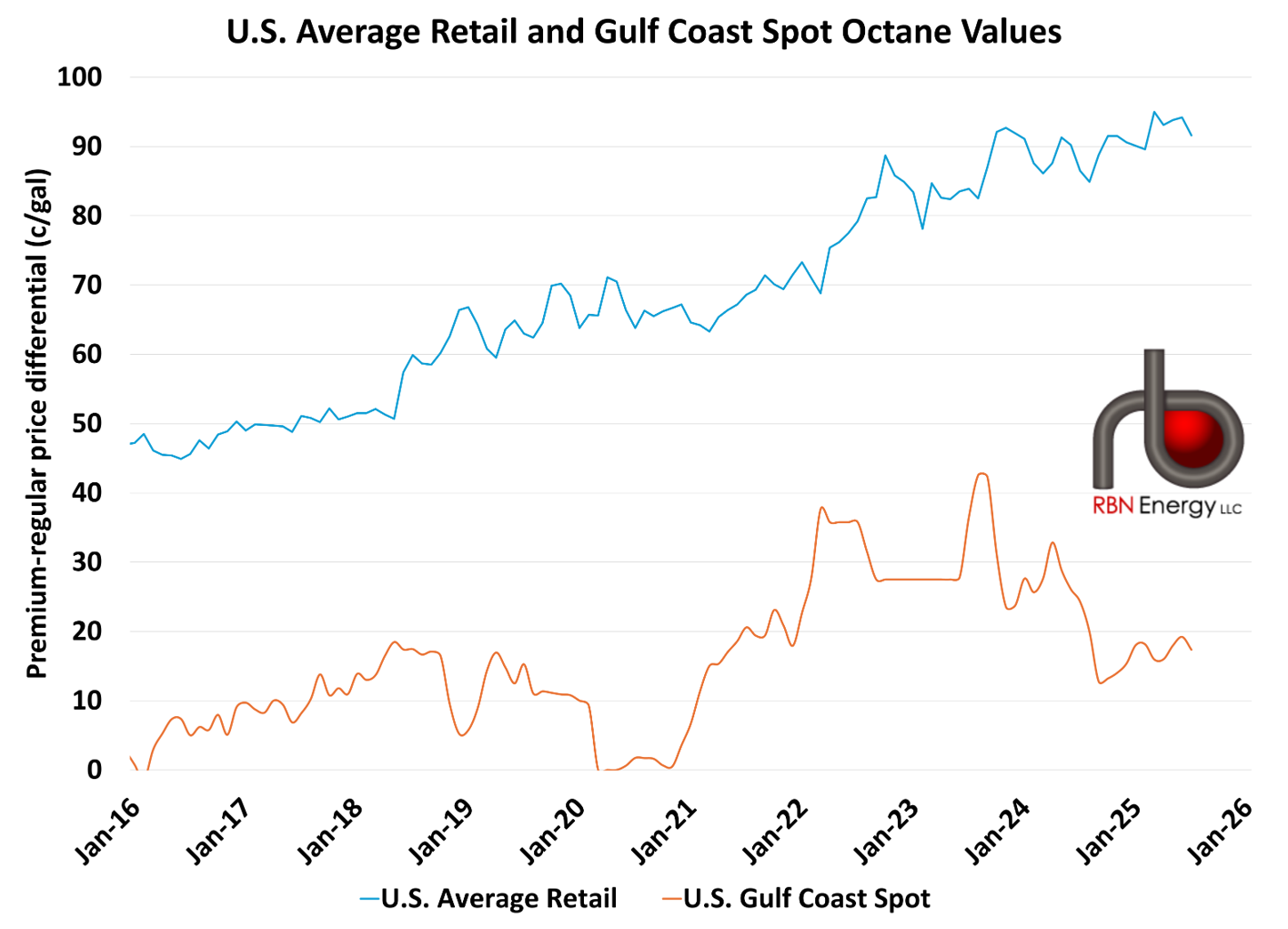
Figure 1. U.S. Average Retail Octane and Gulf Coast Spot Octane Values. Sources: Hoekstra Trading, RBN
About the song
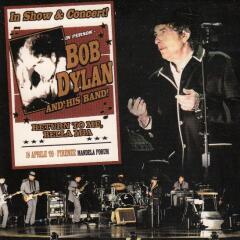
“Return to Me” was written by Carmen Lombardo with lyrics by Danny DiMinno. Bob Dylan’s rendition of the song appears as the sixth track on disc two of The Sopranos — Peppers and Eggs — Music from the Original Series. The LP was first released on Columbia in May 2001 and later re-released on Sony Legacy in October 2016. The song was originally released by Guy Lombardo and His Royal Canadians in December 1957. Dean Martin released it as a single in February 1958 and it went to #4 on the Billboard Hot 100 Singles chart. It has been covered by Connie Francis, Marty Robbins, Jerry Vale, Tony Bennett and Chris Isaak. The song was recorded for The Sopranos at Dylan’s request, as he was a big fan of the series. He sings the last verse of the song in Italian. This may be the spark that ignited Dylan to do a series of albums from the American Songbook later. Personnel on the Dylan recording were: Bob Dylan (vocals, guitar, piano, harmonica), Tony Garnier (bass), David Kemper (drums) and Brian Mitchell (accordion).
The Sopranos is an American crime drama television series that ran from 1999 to 2007. The series followed the life of New Jersey Italian-American crime boss Tony Soprano (James Gandolfini). The series, created by David Chase, won two Peabody Awards, 21 Prime Time Emmys and five Golden Globe Awards.
Bob Dylan is an American singer, songwriter and artist whose six-decade career has established him as an iconic figure in American culture. He is considered one of the greatest songwriters of all time. He released his debut album, Bob Dylan, in 1962. He has released 40 studio albums, 21 live albums, seven soundtrack albums, 44 compilation albums, 24 EPs and 104 singles. He has sold more than 125 million records worldwide. He is a member of the Rock and Roll Hall of Fame, Songwriters Hall of Fame, Nashville Songwriters Hall of Fame, and is the recipient of a Nobel Prize in Literature. He has received Kennedy Center Honors and the Presidential Medal of Freedom. His archives are housed at The Bob Dylan Center in Tulsa, OK, next to the Woody Guthrie Center. Dylan continues to record and tour. He is currently on his Rough and Rowdy Ways World Wide Tour in the U.S., which will go to Europe in October and November.