If pipeline-constrained Haynesville Shale producers’ New Year’s resolution was to grow volumes, they just got a big boost: Energy Transfer recently placed in service its new Gulf Run Transmission natural gas pipeline in Louisiana, increasing north-to-south capacity in the state by 1.65 Bcf/d. It’s the first of several pipeline projects due online in 2023 — and among others proposed for subsequent years — that will be critical for debottlenecking the Louisiana pipeline network and connecting Haynesville and other gas production volumes to LNG export projects vying for feedgas supply on the Louisiana coast. U.S. LNG developers are in a race to capitalize on the tight global LNG market and finalize terminal plans, with much of the next wave of liquefaction and export capacity additions planned for the Louisiana coast which may, in time, help alleviate energy security concerns, particularly across the pond in Europe. If these pipeline projects don’t get built on time, the resulting supply shortage in southern Louisiana would not only wreak havoc on Henry Hub and the domestic gas market but would reverberate around the globe. Gulf Run’s in-service is good news for at least one facility: the under-construction Golden Pass LNG, which is the anchor shipper on the pipeline and due to begin commissioning later this year. In today’s blog, we look at what the new capacity could mean for flows and production growth in the short- and long-term.

As we’ve said in recent blogs — (LNG) Will Never Do Without You and Where It’s At — one of the biggest uncertainties — and risks — to the next wave of U.S. LNG export projects is the availability of feedgas supply when and where it will be needed. Energy reliability problems in Europe unleashed demand for North American LNG export projects, and the bulk of those are located along a less-than-100-mile stretch of coastline straddling the Texas-Louisiana border. That, in turn, has spurred activity and growth in the Haynesville Shale in Louisiana. Haynesville output ballooned to record highs and led the overall rebound in Lower 48 gas production in recent months. Looking forward, in RBN’s Mid-case scenario (assuming the current futures curve and no pipeline constraints), the Haynesville would grow by 3.8 Bcf/d over the next three years.
The trouble, as we’ve laid out in our Down by the Water series, is that the pipeline network to move gas from the Haynesville and other basins south to the export supply hubs in southern Louisiana — what RBN calls the Central Corridor — has been running chock-full and, much like in Appalachia, north-to-south flows in the Bayou State are increasingly dependent on pipeline expansions. So, the key to unlocking U.S. LNG export growth will be the pace of pipeline expansions and how well they line up with export capacity additions as they come online. A number of debottlenecking projects have come online in Louisiana over the past two years. But a lot more will be needed, and — it can’t be said enough — timing will be everything.
About the song
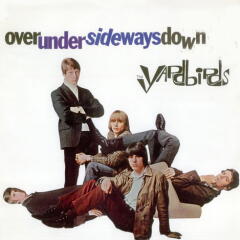
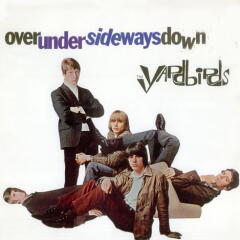
"Over Under Sideways Down" was written by Jeff Beck, Keith Relf, Chris Dreja, Paul Samwell-Smith and Jim McCarty (Yardbirds). It appears as the second song on side one of the Yardbirds' third studio album, released in the UK as Yardbirds and Roger the Engineer, and in the U.S. as Over Under Sideways Down. Released as a single in the UK in May 1966, and in the U.S. in June 1966, the song went to #13 on the Billboard Hot 100 Singles chart. According to Yardbirds' drummer Jim McCarty, the song was inspired by Bill Haley and His Comets' "Rock Around the Clock." Jeff Beck started jamming on the song's bassline, and the group were soon working on an arrangement. The song was in need of an intro, and when Beck came up with the signature riff of the song — a sinewy, Eastern-inspired, mind-blower of a lick that only the mind of a guitar master like Beck could come up with — the group knew they had a hit on their hands. Guitar players are still trying to master that riff five decades after it was created. The free-form lyrics about Swinging London sound like they could have been penned by the hipster bebop entertainer Lord Buckley. The original chorus was changed from "Over under sideways down, that's the best that I have found," to "Over under sideways down, backwards forward square and round," to make any innuendo less obvious to radio programmers. Personnel on the record were: Keith Relf (lead vocals), Jeff Beck (lead guitar, bass guitar), Chris Dreja (rhythm guitar, backing vocals), Paul Samwell-Smith (backing vocals), and Jim McCarty (drums, percussion, backing vocals).
Roger the Engineer (Yardbirds, Over Under Sideways Down) was recorded between April and June 1966 at Advision in London, with production handled by Simon Napier-Bell and Paul Samwell-Smith. Released in the U.S. in July 1966, the album went to #32 on the Billboard Top 200 Albums chart, making it the highest-charting studio album by the band. The album, along with the Yardbirds' appearance (with Jimmy Page included) in the 1966 Antonioni film, Blow Up, helped catapult the band to the forefront of British psychedelia. One single was released from the LP.
The Yardbirds are an English rock band formed in London in 1963. They started out as a blues band known for their "rave up" instrumental breaks, but broadened their music to include pop, psychedelic, and hard rock. They are famous for starting the careers of the triumvirate of rock guitarists: Eric Clapton, Jeff Beck and Jimmy Page. Under the tutelage of Jeff Beck, they contributed to many electric guitar innovations of the mid- to late ’60s. They have released six studio albums, 12 live albums, 10 compilation albums, two EPs and 16 singles. They were inducted into the Rock and Roll Hall of Fame in 1997. Twenty-four members have passed through the band since its inception. The group still tours with founding member Jim McCarty being the only original member. Keith Relf died in May 1976, and Jeff Beck passed away on January 11, 2023.
We at RBN are deeply saddened by the recent passing of Jeff Beck. The iconic guitarist left an indelible mark on music with his work in the Yardbirds, the Jeff Beck Group (which helped to launch the careers of members Rod Stewart and Ronnie Wood), and all of his innovative solo works. Our sympathies go out to his family, fans and loved ones.