With soaring oil prices dominating recent headlines, it’s no surprise that profits and cash flows for the U.S. exploration-and-production (E&P) sector rebounded dramatically in 2021 from heavy, pandemic-induced losses in 2020. Rising crude oil and natural gas demand fueled a whopping $150 billion turnaround in results, as the 43 major publicly traded E&Ps we monitor recorded $86 billion in pre-tax income after incurring a net loss of $66 billion in 2020. Oh, and by the way, 2021 was the most profitable year in at least the last two decades for producers, which reported income two-thirds higher than the previous peak in 2014, when commodity prices were significantly higher. In today’s RBN blog, we compare producers’ 2021 performance with 2020 and 2014 and explain why results should be even stronger this year.
Today’s blog on E&P profitability builds upon our recent three-part series “I Can’t Go for That (No Can Do),” in which we discussed the degree to which crude oil and natural gas producers are likely to respond to strong price signals by increasing their capex, drilling-and-completion activity, and production. In Part 1, we reviewed the myriad challenges faced by E&Ps, which include inflation, severe labor and material shortages, soaring energy costs, ESG concerns, and an investor-focused strategic shift from growth to free cash flow generation. In Part 2, we explained why there is less than meets the eye in producers’ planned 23% capex increase and 8% boost in production — and why their plans do not represent a strategic shift from the maintenance-level investments they’ve been making the past few years. Then, in Part 3, we drilled down into the details, looking at the capex and production guidance from each of our 43 companies, then discussed the 2022 investment decisions made by the boards of these large oil and gas producers.
Today, we examine E&P profitability. As shown in Figure 1, the 43 E&P companies we track (company level data here) earned a combined $86.1 billion in 2021 and raked in $134.7 billion in cash flow, compared with a loss of $65.8 billion and $49.1 billion in cash flow generated in 2020. Every one of these producers posted a profit in 2021. Realized prices nearly doubled, from $20.93 per barrel of oil equivalent ($/boe) in 2020 to $39.77/boe in 2021, while E&P costs fell by nearly $15/boe, primarily because of lower impairment charges in 2021. The 17 Oil-Weighted E&Ps recorded earnings of $36.1 billion ($21.72/boe), a dramatic turnaround from a loss of $21.8 billion (-$14.1/boe) and cash flow of $22 billion ($14.29/boe) in 2020. The 15 companies in the Diversified E&P peer group generated $32.6 billion ($21.52/boe) in pre-tax income and $58.6 billion ($35.20/boe) in cash flow in 2021, compared with a $27.3 billion loss (-$19.63/boe) and cash flow of $19.8 billion ($14.21/boe) the previous year. The 11 Gas-Weighted E&Ps posted earnings of $17.3 billion ($11.60/boe) and cash flow of $24.4 billion ($16.37/boe), up from a loss of $16.6 billion (-$11.66/boe) and cash flow of $7.2 billion ($5.04/boe) in 2020. Production for our universe of E&Ps was up over 7% this year, but this data was heavily influenced by acquisition activity.
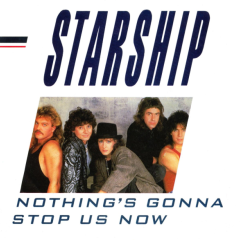
About the song
“Nothing’s Gonna Stop Us Now” was written by Diane Warren and Albert Hammond. It appears as the second song on Starship’s second studio album, No Protection. The song is a power ballad featuring a duet with Starship vocalist Grace Slick and Mickey Thomas. It was the theme song to the 1987 romantic comedy Mannequin. Released as a single in January 1987, the song went to #1 on the Billboard Hot 100 Singles chart and has been certified Gold by the Recording Industry Association of America (RIAA). Personnel on the record were: Grace Slick and Mickey Thomas (vocals), Craig Chaquico (guitar), Pete Sears (bass), Donny Baldwin and Narada Michael Walden (drums), Robert Smith (drum sampling, percussion), Walter Afanasieff (keyboards, synth bass), Corrado Rustici (MIDI guitar), and Karen Brewington, Jim Gilstrap and Donny Baldwin (backing vocals).
No Protection was recorded in 1986-87 at Washington Monument in San Rafael, CA; Lighthouse, Goodnight L.A., and Soundcastle Recording in Los Angeles; Fantasy in Berkeley, CA; and Manzanita in Arrington, TN. Produced by Keith Olsen, Narada Michael Walden and Peter Wolf, the album was released in July 1987. It went to #12 on the Billboard 200 Albums chart and has been certified Gold by the RIAA. This would be the band’s last LP for Grunt Records, the RCA custom label that dates back to Jefferson Airplane and was founded in 1971. Grace Slick left Starship after this album. Four singles were released from the LP.
Starship is an American rock band from San Francisco formed as a continuation of Jefferson Starship in 1985. Jefferson Starship is a band that evolved from Jefferson Airplane, a band that was formed in San Francisco in 1965. Grace Slick was the only member of Starship with roots that go back to the beginning of Jefferson Airplane. After leaving Starship, Slick rejoined Jefferson Airplane for a reunion album and tour in 1989. Slick retired from the music business in 1990 at the age of 49 stating, “All rock and rollers over the age of 50 look stupid and should retire.” Slick is now a painter and visual artist living in the Bay Area of California. Starship has released four studio albums, six compilation albums, and 16 singles. Twenty-seven members have passed through the group since its formation. The group still tours under the moniker of “Starship featuring Mickey Thomas.” Thomas is the only member of the group with roots dating back to Jefferson Starship. Music fans may also remember Thomas as the vocalist on Elvin Bishop’s 1976 hit single, “Fooled Around and Fell in Love.”