Three-quarters of the Bakken's top-tier well sites may have already been drilled and the basin’s remaining inventory may be less than stellar, but a new AI-based analysis suggests that the quality of the locations held by each of the shale play’s top 10 producers varies widely. For a few, there are still plenty of spots that make economic sense to drill and complete, but activity may slow to a crawl for others unless crude oil prices rebound — and in a big way. In today’s RBN blog, we continue our look at Novi Labs’ intense examination of the U.S.’s second-largest onshore production area.
This is the second blog in this miniseries. In Part 1, we said that while Bakken crude oil production is humming along at a steady 1.2 MMb/d, about 75% of the shale play’s top-quartile locations have already been drilled and only 6,100 well sites — about six years of inventory at the current drilling pace — could generate a good return at the range of commodity prices we’ve seen the past couple of years. We also explained Novi’s data-based, machine-learning-enhanced approach to analyzing the many layers (aka benches) in the Bakken (and other shale plays) to determine not only how much crude remains underground but how much is likely to be produced under various price scenarios.
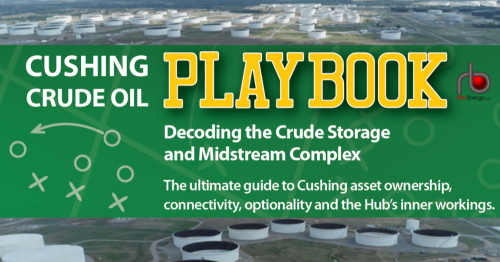
To truly understand Cushing — what it does and how it works — you need to know the hub’s assets and how they fit together. RBN’s Cushing Crude Oil Playbook provides the first one-stop, comprehensive guide to the hub’s assets.
Put simply, machine learning crunches a wide range of geologic, operational and spatial data collected from thousands of drilled wells to recognize patterns and identify the primary drivers of well performance. It then enables operators to assess how changing variables (like drilling in a higher-pressure area, tightening well spacing or increasing proppant intensity) would affect production outcomes in wells yet to be drilled. And it gives operators guidance on how best to lay out, space and sequence the development of the benches.
More important for our purposes, this approach also reveals the relative quality of the rock in various parts of a shale basin and how much of the remaining resource is likely to be developed at various crude oil price points. Regarding rock quality in the Bakken, the basin’s existing and potential wells are separated into four quartiles or tiers, with Tier 1 wells being the juiciest and (generally speaking) the most economic and Tier 4 wells having the lowest quality and being economic only if oil prices are very high. Finally, we noted there are two common ways to assess whether it makes sense to drill and complete a well: using a straight two-year breakeven or using a more conservative NPV25 breakeven, with NPV referring to net present value. (See Part 1 for details.)
Last time, we took a big-picture look at the Bakken’s remaining inventory of drilling locations. In today’s blog, we shift to a company-by-company analysis that reveals significant differences in the quality of their yet-to-be-drilled sites.
Bakken Crude Oil Production by Company
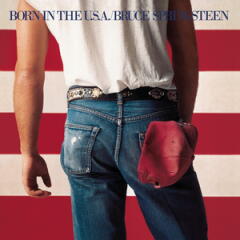
About the song
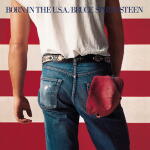
“Glory Days” was written by Bruce Springsteen and appears as the fourth song on side two of Springsteen’s seventh studio album, Born in the U.S.A. Released as the fifth single from the LP in May 1985, it went to #5 on the Billboard Hot 100 Singles chart. It has been certified Platinum by the Recording Industry Association of America. The song was recorded at the Power Station in New York City in May 1982. Personnel on the record were: Bruce Springsteen (lead vocals, lead guitar, acoustic guitar), Roy Bittan (piano, synthesizer), Clarence Clemons (sax, percussion, backing vocals), Danny Federici (organ), Garry Tallent (bass, backing vocals), and Steven Van Zandt (rhythm guitar, acoustic guitar, mandolin, backing vocals).
Born in the U.S.A. was recorded at The Hit Factory and Record Plant in New York City between January 1982-March 1984. Produced by Jon Landau, Chuck Plotkin, Bruce Springsteen and Steven Van Zandt, the album was released in June 1984 and went to #1 on the Billboard 200 Albums chart. It is Springsteen’s biggest-selling album to date, with sales of over 30 million copies worldwide. It has been certified 15x Platinum by the Recording Industry Association of America. Seven Top 10 singles were released from the LP.
Bruce Springsteen is an American singer, songwriter and musician. Nicknamed “The Boss,” his career has spanned six decades. Signed to Columbia records in 1972 by Clive Davis, he has released 20 studio albums, 23 live albums, eight compilation albums, one soundtrack album, seven EPs, and 73 singles. He has sold more than 150 million records worldwide. He has won 20 Grammy Awards, two Golden Globe Awards, an Academy Award, and a Tony Award. He is a member of the Rock and Roll Hall of Fame and the Songwriters Hall of Fame. He has received Kennedy Center Honors and a Presidential Medal of Freedom. In December 2021, Springsteen sold the masters of his entire catalog and the music publishing rights to Sony Music for $500 million. Springsteen and his E Street Band continue to record and tour.
"About the Song" -- written by Mickey McMahan , RBN Director of Musicology