


From an expenditure perspective, the refining side of the U.S. oil sector couldn’t be more different from the exploration and production side. Sure, both demand a lot of capital, but while E&P companies’ capex can ramp way up or way down year-to-year, reflecting shifts in hydrocarbon supply, demand and (mostly) pricing, refiners’ spending tends to be more consistent over time. Refiners focus primarily on maintaining existing assets and on making the incremental enhancements needed to refine new grades of crude, to expand refining capacity and to comply with ever-tightening environmental regulations. Today we review historical capital spending by a few of the largest refining companies in the U.S. and examine several of the larger projects where refiners’ dollars are being invested today.
Refining is a costly business. It involves large, expensive equipment using specialized technology (and associated plumbing) to convert crude oil into saleable petroleum products like motor gasoline, diesel and jet fuel. These refining units must be meticulously maintained to make sure they operate around the clock in the safest, most efficient and most productive manner. Further, over the past 40-plus years, refiners have been called on again and again by federal (and California) regulators not only to reduce their own emissions, but to reconfigure their operations to enable the production of cleaner gasoline and diesel. As a result of all this, a large portion of a refiner’s budget is spent on simply staying in business — that is, keeping things running and staying in compliance with the latest environmental rules.
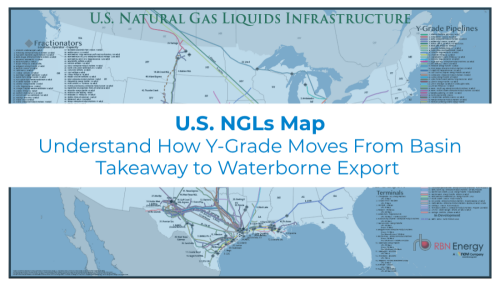
Visualize the infrastructure behind U.S. NGL movement.
The U.S. NGLs Map provides a comprehensive view of the transport, processing, and export networks moving NGLs across the U.S.
Refiners also have had to respond to changes in crude oil markets. For example, a few years ago, big spreads between the prices of light and heavy crude and the expectation of continued production growth in the Canadian oil sands led a number of refiners to invest in new coking projects and new refinery trains (including at Total’s Port Arthur, TX, refinery; Phillips 66 and Cenovus Energy’s Wood River, IL, complex; Marathon’s Detroit, MI, and Garyville, LA, refineries; BP’s Whiting, IN, facility; and Motiva Enterprises’ Port Arthur, TX, site) that collectively cost tens of billions of dollars. A second, much smaller wave of investments completed recently was driven by the need to process greater amounts of light crude being produced in burgeoning U.S. shale plays.

About the song
“I Still Haven’t Found What I’m Looking For” is a song from the 1987 Joshua Tree album by Irish rock band U2. It received nominations for Record of the Year and Song of the Year at the 30th Annual Grammy Awards in 1988.







Comments
Another good article!
If you would have added 2012 & 2013 to your spending chart, you could have added the massive hydrocracker projects that VLO completed at their Port Arthur & St Charles refineries.
So refiners are not only investing into cleaner fuels production but also growing exports. As you have pointed out in previous articles and suppoerted by EIA data, by the end of 2016 US refiners were exporting more than 3 MMBPD of refined products. Several of the MLP projects listed above are for exports.