Crude oil production in U.S. shale and tight-oil plays still hasn’t recovered fully from the demand destruction wrought by COVID-19 in the last year or so. It could be argued, though, that producers in the offshore Gulf of Mexico (GOM) have faced even tougher times as they had to deal with not only pandemic-related staffing issues and project setbacks but the most active hurricane season on record. Offshore GOM production averaged only 1.65 MMb/d in 2020, a 13% decline from the previous year and the lowest since 2016. By August, production fell to less than 1.2 MMb/d, the lowest for that month in seven years. Many new projects were delayed as well, but things may finally be looking up, with first oil from a number of projects coming later this year or in early 2022 and final investment decisions (FIDs) on two major projects expected soon. Today, we discuss the wild ride that GOM producers experienced in 2020 and whether better days can be expected in the future.
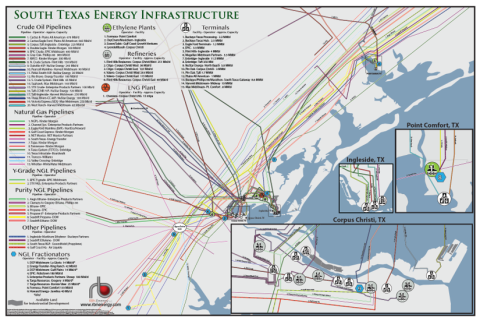
RBN Energy’s South Texas Energy Infrastructure Map brings together all the pieces of the critical and complex puzzle of the greater Corpus Christi region. Spanning from Point Comfort, TX to Corpus Christ, TX and south of the Agua Dulce natural gas hub, the map details the processing, transportation and export facilities in RBN Energy’s classic clear, concise and easy to comprehend style.
As we said a few months ago in Give Me One Reason, the offshore Gulf of Mexico is often viewed — mistakenly, it turns out — as the most rock-steady player in U.S. crude oil production. It’s true that GOM producers base their big, upfront investments in new platforms or subsea tiebacks on really long-term oil-price expectations. Also, unlike shale wells, whose production peaks early then trails off, wells in the offshore Gulf typically maintain high levels of production for years and years. There’s a lot of variability in GOM output, however, mostly due to the hurricanes and tropical storms that threaten the Gulf every year from June through November, but — as we learned in 2020 — also because of once-a-century pandemics. GOM output dropped by 300 Mb/d, or 16%, from March to April last year as producers shut down wells in response to the sharply lower oil prices induced by COVID-related demand destruction and oil price declines. During 2020’s record-breaking hurricane season, offshore production saw even more volatility than normal as one major storm after another forced hundreds of well shut-ins and platform evacuations.
As shown in Figure 1, crude oil production in the offshore GOM started 2020 at just under 2 MMb/d, the best January on record, and posted similar output levels in each of the following three months, according to the Energy Information Administration (EIA). From May through July, however, production in the Gulf hovered at a much lower level — around 1.6 MMb/d (green bars) — reflecting the 300-Mb/d, COVID-related decline we noted above. In August, GOM production plummeted another 28%, to less than 1.2 MMb/d (yellow bar), as wells were shut-in and platforms evacuated in advance of both Hurricane Laura and Hurricane Marco. The pair of sequential storms reduced GOM output by an estimated 14.4 MMbbl over a 15-day period in late August and early September, including 1.56 MMbbl on August 25, according to the Bureau of Safety & Environmental Enforcement (BSEE). (See You Really Got Me for the impact of those storms on crude exports at the time.)
About the song
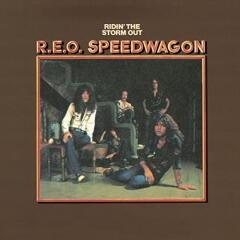
"Ridin' the Storm Out" was written by Gary Richrath, and appears as the first song on side one of R.E.O. Speedwagon's third studio album of the same name. The song was written about an incident in which the band was stuck in a blizzard after a show in Boulder, CO, at a club called Tulagi. Personnel on the record were: Mike Murphy (lead vocals), Gary Richrath (guitar), Neil Doughty (keyboards), Gregg Philbin (bass), Alan Gratzer (drums), and Gloria Jones, Carolyn Willis, and Oma Drake (backing vocals).
The album Ridin' the Storm Out was recorded during the summer of 1973, with Bill Halverson producing. It is interesting to note that the album was almost complete, with lead vocals provided by Kevin Cronin, when Cronin decided to leave the band due to creative differences. All of the lead vocals were re-recorded by Cronin's replacement, Mike Murphy. Released in December 1973, the LP went to #171 on the Billboard Top 200 Albums chart.
Four years later, with the release of R.E.O.'s double live album, Live: You Get What You Play For, "Ridin' the Storm Out" was released as a single with Kevin Cronin on lead vocals. It went to #74 on the Billboard Hot 100 Singles chart, and has since been certified Platinum by the Recording Industry Association of America. Live: You Get What You Play For would become R.E.O. Speedwagon's first Platinum album. After the success of the live album, their third album, Ridin' the Storm Out, also rose to Platinum status.
R.E.O. Speedwagon is an American rock band formed in Champaign, IL, in 1967. After years of touring as a popular Midwest bar band, they were signed by Epic Records in 1971. The band has released 16 studio albums, 10 live albums, 19 compilation albums, and 34 singles. They have sold more than 40 million records worldwide, and have had 13 charting Top 40 singles. Twenty-two members have passed through the ranks of R.E.O. Speedwagon band since its formation. Longtime guitarist and songwriter Gary Richrath died in 2015. Original member Neil Doughty, along with Kevin Cronin, Bruce Hall, Dave Amato, and Bryan Hitt continue to tour as R.E.O. Speedwagon.