
In a world where Marcellus/Utica natural gas supplies and Gulf Coast gas demand are increasingly interdependent, what would happen if flows along a critical route connecting the two regions were disrupted? The market caught a glimpse of that on January 21, when an explosion on Texas Eastern Transmission’s 30-inch line in Noble County, OH, shut down flows through its Berne compressor, which serves as a key gateway for Gulf Coast-bound gas out of Appalachia. Partial service was restored a few days later, but a chunk of the capacity remains offline as repairs are completed, and southbound volumes are running at 60% of what they were prior to the outage. Not too long ago, an outage severing Northeast producers’ access to a major takeaway route to the Gulf would have hammered Northeast supply prices, even during the peak winter demand months. But as expansion projects have vastly improved pipeline connectivity within Appalachia and takeaway capacity out of the region, they’ve transformed how some of those legacy long-haul pipelines function and even the role they play in the market. The TETCO outage provides a glimpse into what that will mean for the Northeast and its downstream markets. In today’s blog, we begin a series looking at the implications of a well-connected Marcellus/Utica, starting with a recap of the TETCO event and its immediate impacts on southbound flows.
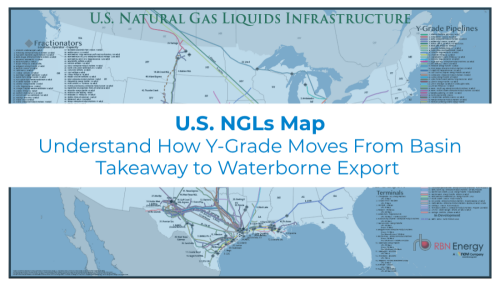
Visualize the infrastructure behind U.S. NGL movement.
The U.S. NGLs Map provides a comprehensive view of the transport, processing, and export networks moving NGLs across the U.S.
TETCO Background
The TETCO pipeline began life way back in the early 1940’s a crude oil system meant to provide security during the WWII war effort. Known then as the Big Inch pipeline, it was developed by the War Emergency Pipeline company which was backed by a consortium led by Standard Oil. Following the war, it was sold to Texas Eastern Transmission Company (TETCO) and converted to gas service. TETCO became the first of the legacy long-haul northbound pipelines connecting the Gulf Coast and premium Northeast demand markets – a development which disrupted those markets. Over the ensuing decades, the Northeast pipeline networks continued to be developed and extended. But with the Shale Revolution, as Appalachia gas production burgeoned, those traditional flows have been flipped on their head and pipelines originally developed to move gas North have been reversed to move Marcellus/Utica gas south and west to serve growing gas-fired power generation demand in the Midwest and southern regions and export markets along the Texas and Louisiana coasts.
As Marcellus/Utica supplies grew, TETCO was one of the first Gulf-to-Northeast pipes to enable bidirectional flows and send Northeast gas southbound towards the Gulf. With pipe extending through eastern Ohio, northern West Virginia and western Pennsylvania, TETCO was perfectly situated to take gas from the southwestern Marcellus and Utica supply areas.
TETCO (light green lines in Figure 1) runs from South Texas up to New Jersey and is segmented into supply zones (yellow ovals), where the pipe traditionally picked up supply, and market zones (orange ovals), where the bulk of that supply was delivered. (That’s all changed in recent years, which we’ll get into in a bit.) For most of the way, TETCO has two legs: the “30-inch” line originating in South Texas that passes through Louisiana and Mississippi and continues northeast from there; and the “24-inch” line that takes a more westerly route from South Texas to the central Midwest, including Illinois and Indiana, before curving east towards Ohio. Those names “30-inch” and “24-inch” linger despite both legs now having multiple lines in the ground along their paths. The pipes converge in eastern Ohio at the Berne compressor station (top black square in Market Zone 2), then head east across the West Virginia panhandle. In Pennsylvania, the pipe splits into upper and lower lines that together are known as Market Zone 3 (M3). There, TETCO is the primary gas provider to the Philadelphia market area and also feeds into other pipes like Algonquin Gas Transmission (AGT) and Transco to serve demand in New England and the New York/New Jersey market areas.

About the song
"Look How Far We've Come," written by Ben McKee, Dan Reynolds, and Wayne Sermon, appears as the seventh cut on Imagine Dragon's third self-released EP, It's Time. The 2011 independent release was recorded at Studio X at the Palms Hotel and Casino in Las Vegas during the fall of 2010. The EP was produced by Imagine Dragons, with Mark Needham mixing. Every song on the EP, with the exception of "Leave Me," was uploaded to YouTube with unofficial videos.
Imagine Dragons had first attracted attention when they played before 26,000 people at the Bite of Las Vegas Festival in 2009, where they filled in for the band Train, who had to cancel at the last minute due to an illness of their singer, Pat Monahan. At the end of 2011, Imagine Dragons inked a deal with Interscope Records and released their debut album Night Visions in September 2012. That album went to #2 on the U.S. Billboard 200 chart, and would go on to three times Platinum status as certified by the Recording Industry Association of America.
Imagine Dragons are an American pop rock band from Las Vegas, NV. Personnel are: Dan Reynolds (lead vocals), Wayne Sermon (lead guitar), Ben McKee (bass), and Daniel Platzman (drums). They have released four studio albums, four live albums, 10 EPs, and 25 singles. Imagine Dragons have sold 12 million albums and 35 million singles worldwide. They have received nine Billboard Music Awards, three American Music Awards, one Grammy Award, one MTV Video Music Award, and one World Music Award. The band is scheduled to play large music festivals beginning in May of this year.