Tech giants such as Google, Amazon and Meta have long sought to meet their data-center power needs while at least limiting their greenhouse gas (GHG) emissions. But while many developers and utilities have turned to natural gas to power data centers because of its ability to provide reliable 24/7 power, renewable generation continues to play a role, especially if it includes plans to utilize on-site battery storage. Data centers are increasingly being co-located near new renewable generation sources, which can also boost grid reliability, as we explain in today’s RBN blog.

Join industry leaders in Calgary on October 29 for market insights, technical presentations, Duvernay inventory analysis, an expert panel, and networking focused on the next chapter of Canadian energy.
Demand for data centers (see Storm Front), which are home to hundreds or even thousands of networked computers that process, store and share data, has grown significantly with the expansion of artificial intelligence (AI) tools like ChatGPT and Perplexity, which demand far more computational power (and energy) than conventional Google searches. Data centers are among the most energy-intensive building types, consuming up to 50 times the energy per square foot of a typical commercial office building, with electrical demand at larger facilities ranging from 100 megawatts (MW) to more than 2,000 MW — larger sites can consume as much energy as a small city. The Energy Information Administration (EIA) estimates that data centers could consume as much as 20% of U.S. power generation by 2030.
The widely forecast spike in AI-driven technology has led to a surge in interest in data-center development, with companies outlining spending plans that reach the tens of billions of dollars. But we should also note that some big players have been reassessing their plans recently. Forecasts for data center power demand — already a moving target — were complicated in January by the introduction of DeepSeek’s R1 Model, which takes a different approach and is reportedly able to perform complicated tasks with less reliance on high-tech chips — and ultimately require less power — an indication that power demand growth for data centers might not be as robust as initially predicted. There’s also the often-changing U.S. position on tariffs, which complicates short- and long-term planning. Microsoft, for example, recently said it was slowing or pausing a number of projects, including a $3.3 billion project in Wisconsin (which we noted in We Should Be Friends) and a $1 billion plan to build data centers in central Ohio.
That is not to say that plans for data centers are not advancing. While Microsoft is reassessing several projects, it still expects to spend about $80 billion on AI-enabled data centers in 2025 alone. Many of the data centers under development in the U.S. are hyperscale sites, which are the largest and generally considered to have at least 5,000 servers and be at least 10,000 square feet in size. Hyperscalers have overwhelmingly turned to natural gas for power generation (see Dive In) because of their need for consistent and uninterrupted power, but there’s also a push to include intermittent sources like wind and solar.
Let’s start with Google, which has invested in renewable energy adjacent to its data centers and has often included battery storage to partially account for intermittent outages. Google said in December it had reached an agreement with Intersect Power and TPG Rise Climate to develop industrial parks — also referred to as energy parks — that would be co-located with $20 billion in renewable energy and battery storage. Energy parks (see rendering below) would essentially act like large microgrids with onsite power. They are intended to increase the speed of infrastructure deployment, ease the burden on the wider power grid, improve overall reliability, and reduce the number of new transmission lines needed to connect generation to load over longer distances. Including battery storage is intended to allow the data centers to be able to also utilize renewable energy. Google expects its first energy park project to be operational by 2026 and complete by 2027.
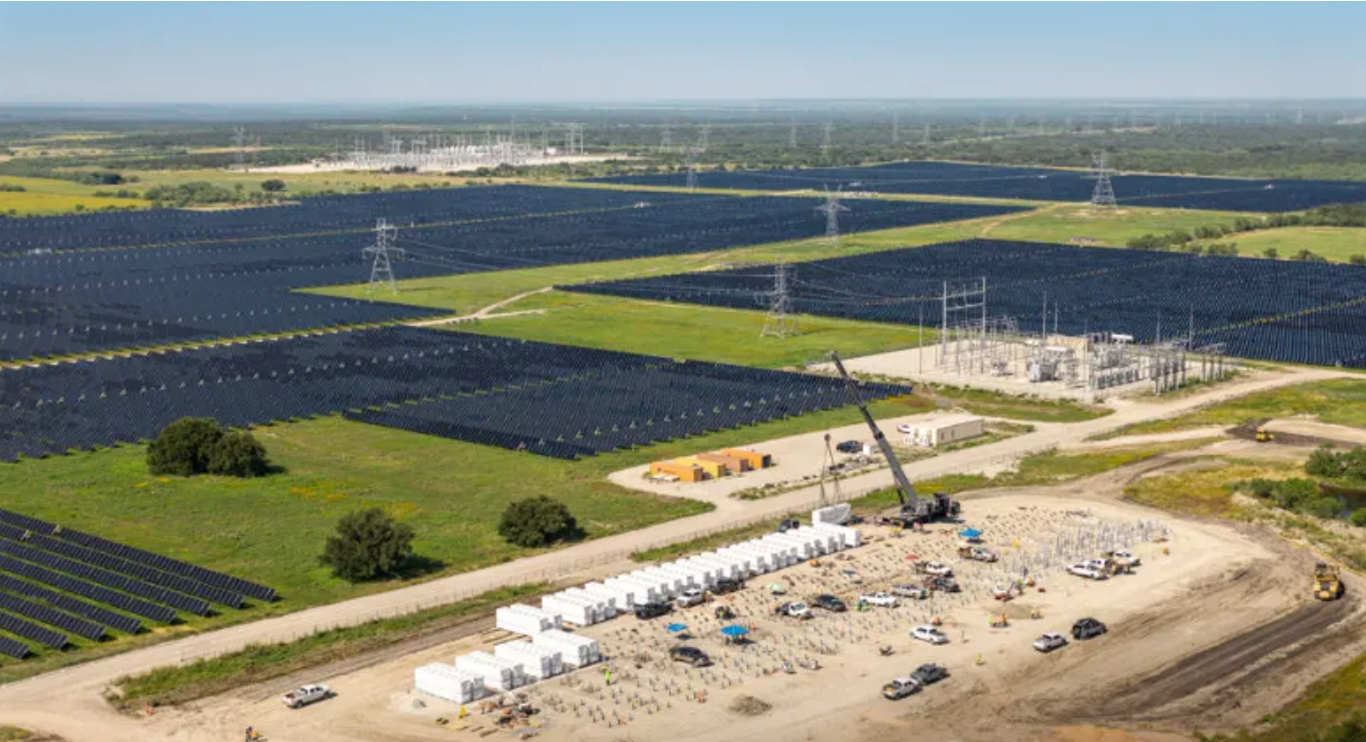
Rendering of an Energy Park Being Developed by Google, Intersect Energy and TPG Rise Climate. Source: Intersect Energy
About the song
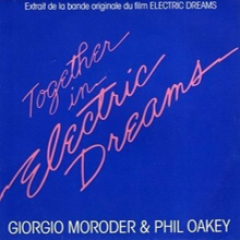
“Together in Electric Dreams” was written by Philip Oakey and Giorgio Moroder and appears as the first song on side one of the soundtrack album from the 1984 motion picture of the same name. Moroder was contracted to be the producer for the film’s music. Oakey is the lead singer and frontman for the British synth-pop band The Human League. Released as a single in the U.K. in September 1984, it went to #3 on the U.K. charts and #20 on the U.S. Billboard Dance Club Singles chart. The song also appears on the studio album Philip Oakey & Giorgio Moroder, released in July 1985. Personnel on the record were: Philip Oakey (vocals), Giorgio Moroder (synthesizer, production), Arthur Barrow (synthesizer, bass, drum programming), Richie Zito (guitar), and Joe Esposito, EG Daly (backing vocals).
The album, Electric Dreams: Original Soundtrack From The Film, featured music from various artists popular at the time, including Philip Oakey, Culture Club, Jeff Lynne, and Heaven 17. It was made to support the 1984 science fiction romantic comedy of the same name directed by Steve Barrow. Giorgio Moroder played Barrow a demo of a song he thought would be good as a theme song for the film, but Barrow was not impressed with the lyrics or the vocalist on the demo. Barrow suggested Philip Oakey to do the vocals and a re-write of the lyrics. Oakey wrote new lyrics on a cigarette pack on the way to the recording studio and completed the vocals in two takes. The film was released in the U.S. in July 1984.
Giorgio Moroder is an Italian composer and music producer known as the “Father of Disco.” With a hand in pioneering Euro Disco and EDM, he was an early proponent of synthesizers in electronic dance music. Moroder has released 15 studio albums and produced records for many different artists. He has won three Academy Awards, four Grammy Awards and four Golden Globes and is a member of the Dance Music Hall of Fame. He continues to compose, score, record and produce music.
Philip Oakey is an English singer and songwriter who is the frontman and co-founder of the British synth-pop band The Human League. With The Human League, he has released nine studio albums and seven singles. He has won a Brit Award and continues to do work with The Human League, solo endeavors, and collaborative work with other artists.