Not long ago, several large-scale carbon-capture projects had plenty of momentum, fueled by a push toward decarbonization and expanded federal tax credits. But while progress on many projects has slowed as they faced a host of problems, Tallgrass’s plan to convert its Trailblazer pipeline from natural gas service to carbon dioxide (CO2) has had a comparatively smooth ride, thanks in large part to an engagement strategy that has allowed it to navigate the trickiest potential complication — local opposition. In today’s RBN blog, we review Trailblazer’s conversion, examine why Tallgrass’s strategy has succeeded where similar projects have failed, and look at what happens next.
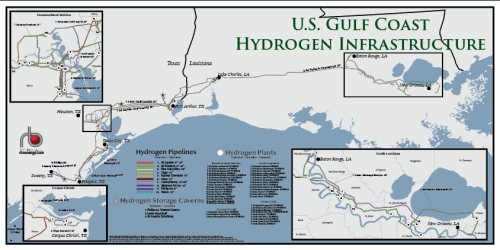
RBN’s U.S. Gulf Coast Hydrogen Infrastructure Map lays out the pipelines and merchant hydrogen plants that make up the gulf coast market, providing an unprecedented snapshot of the region’s hydrogen infrastructure network.
Let’s start at the beginning. Tallgrass Energy unveiled plans to convert its Trailblazer pipeline (pink line in Figure 1 below) from natural gas to CO2 back in May 2022. The backbone of the plan is an agreement to capture CO2 from an Archer Daniels Midland (ADM) corn-processing complex (red star) in Columbus, NE, and transport it to Tallgrass’s planned Eastern Wyoming Sequestration Hub (orange dot) for permanent underground storage (see Two Birds, One Stone), while also allowing for connections to other ethanol plants in the region. (More on that in a bit.)
Tallgrass filed for Federal Energy Regulatory Commission (FERC) approval to abandon 392 miles of Trailblazer gas pipeline to convert that segment to CO2, proposing to preserve natural gas service for Trailblazer’s firm shippers through a 15-year lease on Rockies Express (REX; blue line), which runs parallel to Trailblazer along its entire length. In what Tallgrass called a first for a large-scale FERC abandonment proceeding, the filing faced no customer opposition. FERC approved the abandonment in 2023. Today, interstate natural gas transportation service previously provided to firm shippers on Trailblazer has already been largely shifted to REX.
On the CO2 side, the repurposed Trailblazer pipeline, which runs from Nebraska to Wyoming and cuts across a section of northeast Colorado, is capable of transporting more than 10 million tons per annum (MMtpa, 528 MMcf/d) of CO2 and is the first pipeline conversion of its scale in the U.S. Now in the commissioning phase, it’s expected to begin commercial operations by the end of 2025.

Figure 1. Trailblazer and Rockies Express Pipelines, Archer Daniels Midland Corn-Processing Facility and Eastern Wyoming Sequestration Hub. Source: RBN
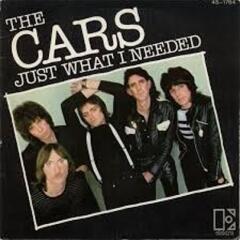
About the song
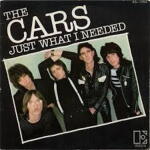
“Just What I Needed” was written by Ric Ocasek and appears as the third cut on side one of The Cars’ debut album, The Cars. Released as a single in May 1978, it went to #27 on the Billboard Hot 100 Singles chart. Personnel on the record were: Benjamin Orr (lead vocal, bass), Ric Ocasek (backing vocals, rhythm guitar), Elliot Easton (lead guitar, backing vocals), Greg Hawkes (keyboards, backing vocals), and David Robinson (drums, backing vocals).
The Cars was recorded at AIR Studios in London, with Roy Thomas Baker producing. Released in June 1978, the album went to #18 on the Billboard Top 200 Albums chart. The striking album cover art featured Nataliya Medvedeva, a Russian-born model, singer, poet and writer. The Cars yielded three charting singles, proving that the band’s new wave/rock sound was radio-friendly. It has been certified 6X Platinum by the Recording Industry Association of America.
The Cars were an American rock band formed in Boston in 1976. Ric Ocasek, Benjamin Orr, Elliot Easton, Greg Hawkes and David Robinson successfully blended guitar-driven rock with synthesizer pop music. The band’s demos were garnering a lot of radio airplay in the Boston area before they signed a record deal with Elektra Records in 1977. The band released seven studio albums, eight compilation albums and 26 singles. They have sold over 23 million records in the U.S. alone. The Cars are members of the Rock and Roll Hall of Fame. They officially broke up for the first time in 1988, with four of the original members reuniting in 2010 to record the album Move Like This, which was followed with a brief tour. All the band members have done solo projects. Benjamin Orr died in 2000 and Ric Ocasek in 2019.